
Beginner Hoverboard for a 6-Year-Old: Australian Guide
What matters more for a six-year-old’s first hoverboard: top speed, or whether they feel steady and confident? If you’re comparing a beginner hoverboard for 6 year old Australia families can consider, start with your child’s size, balance and readiness to learn, not the flashiest features.
It’s natural to want outdoor fun and a little independence while feeling sure your child has the right support. This guide explains how to compare a board’s published specifications with your child’s fit and abilities, identify useful safety information, and plan supervised practice. The Hoveroo Hoverboard is UL 2272 certified, a relevant electrical-safety detail to include when comparing options.
You’ll also find practical pointers on protective gear, adult supervision and choosing a suitable place to ride. Public-use rules vary across Australia, so for a six-year-old, plan on private-property riding and check the rules that apply where you live. A well-fitting board, patient practice and safe outdoor play make a better starting point than speed!
Key Takeaways
- Age is only a starting point. Consider your child’s balance, confidence, attention and readiness to follow instructions.
- Self-balancing technology helps a hoverboard respond to movement, but your child still needs time and practice to learn.
- When choosing a beginner hoverboard for 6 year old Australia families can consider, compare the listing’s rider limits and features with your child’s size and abilities.
- Look for clear, model-specific safety information. The Hoveroo Hoverboard is UL 2272 certified and has a built-in Bluetooth speaker.
- Plan for a helmet, suitable protective gear, close adult supervision and a clear practice area on private property.
Is a Hoverboard a Good First Ride for a 6-Year-Old in Australia?
Is six old enough for a first hoverboard? Age is a useful starting point, but it can’t tell you on its own whether your child is ready. Consider how they balance, respond to changes in movement and follow simple instructions. A child who’s keen to try and comfortable practising with you nearby may be more prepared than one who feels unsure or has difficulty pausing to listen.
Beginner suitability depends on your child’s fit, readiness to learn and close adult supervision. Keep those factors in mind as you compare models. A product described as beginner-friendly may be designed with new riders in mind, but it can’t determine your child’s confidence or coordination for them.
What should parents consider beyond a child’s age?
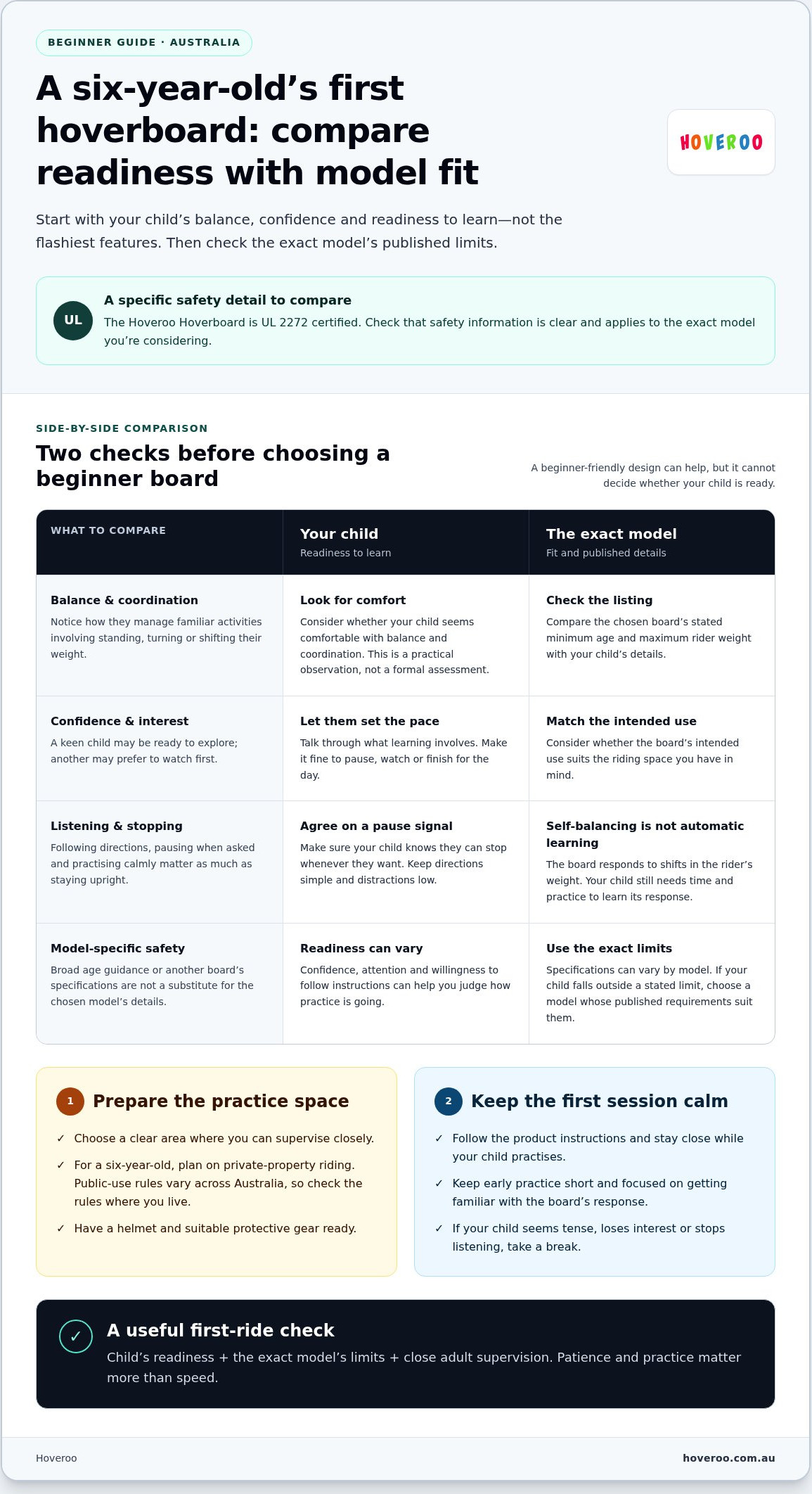
Notice how your child manages familiar activities that involve standing, turning or shifting their weight. This isn’t a formal assessment; it’s a practical way to gauge how comfortable they are with balance and coordination. Interest matters too. Show them the board and talk through what learning involves before deciding whether they’re ready to try.
Listening and stopping matter as much as staying upright. Your child needs to be willing to follow your directions, pause when asked and practise at a calm pace. Some children take longer than others to feel at ease, so don’t treat a birthday or a first attempt as a pass-or-fail test. A short, low-pressure practice gives you a chance to see how they respond.
How can you check whether a board fits your child?
Start with the chosen model’s product listing. Find its stated minimum age and maximum rider weight, then compare those limits with your child’s details. The published limits for that exact model take priority over broad age recommendations or another board’s specifications. If your child falls outside a stated limit, choose a model whose published requirements suit them.
For a beginner hoverboard for 6 year old Australia families are considering, don’t assume a board will suit simply because it’s labelled for children or beginners. Specifications can vary by model. Read the listing carefully and consider whether the board’s intended use matches the riding space you have in mind.
- Check the exact model’s stated minimum age and maximum rider weight.
- Don’t apply one hoverboard’s limits to another model.
- Consider your child’s confidence, willingness to listen and comfort with practice.
Hoverboards are also known as self-balancing scooters, but the name doesn’t mean a rider can skip learning. Keep expectations realistic: a suitable first ride still calls for patience, clear instructions and you close by as your child practises.
How Does a Beginner Hoverboard Work, and What Helps a Child Feel Ready?
A hoverboard responds to shifts in the rider’s weight. In simple terms, leaning or changing your stance can prompt the board to move or turn. This self-balancing response helps the board adjust as the rider moves, but it doesn’t balance for your child or make learning automatic. They still need time to get used to standing on the board and feeling how their movements affect it.
“Beginner-friendly” describes features or a design aimed at new riders. It doesn’t mean every child will feel confident straight away. A six-year-old who’s excited to try may still need time to get comfortable, while another child might prefer to watch first. Let your child’s reactions set the pace rather than expecting a particular result after one session.
What does self-balancing mean for a first-time rider?
Think of self-balancing as the board responding to the rider, not taking over the job of riding. Your child needs to learn how it feels to stand and move on the board, and that can take practice. The board’s design may suit beginners, but your child’s comfort and coordination are individual. Stay close and keep your attention on them while they get familiar with the movement.
What makes a first session feel less overwhelming?
Choose a clear practice space where you can supervise closely, and keep the first session calm and short. Explain that it’s fine to pause, watch or finish for the day. Praise steady effort rather than speed or tricks. Small signs of growing comfort, such as listening to a reminder or wanting another try, can help you decide whether to continue or call it a day.
Your role is to make the experience feel supported, not rushed. Stay nearby, give simple instructions and keep distractions low. If your child seems tense, loses interest or stops listening, take a break. There’s no need to turn practice into a test. A relaxed approach gives your child room to decide how they feel while you remain ready to supervise.
Before practice, agree on a simple pause signal and make sure your child knows they can stop whenever they want. Focus on getting comfortable with the board’s response, not travelling far or showing off. Follow the product’s instructions and keep early attempts within the space you’ve chosen for supervised use.
When comparing a beginner hoverboard for 6 year old Australia families might choose, consider both the model’s beginner-friendly design and the support your child will have while learning. The board can be part of the fun, but your presence, patience and attention help shape a positive first experience.
For wider buying considerations, including what to review before ordering, see this guide to how to buy a hoverboard online in Australia. You can also explore the Hoveroo Hoverboard as you compare options for your family.
Which Hoverboard Features Matter Most for a Six-Year-Old Beginner?
A product listing can help you compare options, but the most eye-catching feature isn’t always the most useful for a young beginner. Start with details that affect whether a model suits your child and planned riding area. Separate entertainment extras from safety information, and compare specifications for the exact board rather than relying on broad product descriptions.
Use this table as a quick guide while reading a listing. Details can vary between models, so check each point against the specific hoverboard you’re considering.
| Feature | Why parents care | What to check on the listing |
|---|---|---|
| UL 2272 certification | It’s a relevant certification detail to include in your product comparison. | Check whether UL 2272 certification is stated for the exact hoverboard model. |
| Maximum rider weight | Your child needs to fall within the model’s published rider limits. | Find the maximum rider weight for that model. Don’t assume the limit is the same across hoverboards. |
| Intended riding surface | The right board type depends on where your child will ride. | Check whether the listing describes a regular or off-road hoverboard and which surfaces it’s intended for. |
| Wheel details | Wheel information can help you compare boards intended for different surfaces. | Compare the stated wheel details with the planned use. Don’t assume one size or style suits every setting. |
| built-in Bluetooth speaker | A speaker is an entertainment extra, not a safety feature. | Check whether the specific listing includes a built-in Bluetooth speaker. |
How should parents compare safety information?
Look for clear safety information on the product listing, including whether UL 2272 certification applies to the exact model you’re considering. Don’t assume a detail shown for one board also applies to another. Certification is one part of your comparison, not a replacement for following the model’s instructions and using the board with care.
Do wheel size and riding surface change the experience?
Regular and off-road hoverboards are different options, not interchangeable labels. Think about where your child is likely to ride: a smooth, clear area differs from grass or gravel. Check the listing’s intended surfaces and wheel details instead of assuming a model will suit every terrain. For a closer look at surface differences, see this guide to off-road versus regular hoverboards.
When comparing a beginner hoverboard for 6 year old Australia parents are considering, use the exact listing as your source for rider limits, certification and intended use. Treat extras such as a speaker as entertainment, not evidence of suitability. Match the model’s published details to your child and planned riding area, then make your decision with those specifics in view.
To compare a Hoveroo option, explore the Hoveroo Hoverboard and review its published details alongside your family’s needs.
What Should You Prepare Before Your Child’s First Hoverboard Session?
A little preparation helps keep the first practice session organised and calm. Before your child steps on, make sure they’re comfortable, the space is clear and you’re ready to supervise closely. Read the instructions for your exact model first. They explain how to use, charge, store and care for that board.
Protective gear, clear space and close adult supervision are the essentials for a first hoverboard session. Use this checklist before each ride and take your time. The aim is a safe, enjoyable introduction, not a perfect first attempt!
How do you set up a suitable practice space?
Choose a flat, clear area away from traffic, obstacles and other active play. Look for anything your child could bump into, including toys, garden equipment and people moving through the space. Leave room for them to stop safely, and stay close enough to guide and supervise. Keep early practice calm, with no pressure to ride further or faster.
- Read the model’s instructions. Review the manufacturer’s guidance for use and charging before getting started. Follow the directions for that board rather than relying on assumptions from another model.
- Check the riding area. Choose a flat, open space and clear away obstacles. Make sure other children aren’t running or playing through the practice area.
- Put on protective gear. Have your child wear a properly fitted helmet and suitable protective gear, such as wrist guards, elbow pads and knee pads.
- Inspect the equipment. Look over the board and protective gear for visible damage before use. If anything appears damaged, don’t start the session.
- Agree on a pause signal. Make sure your child knows how to get your attention and that they can stop if they feel uncomfortable. Keep your attention on them throughout the ride.
- Follow care guidance after riding. Use the product instructions for charging and storage. Put the board and gear away as directed, ready for the next supervised session.
What should you do before and after each ride?
Before each session, repeat the simple checks: protective gear is on, the practice space is clear and the board shows no visible damage. Stay nearby as your child rides and watch for signs they’ve had enough. If they seem uncomfortable, pause or end the session. Afterward, follow the model’s guidance for charging, storage and care. Consistent checks help make preparation part of the routine.
Keep the session focused on comfort and enjoyment. If your child is ready to finish, they can try again another time; there’s no need to push on. If you’re choosing a board for supervised first rides, explore the Hoveroo Hoverboard and review its product information before practice.
How Can You Choose a Hoveroo Hoverboard for a Beginner in Australia?
Make the decision in a clear order: consider your child’s readiness, compare their size with the chosen model’s limits, review its safety information, then match the board type to the surface where they’ll ride. This keeps your choice grounded in your child’s needs and the published details for that specific product.
Which Hoveroo details should parents compare before choosing?
Start with the individual product listing. Compare its stated minimum age and maximum rider weight with your child’s details, then read about the model’s intended riding surface. Don’t assume specifications for one hoverboard apply to another. Hoveroo is an Australian retailer specialising in children’s hoverboards and electric ride-on toys, so you can compare its hoverboard options and their published product information.
Hoveroo’s homepage also lists a built-in Bluetooth speaker as a feature of its hoverboard. Treat it as an entertainment extra, not a measure of suitability for your child. Hoveroo also shares that 50,000+ families are part of its community. That’s a community trust point, not a guarantee of how a particular board will perform for your family.
Think about where your child will ride, too. A regular hoverboard and an off-road hoverboard are different options, so compare the selected model’s stated intended surface with your planned riding area. Use the product listing to guide your decision rather than assuming every board suits every surface.
How can you make the decision with confidence?
Bring your checks together before choosing. Consider whether your child is ready, compare their size with the selected model’s limits, and review its safety information and intended surface. Then use your preparation checklist to plan supervision and the first practice space. The right choice depends on both your child and the details of the exact model.
- Child readiness: Consider your child’s comfort, confidence and willingness to follow instructions.
- Product limits: Read the chosen model’s published age and rider-weight information.
- Safety details: Review the safety information stated for that hoverboard.
- Riding surface: Match the board type to its stated intended use.
Choosing a beginner hoverboard for 6 year old Australia families can feel confident about means keeping your child’s needs at the centre of the decision. Take your time, check the model-specific details and plan a supervised first session that feels right for your family.
Ready to compare options? Explore Hoveroo hoverboards and review the published details for the model that interests you.
Make the next step a confident one
Choosing a beginner hoverboard for 6 year old Australia families can feel good about isn’t about finding a board that promises instant confidence. It’s about making a considered choice for your child, then giving them room to decide how they feel as they get familiar with it. Talk together about what they’re excited to try and remind them that learning can happen at their own pace.
Before you settle on a model, review its product details and think about how you’ll support your child’s first few sessions. A thoughtful choice can help set the scene for enjoyable outdoor play and shared family moments, without making the hoverboard more than it is: one fun way to play.
Ready to compare options? Explore Hoveroo hoverboards and find a model to consider for your family. Here’s to happy practice, growing confidence and plenty of encouragement along the way!
Frequently Asked Questions
Is a hoverboard suitable for a six-year-old?
It can be, if the child and specific model are a suitable match. Before deciding, show your child the board and talk through what riding involves. Can they explain what they’ll do if you ask them to stop? This simple conversation can help you gauge whether they understand the expectations. If the model’s stated limits don’t suit your child, choose another activity or model.
Can a six-year-old ride a hoverboard without an adult nearby?
No. A young beginner shouldn’t ride without an adult actively supervising. Make supervision your only task: put your phone away, keep siblings and pets out of the practice area, and stay positioned to respond promptly. Don’t supervise from a distance or while doing another activity. Follow the product instructions, and remember that an adult’s presence doesn’t remove the need for protective gear.
Does a hoverboard need UL 2272 certification in Australia?
Don’t treat certification as proof that a hoverboard is approved for every use in Australia. Rules for riding in public can vary between states and territories, and may treat hoverboards differently from other devices. For a six-year-old, plan on riding on private property, and consult current official guidance for your state or territory before considering public use.
Can children ride a hoverboard on grass or gravel?
That depends on the exact model’s stated use. Before a session, look over the ground for holes, loose stones, sticks or other hazards that could be hard to spot, particularly in grass. Don’t assume a surface is suitable just because it looks smooth from a distance. Follow the board’s instructions and avoid trying a new surface until you’ve checked the model guidance.
Should a child wear a helmet on a hoverboard?
Yes. Choose a helmet that fits your child and follow its maker’s fitting instructions. Before each ride, check that it sits securely and has no visible damage; do the same for other protective gear. Set aside any damaged or poorly fitting equipment rather than letting your child ride in it. Check the product listing to see whether any accessories are included.
Can a hoverboard be used in wet weather?
Don’t assume it’s suitable for rain, puddles or damp ground. If the product information gives an IP rating, that rating describes a defined level of water and dust protection, not permission for every wet-weather activity. Read the exact model’s instructions and wait until the riding surface is dry if you’re unsure. Follow the product guidance rather than making assumptions about weather suitability.
How do you know when a child is ready to move beyond beginner practice?
There’s no set number of sessions that marks a child as ready. Keep early practice in a familiar setting, and only consider a change after reviewing the model’s instructions for that situation. Avoid changing several things at once, such as the location and riding surface, as it can make it harder to tell what your child is comfortable with. Keep the pace unhurried.