
Best Electric Ride-Ons for Toddlers: 2026 Parent Guide
The best electric ride on for toddlers isn’t the one with the biggest motor or flashiest features. It’s the one that suits your child’s stage of control. Choosing the best electric ride on for toddlers can feel tricky when age guidance, rider limits and controls aren’t easy to compare.
You want a fun new way to play, but you also want to know how much supervision is needed and whether your play area suits the ride-on. Start with those practical questions. This guide compares different styles and explains what to check in each product’s details, so you can focus on fit, confidence and age-appropriate play.
We’ll look at options such as the Hoveroo 5 in 1 Rocking Horse and Zippy Electric Wiggle Car, then cover the information to check before choosing. Look for the manufacturer’s age guidance, maximum rider weight, how the toy moves, available controls and any stated safety standards or features. With those details in view, you can choose a play option that suits your toddler and the space where they’ll ride, with an adult close by to supervise.
Key Takeaways
- Choose the best electric ride on for toddlers by matching the play style to your child’s confidence and ability to control it, not by chasing extra speed.
- Compare rocking, wiggle and powered play by considering how each moves and how closely an adult needs to be involved.
- Before buying, check the manufacturer’s age guidance, maximum rider weight, instructions and any stated safety standards for that specific product.
- Use the parental peace of mind checklist to review controls, braking and supervision needs before your toddler rides.
- Consider where your child will play, then choose a style and surface that suit your home and the level of adult involvement you can provide.
How to choose the best electric ride on for toddlers
A first ride-on can bring big grins and a fresh sense of independence. You want that excitement, along with confidence that the toy suits your child and the place they’ll use it. The best electric ride on for toddlers isn’t decided by age alone. Check the maker’s guidance, maximum rider weight, controls and supervision instructions before choosing.
Suitability depends on the child, product instructions and play setting. A toddler who’s keen to climb aboard may still need help understanding how to start, steer or stop. Consider the whole play experience, not just the product’s appearance or feature list.
Readiness is more than a number on the box
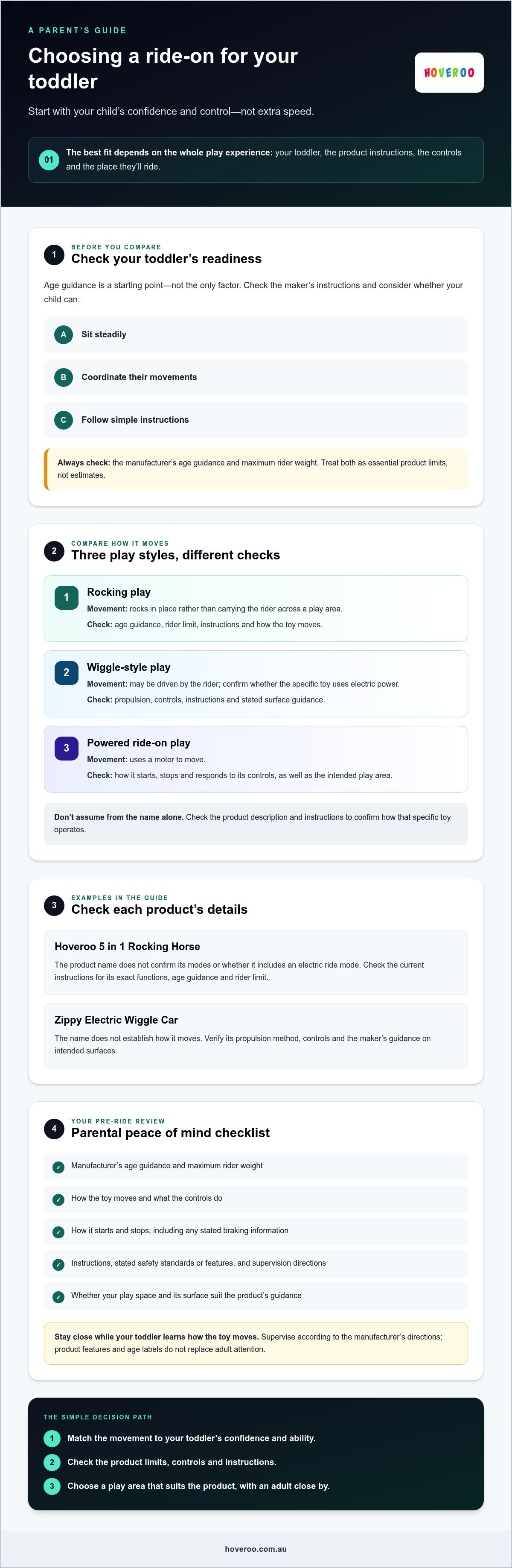
Start with the product’s stated age guidance and maximum rider weight. Treat both as essential checks, not limits to estimate around. Then consider your child: can they sit steadily, coordinate their movements and follow simple instructions? These abilities matter because different ride-ons call for different levels of balance and control.
Supervise your child according to the manufacturer’s directions. Stay close enough to respond, especially while they’re learning how the toy moves. An age label or product feature can’t replace an adult’s attention during play.
Start with the play experience you want
Think about the movement first. Rocking play offers a back-and-forth experience; a powered ride-on moves by motor; and manually propelled play depends on the child or an adult to move it. Product names alone don’t confirm how a particular toy operates, so check its instructions and description. For background on battery-powered ride-on toys, see Power Wheels.
Would your child use it indoors, outdoors or in both settings? Consider the available space and surface, then check whether the manufacturer says the product is suitable for that use. Hoveroo’s toddler-relevant options include the Hoveroo 5 in 1 Rocking Horse and Zippy Electric Wiggle Car. Check the individual product details to decide which may suit your child. For more age-specific considerations, read the safest electric ride-on for a 2-year-old.
Once you’ve settled on the kind of play you want, compare the controls and supervision needs with your toddler’s confidence. That’s a more useful starting point than choosing by age alone.
Electric ride-on styles for toddlers: rocking, wiggle and powered play
These play styles can look similar in a product listing, but their movement and adult involvement may differ. A rocking toy moves in place; a wiggle-style toy may be moved by the rider; and a powered ride-on moves using a motor. Check the manufacturer’s description to confirm how each specific product works. The name alone doesn’t tell you whether a toy is powered or suitable for your child.
Rocking play
What to check: How the toy moves, its age guidance, rider limit and instructions.
Parent considerations: It rocks rather than travelling across a play area, but supervision and safe use still matter.
Wiggle play
What to check: Whether the rider propels the toy or it uses electric power, plus the stated surface guidance.
Parent considerations: Consider whether your child can follow the operating instructions and whether your play space is appropriate.
Powered ride-on play
What to check: How the vehicle starts, stops and responds to its controls, along with age guidance and maximum rider weight.
Parent considerations: Follow supervision directions and check that the intended play area suits the product.
Rocking and multi-mode play
Rocking is different from travelling on a motor-powered vehicle: the toy moves in place instead of carrying the rider across a surface. Hoveroo offers the Hoveroo 5 in 1 Rocking Horse, but the product name alone doesn’t confirm its modes or whether it includes an electric ride mode. Check the current product instructions for its exact functions, age guidance and rider limit. Stationary play still calls for supervision and use as directed.
Wiggle cars and powered ride-ons
The Zippy Electric Wiggle Car is another Hoveroo offering, but its name doesn’t establish whether it uses electric power or movement from the rider. Verify the propulsion method and controls in the product information. Check the maker’s guidance on intended surfaces, too. Where a toy can be used affects how it fits your home or outdoor space, so don’t assume it suits every surface.
Before choosing the best electric ride on for toddlers, compare the product’s instructions, age and weight limits with your child’s confidence and the intended setting. For an additional safety reference, the US Consumer Product Safety Commission explains the mandatory toy safety standard in the United States. That source describes US requirements, so use Australian product information when checking a ride-on for use here.
To compare the confirmed options, browse Hoveroo’s children’s ride-on range and review each product’s details before deciding.
Which toddler ride-on features deserve a closer safety check?
Powered play calls for product-specific checks and close adult supervision. A feature list is useful only if you confirm what applies to the exact model you’re considering. The best electric ride on for toddlers should have clear instructions you can follow and controls that suit your child’s abilities.
A named certification relates to a defined test scope; a general safety claim isn’t a substitute for product-specific documentation. UL 2272 concerns the electrical systems of personal e-mobility devices such as hoverboards. Don’t assume it certifies a toddler ride-on. Check the product’s own documentation for any standards or certifications it claims.
Use the parental peace of mind checklist
Review the product page and instructions before buying. Look for the details below, and confirm each feature is listed for that specific ride-on rather than relying on a general brand statement.
- Controls: Check how the toy starts and stops, and whether an emergency stop, speed limiter or parental remote override is included.
- Rider limit: Confirm the maximum rider weight and manufacturer age guidance for the exact model.
- Braking: Find out how the ride-on stops and what the child needs to do to bring it to a halt.
- Helmet: Check whether one is included or recommended. Don’t assume it comes with every ride-on.
- Supervision: Follow the manufacturer’s directions and stay involved during play.
These checks turn a feature list into practical questions: can you understand the controls, and can your child follow the instructions? For general advice on choosing safe toys, see the guidelines from the American Academy of Pediatrics. This is a US resource, so use it as general guidance rather than a statement of Australian requirements.
Check batteries, charging and product documentation
Read and follow the supplied charging and battery-care instructions. Make sure you understand how to charge and store the toy as directed, and keep the instructions available for future reference. Don’t rely on assumptions based on another ride-on, even if it looks similar.
Apply the same model-specific check to any claimed certification, remote control or other safety feature. Confirm the feature on the product’s own information before relying on it. Clear details make it easier to choose with confidence and supervise play appropriately.
How to match a toddler ride-on to your child and home
A good fit starts with your toddler, then moves to the toy and the place you’ll use it. Work through these checks before choosing. They’ll help you compare options on practical details, not just appearance.
Five checks before you choose
- Check readiness and limits. Read the manufacturer’s age guidance, maximum rider weight and intended use for the exact product. Consider whether your child seems ready for its type of play.
- Match the play style to your child. Think about your toddler’s confidence and how much adult involvement you want. Rocking, rider-propelled movement and powered play can call for different levels of control.
- Understand the controls. Check how your child starts, steers, slows or stops the ride-on. Consider whether they can follow the instructions and whether you can supervise as directed.
- Check the play space and surface. Decide whether you have a suitable area indoors, outdoors or both. Follow the product’s guidance for where it can be used, and consider whether there’s enough room for supervised play.
- Plan for care and storage. Check where the ride-on can be stored and whether you have an appropriate place to charge it. For Australian conditions, read the manufacturer’s care guidance for exposure to sun, dust or wet weather. Don’t assume the toy is weather-resistant or suited to every outdoor surface. Review the supplied instructions and confirm which accessories are included.
Plan a supervised first ride
Before your child climbs aboard, prepare a clear play area on a surface allowed by the product instructions. Keep other people and potential obstacles out of the space, and stay close enough to supervise. For powered play, make sure you understand the controls and stopping method before the first session begins.
Keep the first session short and let your toddler get used to the experience at their own pace. Watch how they respond. If they seem uncomfortable or can’t follow the operating instructions, pause the play and reassess whether the ride-on or setting is a good fit. A confident start comes from close supervision and a space that suits both the child and the product.
Ready to compare options against your checklist? Explore Hoveroo’s ride-on range and review the product-specific guidance before choosing.
Finding a toddler-friendly ride-on at Hoveroo
There isn’t one ride-on that’s right for every toddler. Your child’s confidence, the kind of movement they enjoy and the play space you have all matter. Hoveroo is an Australian retailer of children’s electric mobility toys, with two toddler-relevant options to compare: the Hoveroo 5 in 1 Rocking Horse and the Zippy Electric Wiggle Car. Their names suggest different play formats, but check the product information to confirm how each works.
Compare Hoveroo’s toddler-relevant options
Use each product’s current listing to check what the toy does, rather than relying on its name or a general description. For the Hoveroo 5 in 1 Rocking Horse, confirm which modes it offers and whether it has an electric ride mode. For the Zippy Electric Wiggle Car, check whether it’s powered or moved by the rider, then review its stated controls and intended use.
These details can help you decide which play experience better matches your child, but they don’t make either product a universal choice. Before ordering, confirm the manufacturer’s age guidance and maximum rider weight, and consider whether the stated use suits your intended play space. If a detail isn’t clear on the listing, don’t guess. Seek clarification before making your decision.
Make your final checks before ordering
Product information can change, so check the current listing before you buy. Use this final checklist:
- Availability: Confirm the item is currently listed as available.
- Fit: Check the manufacturer’s age guidance and maximum rider weight for that exact model.
- Features: Confirm whether parental controls or safety accessories are included with the specific item. Don’t assume a helmet, parent remote or other feature comes as standard.
- Warranty: Read the current warranty information for the product, rather than relying on assumptions about other items.
- Use and care: Follow the manufacturer’s setup, charging and supervision instructions.
Let the product-specific details guide your decision. Match the ride-on’s guidance to your child and the setting where they’ll play. A little checking now helps you feel prepared for that first play session.
Explore Hoveroo’s ride-on toys and review the current product details to see which option may suit your family.
Choose a ride-on that fits your family’s next adventure
The best electric ride on for toddlers isn’t a one-size-fits-all pick. It’s the option that suits your child’s confidence, the way they like to play and the space you can supervise. Rocking, wiggle and powered styles offer different experiences, so compare the actual product instructions rather than relying on a name or headline feature.
Before choosing, check age guidance, maximum rider weight, controls, accessories and warranty details for the specific item. Make sure you understand its setup and care instructions, too. Those practical checks help you feel ready to support your toddler as they explore a new kind of play.
Hoveroo is an Australian retailer of children’s ride-on toys, with options including the Hoveroo 5 in 1 Rocking Horse and Zippy Electric Wiggle Car. Review the current product details, then decide what feels right for your child and home. Explore Hoveroo’s ride-on toys and find an option to consider for supervised play.
Frequently Asked Questions
Is an electric ride-on suitable for every toddler?
No, an electric ride-on isn’t automatically right for every toddler. Match the specific model’s manufacturer age guidance and maximum rider weight with your child’s coordination, confidence and ability to follow simple directions. Check how its controls work and what the instructions say about use and supervision. If a listing leaves these details unclear, ask the retailer to clarify before buying. Stay close and supervise in line with the manufacturer’s directions.
What age can a toddler use an electric ride-on?
There’s no single age that suits every product or child. Check the manufacturer’s age guidance and rider limit for the exact model, then consider whether your child can manage its movement and follow instructions. Don’t use another ride-on’s age label as a guide. If you’re choosing for a child around two, seek age-specific advice and confirm the product details before deciding. Read the instructions to understand the recommended supervision.
Are electric ride-ons safe for toddlers?
No ride-on should be considered risk-free, but you can make a more informed choice by reviewing the exact product’s instructions, rider limit, controls and stated safety features. Choose a play area that follows the manufacturer’s guidance, and supervise your toddler closely. Follow the supplied charging and operating directions. Don’t assume a safety feature or certification applies to every product in a range; check the documentation for the specific model you’re considering.
Can toddlers use electric ride-ons indoors?
Some may be intended for indoor use, but check the instructions for the particular ride-on. Consider its dimensions, the space available and the manufacturer’s stated intended use. Clear the area and supervise closely if indoor use is permitted. A compact appearance doesn’t confirm that a toy suits indoor floors. If the product information doesn’t specify where it can be used, contact the retailer for clarification before your toddler tries it.
What should I check before buying a toddler ride-on?
Start with the manufacturer’s age guidance and maximum rider weight. Then check how the toy moves, starts and stops, and whether your child can manage its controls. Review the stated safety features, intended play setting and supervision directions. Read the charging and care instructions as well. Treat every listing as model-specific: a parent remote, helmet, overload protection or certification should only be considered included if the product details confirm it.
Does UL 2272 certification apply to all electric ride-on toys?
No, UL 2272 isn’t a blanket certification for every children’s ride-on. It relates to the electrical systems of personal e-mobility devices such as hoverboards, so check the exact product documentation to see whether a certification is stated and what it covers. For other toddler ride-ons, assess the manufacturer’s instructions, controls and product-specific safety information. Don’t use a certification claim for a different product category as proof about the toy you’re considering.
Is a rocking toy or powered ride-on better for a toddler?
Neither is automatically better for every toddler. A rocking toy gives a different play experience from a vehicle that travels across a surface, and each product may call for a different level of adult involvement. To choose the best electric ride on for toddlers, consider your child’s confidence, your intended play setting and the product instructions. Check the exact item’s modes and controls rather than assuming how it works from its name.