
Best Rough Terrain Hoverboards for Kids: 2026 AU Guide
The Best hoverboard for rough terrain kids isn’t simply the one with the boldest off-road claim. A smooth path is very different from grass, loose gravel or uneven dirt, and the wrong match can make a ride less steady and fun. Look beyond exciting product claims and think about where your child will actually ride.
Choosing an off-road hoverboard means matching its terrain design to the ground, then checking that your child’s size and riding experience suit the board. Safety deserves the same close look: consider certification information, helmet use, the maximum rider weight and any listed safety features before deciding.
This guide will help you distinguish smooth surfaces from uneven terrain, understand what “off-road” can and can’t mean, and compare the details that matter for fit and confidence. You’ll also learn how Hoveroo’s Off-Road Hoverboard can fit into your comparison, so you can make an informed choice and get your child excited about outdoor play!
Key Takeaways
- Start with the ground your child will ride on most, and distinguish smooth paths from grass, gravel and uneven dirt.
- The Best hoverboard for rough terrain kids is a match for your child and their riding area, not just a bold off-road label.
- Compare wheel design and motor details as clues to a board’s intended use, not guarantees of how it will handle every surface.
- Compare your child’s current weight with the hoverboard’s stated maximum rider weight, and review safety information before choosing.
- Compare Hoveroo’s Off-Road Hoverboard with your family’s terrain, rider-fit and safety priorities.
What makes a kids’ hoverboard suitable for rough terrain?
Terrain suitability is how well a hoverboard’s design matches the firmness, grip and consistency of the ground, not a promise that it can ride everywhere. That distinction matters when choosing for a child. “Off-road hoverboard” describes a board designed for uneven surfaces such as grass, gravel or dirt, but each surface behaves differently under the wheels.
Think about the route your child will actually ride, not just the broad label on a product page. A smooth backyard path may be a practical place to practise, while the lawn beside it could be softer, bumpier or less predictable. Even one yard can have several types of ground to assess.
What counts as rough terrain for a child’s hoverboard?
Rough terrain is ground that isn’t consistently flat, firm and smooth. Grass, gravel and dirt each bring different challenges. Short, firm grass may feel more consistent than long or soft grass, where the surface can shift beneath the wheels. Loose gravel can move as a wheel rolls over it, while compacted dirt may feel firm until ruts, stones or dips interrupt the path.
Before choosing, walk the planned riding area. Look for soft patches, loose stones, uneven edges, ruts and changes in slope. A paved or concreted path provides a firmer, more even surface than loose ground. Consider how the area changes after rain, too. Dampness can affect the ground underfoot, so don’t assume a board suited to dry conditions will suit every version of that surface.
- Firm, short grass: Choose an even patch and check for hidden holes or bumps.
- Loose gravel: Notice how deep or mobile the stones are, as the surface may shift.
- Soft ground: Check whether it compresses or gives way underfoot.
- Rutted dirt: Look for grooves and uneven spots that could interrupt a smooth route.
Off-road hoverboard or regular board: what changes?
A regular hoverboard is generally intended for smoother, more even riding surfaces. An off-road hoverboard is designed for uneven surfaces, but that description alone can’t tell you how it will handle your child’s particular riding area. Surface firmness, loose material and bumps all matter. The Personal Transporter overview provides general background on self-balancing scooters and how hoverboards fit within the wider category of personal transporters.
Start with where your child will ride most often. If their usual route is a smooth path, compare boards for that environment. If it includes grass, gravel or dirt, look at off-road designs and the maker’s description of intended use. For a closer look at the differences, explore this off-road and regular hoverboard comparison. The Best hoverboard for rough terrain kids is the one that suits the real surface and your child’s riding situation, not simply the most exciting label.
How terrain, wheels and motor power affect the ride
A hoverboard’s ride depends on how its wheels meet the ground and how its motor responds to the load. Grass, gravel and dirt don’t provide the same surface contact as a smooth path. Even on one route, firm patches can alternate with loose stones or shallow ruts. Headline figures can help you compare designs, but they can’t recreate your child’s riding conditions.
Terrain performance can’t be judged from one specification alone; wheel design, motor power, rider weight and the ground itself all matter. Use the maker’s terrain guidance as a starting point, then compare it with the surfaces your child will ride on and the board’s stated limits.
Why wheel size and surface contact matter
Wheel size is one useful clue, not a promise of grip or comfort. A firm, even track supports more consistent contact than loose material or uneven ground. If a wheel meets a rut or a patch of gravel, the board may feel different from when it’s on a smooth path.
Compare the wheel details with the intended terrain. A larger wheel may be designed with uneven surfaces in mind, but size alone can’t tell you how it will behave on every kind of grass, gravel or dirt. Check whether the model description names the surfaces it is intended for. If a listing specifies air-filled tires, consider that feature alongside the terrain guidance, not as a guarantee of traction or stability.
Look at the whole route, too. A board may cross from paving to grass, or from compact ground to loose stones. These transitions can affect ground contact. A clear, level area gives a child more predictable space to practise than a route with mixed surfaces and uneven patches.
What motor wattage can and cannot tell you
Motor wattage is the motor’s power rating. It can help you compare models, but it isn’t a complete measure of a hoverboard’s suitability for a child or a particular surface. Don’t assume a higher number means a board will handle every rough patch, or that it’s automatically the right choice for a younger or less experienced rider.
Read motor details alongside the board’s intended terrain and maximum rider weight. The weight limit is a separate suitability check, not something to estimate from motor wattage. Specifications apply to the exact model, so don’t carry figures from one hoverboard across to another.
As you compare, note whether the product information describes the intended surfaces and gives a clear maximum rider weight. These details help put the motor figure in context. Add the Hoveroo Off-Road Hoverboard to your shortlist and compare its model information with your child’s riding needs.
Which rough-terrain hoverboard features should parents compare?
An off-road label is a starting point, not proof that a hoverboard suits your child or their riding area. Compare the exact model details with your child’s weight, confidence and experience, then consider the surfaces they’ll encounter. This helps you weigh product claims against practical fit and safety information.
Use this table to organise the details before deciding. Focus on information for the exact model rather than relying on specifications or features described for a different board.
| Criteria | What to look for | Why it matters |
|---|---|---|
| Terrain guidance | Named surfaces and intended-use details | An off-road label alone doesn’t show how well the board matches your child’s actual route. |
| Maximum rider weight | The model’s stated maximum rider weight | Compare it directly with your child’s current weight. Don’t estimate or infer a limit. |
| Certification | Whether the exact model listing states UL 2272 certification | It gives you specific certification information to include in your safety comparison. |
| Helmet and protective gear | Model-specific details about a helmet or other protective equipment | Plan for protective gear as part of the riding setup. |
| Parent controls and protection | Whether parental remote override or overload protection is listed | These are useful details to weigh when comparing a board’s stated safety features. |
Which safety details deserve a close look?
Check the exact model listing for UL 2272 certification. It relates to a hoverboard’s electrical system, but it doesn’t replace adult supervision, a helmet or other protective gear. Look for clear, model-specific information about helmet availability and protective equipment, too. A parental peace of mind checklist can help you compare safety details without letting a single feature decide the whole purchase.
Parental remote override lets an adult control a ride-on vehicle remotely, while overload protection helps prevent the battery from being drawn beyond its safe current limit. These are useful features to compare, but don’t assume every model includes them. Look for details stated for the specific board.
How to compare a board’s fit for your child
Start with the maximum rider weight published for the model and compare it with your child’s current weight. Treat that figure as a firm comparison point, not something to calculate from motor power or the board’s appearance. Then think about your child’s balance, confidence and experience. A child who’s new to riding may need more time and close adult guidance to build confidence than a practised rider.
The Best hoverboard for rough terrain kids is a choice based on the child and the intended riding conditions, not the “off-road” label alone. For more family-focused buying considerations, the hoverboard buying guide for Australian families can help you weigh model details alongside fit and safety.
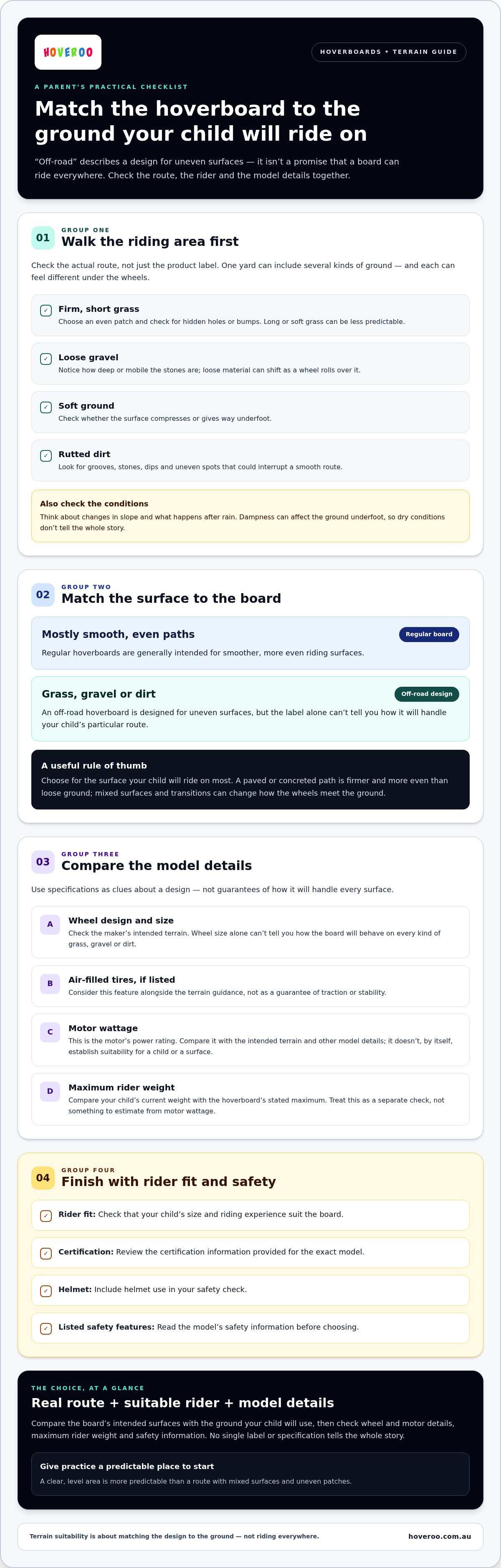
How to choose a rough-terrain hoverboard for your child
Make your choice from the ground up! Start with the place your child will ride most often, then match the board’s stated terrain guidance, weight limit and safety details to your child. This sequence helps you compare real-world fit instead of relying on a broad off-road label.
- Map the usual riding area. List the surfaces your child will encounter, such as a paved backyard path, firm short grass, loose gravel, soft ground or dirt. Note whether each area is flat, sloped, rutted or uneven. A route that switches from a smooth path to a loose lawn edge needs a different assessment from a single, firm surface.
- Match the surfaces to the product guidance. Read the exact model’s description for its intended terrain and compare it with your list. If a surface isn’t covered by the product information, don’t assume the board is suitable for it. Keep the route within the stated use.
- Check rider fit. Compare your child’s current weight with the model’s published maximum rider weight. Treat the stated limit as a firm comparison point. Then consider your child’s balance, confidence and riding experience. Think about whether they can follow guidance and stay focused while learning, without using age alone as a measure of readiness.
- Review the model’s safety details. Look at the listing for UL 2272 certification, helmet information and any protective equipment details. Check whether parental remote override or overload protection is stated for that particular model. Compare what’s actually listed rather than assuming a feature carries across an entire product range.
- Plan the first ride. Choose an area within the product’s stated use, supervise the first outings and allow your child time to get familiar with the board. If the ground is uneven, watch for changes in surface and give your child room to ride at a comfortable pace.
Use this parental peace of mind checklist before you decide:
- Does the model’s terrain guidance match the surfaces you listed?
- Is your child within the stated maximum rider weight?
- Have you reviewed the listing’s certification and helmet information?
- Have you considered your child’s confidence and planned supervised first outings?
Proceed if terrain, fit and safety information all line up. Compare further if a key detail needs closer consideration. Choose another ride-on if the product guidance doesn’t match the route or your child’s fit. The Best hoverboard for rough terrain kids is the one that makes sense for your child and their actual riding environment.
Ready to compare an option against your checklist? Explore Hoveroo’s off-road hoverboard and compare its product information with your family’s riding plans.
Discover Hoveroo’s off-road hoverboard for kids
Hoveroo sells the Off-Road Hoverboard for kids’ off-road riding. Assess it by comparing its product details with your family’s checklist. That keeps the decision grounded in your child’s needs, rather than relying on the words “off-road” alone.
Connect the product to your checklist
Start with the surface. Compare the riding areas you identified with the terrain described for the Hoveroo Off-Road Hoverboard. If your child’s usual route includes different ground types, consider each one separately and use the product information to guide your assessment. Don’t assume a broad off-road description means every surface or condition is suitable.
Next, look at rider fit. Compare your child’s current weight with the model’s published maximum rider weight, then consider how comfortable they are balancing and following instructions. Being within the weight limit is one part of the decision, not a stand-in for riding experience or adult supervision.
Review the safety details for this specific model. Look for UL 2272 certification information and helmet details, along with any listed parental remote override or overload protection. These features can inform your comparison, but certification alone doesn’t make a ride risk-free or replace protective gear and supervision. Use the model’s stated information when weighing those features.
Make the next step simple for Australian families
Before deciding, bring the details together. Does the terrain guidance reflect where your child will ride? Is their current weight within the stated limit? Have you considered their confidence and experience, and reviewed the available safety information? If the details suit your family’s plans, you’ll have a clearer basis for deciding whether this board belongs on your shortlist.
The Best hoverboard for rough terrain kids isn’t chosen by a label alone. It’s the option whose stated use, rider limit and safety details line up with your child and the place they’ll ride. Careful comparison can help keep outdoor play exciting while making your decision focused and informed!
Ready to put those criteria into practice? Explore Hoveroo’s off-road hoverboard and compare its product details with your child’s riding needs.
Turn your choice into their next outdoor adventure
Choosing the Best hoverboard for rough terrain kids can be the start of a new family routine, not just a purchase. Invite your child to help plan where they’d like to ride and talk about building confidence gradually. Shared preparation gives them a sense of independence while keeping you involved in their first adventures.
As you get ready, include the product details in your final decision. Set aside time to introduce the board calmly and stay close while your child gets familiar with it. Encouragement can turn those early wobbles into a fun moment you share, at a pace that feels right for your family.
Ready to take the next step? Explore the Hoveroo Off-Road Hoverboard and compare its product details with your child’s plans for outdoor play. Explore Hoveroo’s off-road hoverboard for kids, then get ready to make room for fresh-air fun and new memories!
Frequently Asked Questions
Can kids’ hoverboards ride on grass, gravel and dirt?
Some models are designed for grass, gravel or dirt, but the product instructions are the guide for the exact board. Read them before planning a route, especially if it includes more than one surface. Keep the ride within the stated use, and stop if conditions change or the board doesn’t feel right. A route that’s suitable one day may feel different after rain or yard work.
Is an off-road hoverboard suitable for every child?
No. A child’s readiness depends on more than the board’s terrain label. Consider whether they can listen to instructions, stay focused and manage the movements needed to ride. Choose an open practice area away from traffic, obstacles and other people. Stay close, allow plenty of room to stop, and pause if your child feels unsure or tired. Let their comfort guide practice rather than applying pressure.
What does UL 2272 certification mean for a kids’ hoverboard?
It’s a certification relating to hoverboard electrical safety. Check that the exact model is identified in the product information rather than assuming certification applies to every board from a brand. Keep the supplied charging instructions with the hoverboard and follow them each time. Certification is one part of a careful purchase and care routine, not a replacement for using the product as directed.
Can a hoverboard be ridden in wet weather?
Follow the model’s own instructions, and don’t treat an IP rating as permission to ride in any wet conditions. Rain can leave the ground slippery, while puddles and damp surfaces create different conditions from those described in product guidance. If the instructions don’t clearly cover the situation, put the ride off until the area is dry. Never charge a wet board.
How should you store a hoverboard between rides?
Switch it off and store it indoors in a dry place, away from direct heat and moisture. Keep it where it won’t be knocked over or buried under other items, and use the charger supplied for the model according to its instructions. Before charging, look over the board and charger for visible damage. If you spot a problem, stop and follow the manufacturer’s care guidance.
What should a child wear when learning to ride a hoverboard?
Choose a properly fitted helmet and protective pads for the wrists, elbows and knees. Closed-toe shoes that stay secure are a practical choice; tie laces neatly and avoid loose items that could distract the rider. Dress for the weather so your child can move comfortably. Before each session, check that protective gear fits well and isn’t damaged, then keep an adult nearby while they practise.