
Durable electric 4x4s for children’s outdoor play
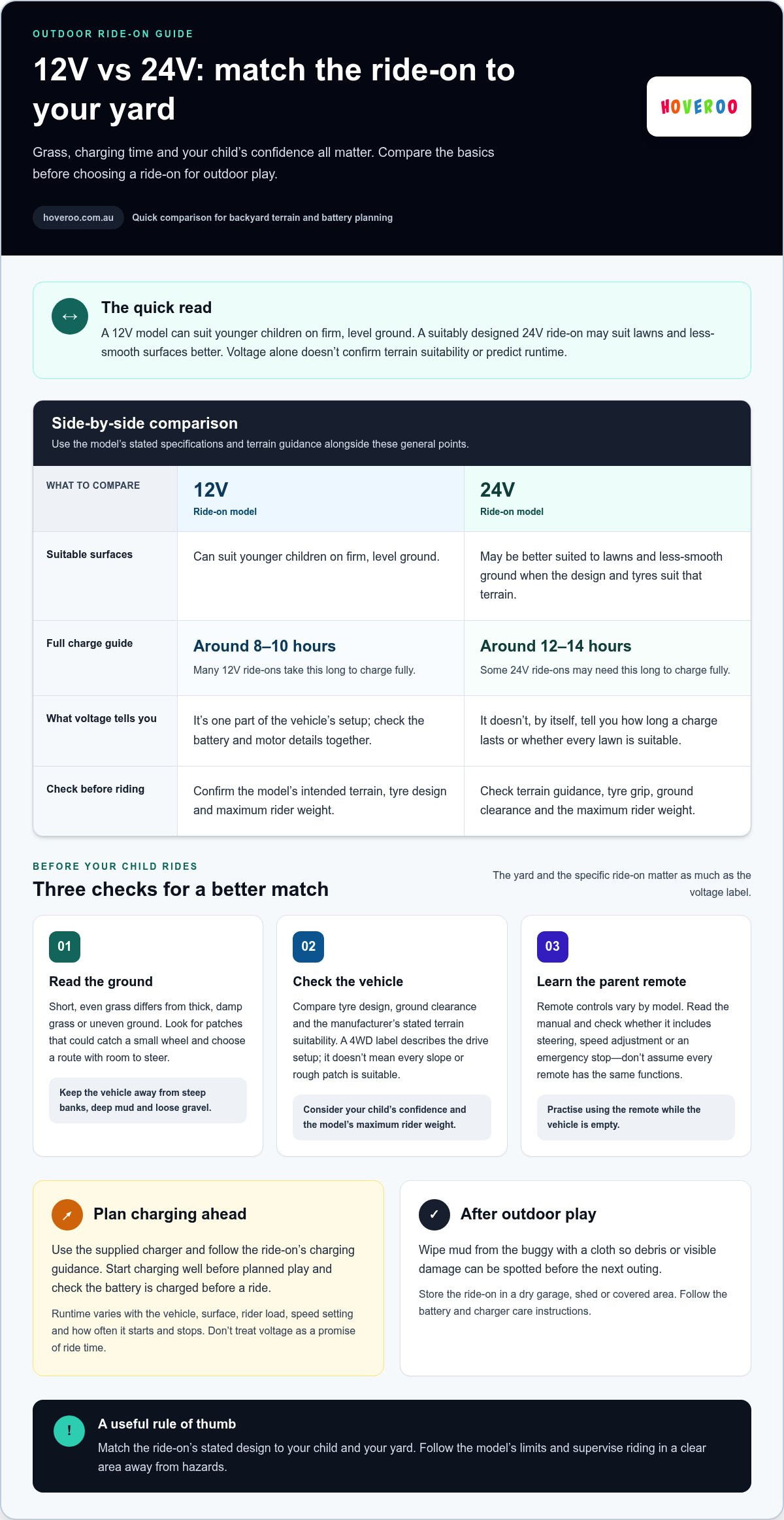
A durable electric 4x4 for outdoor play can handle grass when its tyres and design suit the surface. A 24V ride-on may be better suited to lawns and uneven ground, while a 12V model can suit younger children on level, firm surfaces. Charge times vary: many 12V ride-ons take around 8 to 10 hours, and some 24V models around 12 to 14 hours.
Grass brings more adventure, but it can also make a ride-on work harder than smooth paving. You’re right to consider traction, power and how easily you can step in if your child needs help. The right match can make outdoor play exciting while keeping you close to the controls.
Here, you’ll learn what affects a ride-on on grass, how charging works and how to compare power and parental controls. We’ll also cover how to set up a safer play area and care for a vehicle after outdoor adventures. Use these points to find features that suit your child, your yard and the kind of play you have in mind.
Key Takeaways
- Plan charging ahead: many 12V ride-ons take around 8 to 10 hours to charge, while some 24V models take around 12 to 14 hours.
- Match the ride-on to your yard: 12V models can suit firm, level ground, while a suitably designed 24V ride-on may handle lawns and less-smooth surfaces better.
- Use parental remote control to step in when needed, and set up a clear, supervised riding area away from hazards.
- Compare drive layout, tyres and terrain before choosing a four-wheel-drive buggy; keep it away from steep banks, deep mud and loose gravel.
- Look beyond voltage when comparing models. Consider your child’s confidence, the available speed options and how the ride-on will be used outdoors.
How long does a 4WD ride-on car take to charge?
Many 12V ride-on toys take around 8 to 10 hours to charge fully. Some 24V ride-ons may need around 12 to 14 hours. Battery runtime varies with the vehicle, surface and riding style, so plan charging before each outdoor session.
Motor power and battery voltage
Voltage and motor power help you compare how a powered ride on car is set up. A 24V battery system differs from a 12V system, but voltage alone doesn’t tell you how long a charge will last. Check the vehicle’s stated battery and motor details together, then consider whether its intended use matches your child’s play area.
Grass and frequent stop-start driving can place different demands on a battery than short rides on a firm, flat path. These conditions affect runtime, so don’t treat voltage as a promise of how long a charge will last. Check the model’s charging guidance and battery information before planning a long play session.
Battery runtime is how long a ride-on can be used between charges. It depends on factors such as the surface, rider load, speed setting and how often the vehicle starts and stops. A long lawn session can use charge differently from a shorter ride on smooth ground. Follow the model’s guidance and recharge as directed.
A spare battery may reduce waiting between play sessions, but it must be compatible with the specific ride-on. Match its voltage, battery type and connections to the vehicle’s requirements. A spare isn’t a substitute for following charging instructions. Store and charge it as directed, using the charger designed for that battery.
For a ride-on ute, don’t guess the battery voltage from its shape or size. Check the model’s specification label or manual for the voltage and charging instructions. Use those details to plan charging and compare the vehicle with the terrain and riding time you expect. The battery specifications, not the vehicle’s appearance, guide the right charging routine.
Charging time and battery care
Use the supplied charger and follow the recommended charging guidance for that ride-on. As a guide, many 12V toys take around 8 to 10 hours for a full charge; some 24V models take around 12 to 14 hours. Start charging well before planned play, and check that the battery is fully charged before a ride.
After outdoor use, store the ride-on in a dry garage, shed or covered area to protect its battery, electronics and finish from exposure. Keep the charger and battery care instructions together so you can follow the correct steps each time. Before the next ride, check the charge and make sure the vehicle is ready for your child.
Can 4WD Ride-On Cars Go on Grass?
Yes, some children’s electric ride-ons can travel on grass, but performance depends on voltage, tyres and design. A 12V model can suit younger children on level, firm surfaces. A 24V ride-on may be better suited to lawns and less-smooth ground when its design and tyres suit that terrain. A durable electric 4x4 for outdoor play should match the lawn your child will drive on.
Assess your backyard before choosing a vehicle. Short grass on an even lawn differs from thick, damp grass or uneven ground. Match the ride-on to the surface your child will use, rather than choosing by voltage alone. Tyre grip, ground clearance and the manufacturer’s intended terrain all matter. Higher voltage doesn’t make every ride-on suitable for off-road use.
Consider your child’s confidence and the vehicle’s maximum rider weight, too. That limit helps determine whether your child fits the model, but it doesn’t measure terrain ability. For a small, flat lawn, a ride-on intended for firm surfaces may fit. For longer runs across grass, compare children’s electric ride-on options by their stated terrain suitability and tyre design.
Electric ride-on utes bring pretend driving into the backyard. Their ute shape alone doesn’t show whether they’re designed for grass. Check the terrain guidance and maximum rider weight for the specific model. A 4x4 or 4WD label describes the drive setup, but doesn’t mean every lawn, slope or rough patch suits the vehicle.
For Ford Super Duty ride-on models, a licensed name or familiar styling isn’t proof of off-road capability. Check the model’s terrain guidance against your yard. Choosing a durable electric 4x4 for outdoor play means matching its stated design to the ground your child will use, rather than relying on its appearance or badge.
Before riding on grass, assess both the route and the vehicle. Look for uneven patches that could catch a small wheel, and choose a path with room to steer. Stay within the model’s stated limits. After play, wipe mud from the buggy with a cloth so you can spot debris or visible damage before the next outing.
Do 4WD ride-on toys come with parental remote control?
Some 4WD ride-on toys include a parent remote, allowing an adult to control the buggy when needed. Its controls and operation vary by model, so learn the specific remote before your child rides.
Remote-control safety features
Start with the manual and learn what each remote button does. A parent remote may provide adult control, but functions vary by model. Check whether it offers steering, speed adjustment or an emergency stop. These are separate capabilities, so don’t infer them from the word “remote” alone.
A parental peace-of-mind checklist can help you compare the remote and other controls. Look for clear information about speed limiting, stopping and how an adult takes control. Compare those functions with your child’s experience. A simple control layout can make it easier to use the right control promptly.
Parent controls and supervision
Before the first ride, practise using the remote while the vehicle is empty. Follow the model’s instructions to learn how its buttons work and how it responds. Explain to your child that an adult can intervene with the remote. Agree on a simple cue, such as pausing when you call, so your child knows what to expect.
Remote control supports adult supervision, but doesn’t replace it. Stay attentive to your child’s driving and keep the remote ready to use. For a beginner, practise switching between child-operated controls and adult intervention. This helps both of you understand who is controlling the buggy at each moment.
Remote operation can feel different from using the vehicle’s own steering and accelerator. Practise the controls in sequence, following the manual: check the response, release the control and observe how the buggy behaves. Don’t assume that releasing a remote button stops the vehicle unless its instructions say so. Knowing its actual response helps you act confidently if you need to intervene.
Make the remote part of your pre-ride routine. Keep it accessible, check its controls as directed and decide which adult will hold it. If another adult takes over, explain the buttons and intervention method first. A clear handover avoids confusion about who is guiding the ride.
Remote control is one factor when choosing a suitable ride-on. Compare the model’s instructions, control layout and stated safety functions. A remote can help an adult guide a child’s ride, while clear expectations help the child build confidence and understand when an adult may step in.
Four-wheel-drive buggy capabilities
A four-wheel-drive buggy sends power through all four wheels, but the drive layout is only one part of the comparison. Check the motor arrangement, rider fit and suspension alongside the manufacturer’s specifications.
Buggy drive capabilities
A dual-motor electric 4WD typically has one motor driving the front axle and another driving the rear axle. This differs from a single-motor layout, where one motor powers the vehicle. The drive setup describes how the buggy is powered, not its speed, carrying capacity or handling. Compare those details separately in the model information before deciding what suits your child.
Consider how your child fits the controls, too. A buggy that looks roomy may still have a seat or footwell that doesn’t suit your child’s build. Check the vehicle’s listed dimensions and rider guidance, then consider whether your child can sit comfortably and reach the steering wheel and pedals.
Traction and suspension
Tyres and suspension affect how a ride-on responds to the ground beneath it. Tread design influences contact with the surface, while suspension can help manage movement over uneven sections. These features vary between models, so compare the manufacturer’s descriptions rather than assuming every 4WD buggy has the same setup.
Wheel size and seat-height filters can help narrow your choices, but they answer different questions. Wheel dimensions describe part of the vehicle’s build; seat height helps you assess how your child may sit. Neither measurement alone tells you whether a buggy suits a particular surface or every rider.
Use the listed dimensions to picture the buggy in your play area and storage space. Check its width against the route through a gate and its length against the space where you’ll store it. These measurements can also help you judge whether there’s enough room to turn in your child’s practice area.
Fit matters while driving, too. Check the seat position, footwell and reach to the steering wheel before the first outing. Your child should be able to sit naturally without stretching for the controls. Maximum rider weight is a separate limit, so consider it alongside seating dimensions rather than treating weight as a complete guide to fit.
When comparing buggies, note the drive layout, tyre description, suspension details and rider dimensions. Compare these with your child’s fit and your intended use. This gives you a clearer picture of each model’s design without treating four-wheel drive as a measure of every capability.
12V and 24V model comparisons
Choose a ride-on voltage by matching the vehicle to your child and the ground they’ll drive on. A 12V or 24V label helps compare models, but it doesn’t replace checking the intended terrain, tyres and speed options.
For younger children using level, firm surfaces, a 12V ride-on can be a suitable starting point. It may fit a smooth path or compact, even play area. If your child will mostly drive across lawn or cover longer runs, consider a 24V model designed for that use. Its suitability still depends on the tyres and vehicle design.
Voltage alone doesn’t tell you which ride-on will be easiest to control. Check the model’s speed settings and whether a lower setting suits a beginner. Some children’s buggies offer several speed options that can be increased as confidence grows. A gradual step-up lets your child practise steering and stopping before trying a faster setting.
Compare the expected surface, too. A firm, level driveway asks less of the tyres than a lawn with uneven patches. For grass, the guidance is clear: a suitably designed 24V ride-on may be better suited to lawns and less-smooth ground. Don’t assume every 24V vehicle is made for rough terrain. Check its intended use and tyre design.
Use this quick comparison when narrowing your options:
- 12V: Consider it for younger children and level, firm surfaces.
- 24V: Consider it for lawn, longer runs or less-smooth ground when the tyres and design suit those conditions.
- Either voltage: Compare speed settings, rider guidance and the vehicle’s intended surface before choosing.
Your child’s confidence matters as much as the backyard. A new driver may prefer a lower speed setting and a smooth, open route. An experienced child might enjoy a larger play area, but the ride-on still needs to suit the surface. Unless the model is designed and rated for two children, keep it to one driver at a time.
Battery charging is another practical difference to consider when planning play. Many 12V ride-on toys take around 8 to 10 hours for a full charge. Some 24V ride-ons may need around 12 to 14 hours. Follow the supplied charger instructions, and plan ahead so charging fits your family’s routine.
Ready to compare options for backyard adventures? Explore electric ride-on models and match the vehicle’s stated use to your child’s play space.
Hoveroo: Hoveroo Hoverboard
Hoveroo Hoverboard offers a different kind of powered play for children ready to balance and move independently. If your priority is a child-sized vehicle for backyard driving, the Voltrix TerrainMaster 24V 4x4 Ride On is more directly matched to this article’s focus.
Compare the TerrainMaster’s intended use with your yard, then consider your child’s confidence, the stated rider weight limit and the available safety controls. Those details help you decide whether a 4x4 ride-on suits your family’s outdoor play. For other adventures, Hoveroo also offers the Off-Road Hoverboard and Thunderbolt Electric Dirt Bike.
Explore the options at hoveroo.com.au or contact Hoveroo to discuss your child’s outdoor ride-on needs.
Make your next backyard adventure a great fit
Choosing a durable electric 4x4 for outdoor play is also a chance to make outdoor time part of your child’s everyday adventures. Before deciding, picture how your family will use the ride-on: a short loop around the yard, a shared play session, or a little independent driving with you close by. Let your child help imagine the route, then set clear boundaries for where riding begins and ends.
A little planning can turn a new vehicle into a play routine your child looks forward to. Choose an easy-to-recognise route, make supervision part of the fun and build confidence at your child’s pace. The best choice suits your space and makes outdoor play exciting for everyone.
Ready to explore the next step? Talk with Hoveroo about ride-on options and find a fun fit for your family’s outdoor play.
Frequently Asked Questions
Can I pick up a 4WD ride-on car today?
Hoveroo sells its children’s ride-on vehicles online, with delivery rather than a stated same-day collection option. Published delivery information lists dispatch within 24 hours, with standard delivery taking 4-7 days or express delivery taking 1-3 days. Choose a delivery option at checkout and plan around its estimated timeframe. If you’re organising a birthday or weekend surprise, order ahead so the ride-on has time to arrive.
How do I look after the battery?
Use the charger supplied with your ride-on and follow the manual’s charging instructions. Before connecting it, check the charger, cable and battery connection for visible damage or dirt. Keep the connection clean and dry, and stop if you notice damage. After charging, unplug the charger and store it safely. These simple checks help keep the battery and charging equipment in good condition between outdoor play sessions.
Should I choose a 12V or 24V 4WD ride-on toy?
Choose according to the surface, your child’s confidence and the vehicle’s intended use. A 12V ride-on can suit younger children on level, firm ground; a suitably designed 24V model may suit lawns and less-smooth surfaces. For example, the Voltrix TerrainMaster is a 24V 4x4 ride-on. Compare its age guidance, rider limit and speed controls with your child’s needs, not voltage alone.
What does 4WD mean on a kids’ ride-on car?
4WD means the vehicle’s drive system sends power to all four wheels. In an electric buggy, this may involve motors driving the front and rear axles. It describes the drivetrain, not a guarantee that the ride-on suits every surface. Check the vehicle’s terrain guidance and tyre design, then keep children away from steep banks, deep mud and loose gravel.
What are the most durable kids' electric 4x4 ride-on vehicles available in Australia?
There’s no universal durability ranking that applies to every child or backyard. Compare the stated terrain use, maximum rider weight, wheel design and warranty details before choosing. Hoveroo offers the Voltrix TerrainMaster 24V 4x4 Ride On for families considering a children’s 4x4. Match its product guidance to your intended use, and look for clear care instructions and safety information alongside construction details.
What age, weight and height limits apply to popular electric 4x4 ride-on cars in Australia?
Limits vary by model, so use its age recommendation and maximum rider weight rather than assuming all 4x4s share one standard. The Voltrix 4WD ride-on is recommended for ages 6-12, with a maximum rider weight of 75 kg. Height guidance can affect fit too: check that your child sits comfortably and can reach the controls without stretching.
Are kids' electric 4x4 ride-on vehicles safe to use outdoors, and what safety features should I look for?
Outdoor use calls for adult supervision, a clear riding area and safety features suited to the child. Look for a parent remote, speed control, braking features and clear rider limits. A helmet and protective pads are strongly recommended. Use of products sold by Hoveroo is subject to applicable national, state, territory and local laws, regulations and local council by-laws. Consumers are responsible for checking and complying with all applicable local requirements before use. Products are not represented as approved for use in any particular public area unless expressly stated.