
Durable Hoverboard for Kids: Parent’s Guide to Outdoor Play
What if a board that looks tough still struggles on your child’s favourite outdoor surface? Choosing a durable hoverboard for kids outdoor play means matching the model to the terrain, not judging it by rugged looks alone. Grass, gravel and dirt each bring different demands, so it’s worth checking how a board is designed to be used.
You want your child to enjoy outdoor independence while choosing a board that suits their needs and your family’s safety expectations. Look beyond broad “outdoor-ready” claims and compare the model’s intended use, safety details and rider limit. This guide explains what to check, including UL 2272 certification and maximum rider weight, and shares practical care tips for boards used outdoors.
Hoverboards are restricted to private property in most of Australia, so check the rules where you live and choose a suitable private riding area. From comparing a standard hoverboard with an off-road hoverboard to checking and cleaning the board after a ride, here’s how to make outdoor play more informed, safe and fun!
Key Takeaways
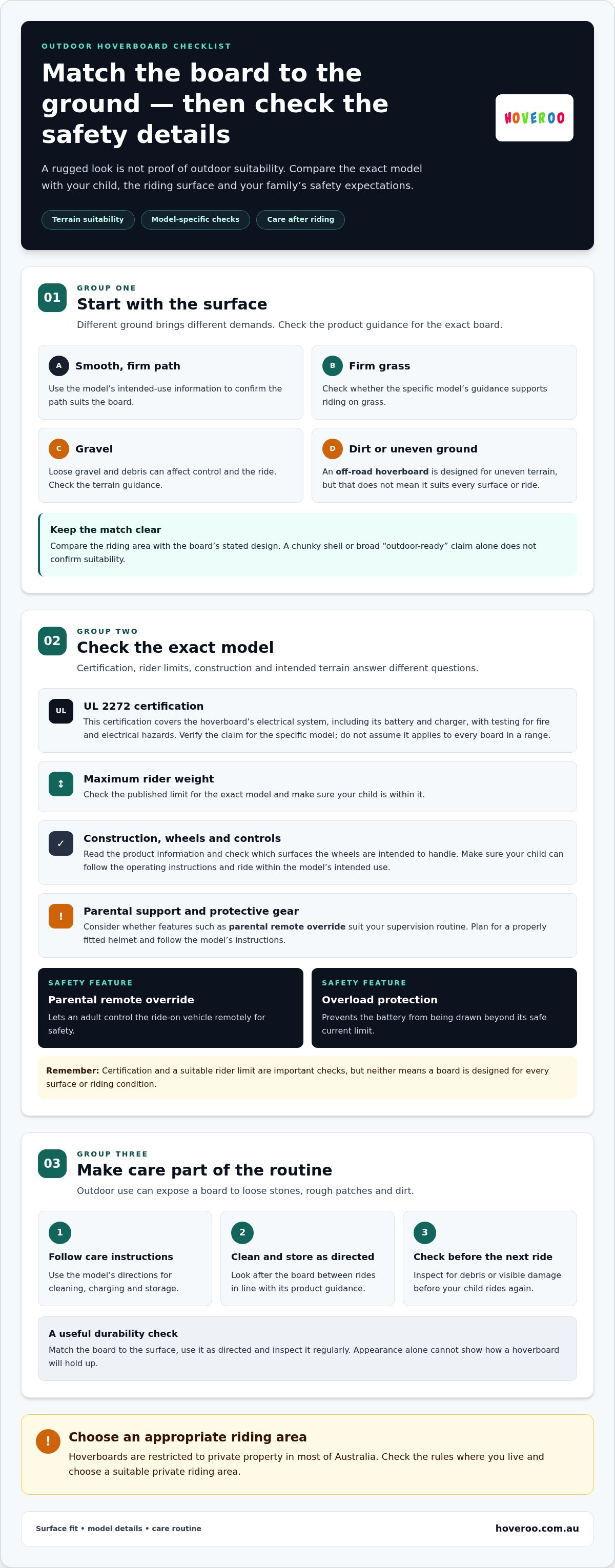
- For a durable hoverboard for kids outdoor play, start with the riding surface. Match the model’s stated terrain suitability to where your child will ride.
- Check model-specific details, including UL 2272 certification, maximum rider weight and construction, before choosing.
- Compare smooth paths, firm grass, gravel and dirt carefully. Uneven ground and loose debris can affect control and the ride.
- After outdoor rides, follow the care instructions, clean and store the board as directed, then check for debris or visible damage before the next ride.
- Compare the Hoveroo Hoverboard and Off-Road Hoverboard by their safety details and intended use to see which better fits your family.
What makes a durable hoverboard for kids’ outdoor play?
A board can look ready for an adventure without being suited to the ground your child will ride on. For a durable hoverboard for kids outdoor play, durability means the model is designed for its intended surfaces, can be cared for as directed and is suitable for regular use. It doesn’t mean the board can handle every bump, surface or condition.
Outdoor rides can expose a board to loose stones, rough patches and dirt. How it holds up depends on its design, how it’s used and how it’s cared for. Check the guidance for the specific model rather than assuming every hoverboard will perform the same way. Outdoor play also doesn’t mean unrestricted riding: choose an appropriate area and follow local rules.
What outdoor-ready means for a children’s hoverboard
Outdoor suitability is how well a hoverboard’s stated design matches the surfaces and conditions where a child will ride. Compare the product guidance with your planned play area, whether that’s grass, gravel or dirt. An off-road hoverboard is designed for uneven terrain, but that term alone doesn’t mean it suits every surface or ride.
Consider the ground itself. A smooth, firm path is different from soft grass or loose gravel, where changes in texture and debris may affect control. Look for the intended-use information for the specific model and keep rides within those recommendations.
For an overview of how these self-balancing devices work and related safety considerations, see Self-balancing scooter (hoverboard) technology and safety. Use the product guidance to judge whether a particular board suits your child’s intended riding area.
Durability is more than a tough-looking shell
A chunky-looking exterior may catch your eye, but appearance alone doesn’t show which surfaces a board is designed for. Consider the whole product: its construction, wheels, controls and care instructions. These details help you assess whether the model’s stated use matches your child’s play area and how you’ll look after the board between rides.
- Construction: Read the model’s product information. A solid-looking shell isn’t proof of outdoor suitability.
- Wheels: Check the product guidance for the surfaces they’re intended to handle.
- Controls: Make sure your child can follow the model’s operating instructions and ride within its intended use.
- Care: Follow the cleaning, charging and storage instructions to look after the board.
There’s no need to guess at a board’s lifespan or assume it’s impact-proof. Match the model to the surface, use it as directed and inspect it regularly. That’s a more useful way to assess durability than relying on rugged styling or broad outdoor-ready wording. Your child can enjoy active play while you make the choice with clearer expectations!
Which hoverboard details matter for outdoor durability and safety?
Start your comparison with the exact model, not a broad claim about an entire range. Certification, rider limits, construction and intended terrain each tell you something different. Check them together, then consider whether the safety features and care instructions suit your child and the place they’ll ride.
Check certification and rider limits for the exact model, as neither detail automatically applies to every board in a product range. Keep this rule in mind while comparing options. A durable hoverboard for kids outdoor play should suit both your child and your planned riding area, with clear model-specific information to guide your decision.
Check certification and the maximum rider weight
UL 2272 is a certification covering a hoverboard’s electrical system, including its battery and charger, with testing for fire and electrical hazards. Verify the certification for the specific model rather than assuming it applies across a brand’s range. Check the product information for the certification claim and make sure your child is within the published maximum rider weight.
Next, check the model’s stated construction and intended terrain. If your child will ride on a particular surface, confirm the product guidance supports that use. Certification and a suitable rider limit are important checks, but they don’t mean a board is designed for every surface or riding condition.
Look for safety support that suits your family
Think about how you’ll supervise a beginner and which features could support your family’s routine. A parental remote override lets an adult control the ride-on vehicle remotely for safety. Overload protection prevents the battery from being drawn beyond its safe current limit. These are features to look for, not a promise that every battery issue can be prevented.
Use this checklist as you compare model details:
- Certification: Is the model specifically identified as UL 2272 certified?
- Maximum rider weight: Is your child within the published limit?
- Construction and terrain: Do the model details match the surface where your child will ride?
- Adult support: Does the model offer features such as parental remote override?
- Protective gear: Plan for a properly fitted helmet and follow the model’s instructions.
You can also use a parental peace of mind checklist, a list of safety features such as an emergency stop, speed limiter and remote override. Check which features apply to the exact model rather than assuming every board includes them. Compare these details with your child’s experience and your supervision plan. Explore Hoveroo’s hoverboard range with this model-by-model checklist in mind!
How should you match a hoverboard to outdoor surfaces?
Start with the ground your child will actually ride on. A clear, smooth area can be a practical starting point for supervised outdoor riding. Grass, gravel and dirt call for closer attention to the exact model’s intended-use guidance. Uneven ground and loose debris may affect the board’s contact with the ground, your child’s control and how comfortable the ride feels.
Use this comparison to guide what you check, not as a promise that any hoverboard suits every surface.
Choose surfaces that suit the board and rider
Assess the whole area, not just its surface label. A patch of firm grass may feel quite different from soft, uneven ground. A dirt area may include stones, ruts or loose material. These changes can affect how the board moves and how confidently a child can respond. Begin in a clear area, supervise closely and follow the model’s instructions.
Don’t rely on wheel size or an “off-road” label alone. Neither tells you that a particular board suits every type of grass, gravel or dirt. Check the product guidance for the exact model and stay within its stated use.
Know when an off-road hoverboard may suit
An off-road hoverboard is designed for uneven terrain such as grass, gravel or dirt. It may suit a family whose planned play area includes those surfaces, but the label isn’t a guarantee of universal capability. Compare the model’s product information with the ground your child will ride on.
Hoveroo’s Off-Road Hoverboard is one option in its hoverboard range. Read the product guidance to judge whether it fits your intended surface, then choose a clear riding area and supervise the ride. The right match suits both the terrain and your child, not simply the board that looks most rugged!
How can you care for a hoverboard used outdoors?
A quick after-ride routine helps you spot dirt, loose debris or visible damage before the next session. Check the board, clean it only as its instructions allow, then store and charge it as directed. Steps can differ between models, so follow the guidance supplied for your child’s hoverboard instead of relying on general cleaning tips.
After every outdoor ride, check for debris or visible damage, then clean and store the board according to its model-specific instructions. This gives you a practical reset between adventures without assuming the board can handle water, dust or a particular cleaning method.
A simple after-ride check
Before putting the board away, look over the wheels, visible surfaces and controls. Check for stones, grass or dirt caught around the wheels, as well as cracks, loose parts or other obvious changes. Don’t pull at anything that seems stuck or take the board apart unless its instructions tell you to. If you spot damage, pause the next ride and follow the product guidance.
Clean the board only by the method described for that model. Outdoor use doesn’t automatically mean it’s safe to rinse the board or wipe every part with water. An IP rating describes protection against water and dust intrusion, but don’t infer a model’s rating or cleaning limits from its appearance. Check its product information and care instructions first.
A durable hoverboard for kids outdoor play still needs sensible care. The aim isn’t to promise a particular lifespan. It’s to help you spot issues early and avoid cleaning or storage steps that aren’t approved for that board.
Storage and charging between outdoor sessions
After checking and cleaning the board as instructed, store it as directed by the manufacturer. Follow the supplied charging instructions for the exact model, including any guidance on where and how to charge it. Avoid guessing about battery care or applying advice meant for a different board. The model-specific instructions are your clearest guide.
Keep the routine easy to remember: inspect, clean as directed, then store and charge according to the instructions. This habit helps keep outdoor play organised and gives you a chance to notice visible debris or damage before your child rides again. For more battery-care context, use a hoverboard battery safety guide alongside the instructions for your specific model.
Ready to choose a board with outdoor use and care in mind? Explore Hoveroo’s hoverboard range and compare the product guidance with your family’s riding plans.
Find a Hoveroo hoverboard for your child’s outdoor adventures
The right choice should fit your child’s outdoor plans and give you confidence in your decision. Hoveroo is an Australian retailer serving families nationwide, with a community of more than 50,000 families. Its range of children’s hoverboards gives you options to compare for your family’s playtime.
Hoveroo’s range includes the Hoveroo Hoverboard and Off-Road Hoverboard. Compare each product’s information with where your child hopes to ride. The best fit is the one that makes sense for your family’s plans, not simply the one that looks most adventurous.
Use a parent’s checklist before choosing
Before deciding, picture a typical ride for your child. Is the product suited to the place they’ll use it? Do the instructions and care requirements work for your family? A few practical checks can help you choose with confidence and set clear expectations for outdoor play.
- Play plans: Consider where your child will ride and whether the model fits those plans.
- Rider fit: Review the model’s stated maximum rider weight.
- Safety details: Read the product information for model-specific certification and features.
- Family routine: Consider supervision, protective gear and whether you can follow the care instructions.
A parental peace of mind checklist can help you focus on what matters to your family as you compare options. Choose a clear, suitable space for supervised play, and help your child understand the board’s instructions before they set off.
Explore Hoveroo’s hoverboard range
The Hoveroo Hoverboard and Off-Road Hoverboard are options in Hoveroo’s range. Read each model’s product details on their own terms, so your decision reflects the specific board rather than assumptions about the whole range. Then plan a first ride that feels fun, manageable and right for your child.
Ready to find a board for your family’s outdoor adventures? Explore Hoveroo’s hoverboard range and find an option that suits your child’s next playtime!
Make the next ride a confident start
Outdoor play can become a family ritual: a chance to step outside, build confidence and enjoy time together. Let your child help choose a suitable place to ride, and keep the first session relaxed and unrushed. A little planning can set the scene for more happy adventures.
As you browse, picture where the board will be used and how it could fit into your family’s playtime. Ready to find an option for your child’s next adventure? Explore Hoveroo’s hoverboard range and get ready for more outdoor fun!
Frequently Asked Questions
Is an off-road hoverboard suitable for grass and gravel?
An off-road hoverboard is designed for uneven terrain such as grass, gravel or dirt, but suitability depends on the exact model’s guidance. If your child’s route moves between surfaces, assess each part rather than judging it by the roughest patch alone. Begin in a clear space, stay close while your child rides and don’t treat an off-road label as approval for every type of ground.
Can kids ride a hoverboard outdoors after rain?
Only ride after rain if the manufacturer’s guidance allows those conditions. Don’t assume a hoverboard is water-resistant: check the exact model’s IP rating and care instructions. Puddles, damp patches and wet grass can make it harder to judge the ground and maintain control. If you’re unsure whether the board or surface is suitable, wait for dry conditions and follow the product guidance.
How do I know if a hoverboard is durable enough for my child?
Consider the model’s intended terrain, construction information, maximum rider weight, certification details and care instructions together. Compare them with your child’s planned use, including where the board will be ridden and how it’ll be stored between sessions. A rugged-looking shell can’t tell you those things. Base your decision on the information for that particular model, not broad performance promises.
What happens if a child exceeds a hoverboard’s maximum rider weight?
Don’t let a child ride above the maximum rider weight stated for that model. The limit defines the rider range specified by the manufacturer, so it isn’t a figure to test or exceed. Check the product information for the exact board, especially if more than one child may use it. Keep riding supervised and within the instructions rather than relying on how the board appears to handle.
Does UL 2272 certification mean a hoverboard is safe in every situation?
No. UL 2272 certification relates to the hoverboard’s electrical system, including its battery and charger, but it isn’t a guarantee against every riding risk. Check the certification information for the specific model and use the board as directed. Your child’s riding environment, supervision and protective equipment still matter. Certification doesn’t mean you can use a board beyond its stated conditions.
What protective gear should a child wear on a hoverboard?
A properly fitted helmet is a sensible starting point, alongside age-appropriate protective gear suited to your child and the activity. Make sure the equipment fits securely and doesn’t interfere with movement or visibility. Follow any gear guidance supplied with the specific board. Protective equipment is one part of planning a ride; it doesn’t replace adult supervision or following the operating instructions.
How often should I check a kids’ hoverboard after outdoor use?
Give the board a visual check after outdoor sessions and again before the next ride, following its care instructions. Look for anything caught near the wheels or signs of visible damage on the body and controls. If you notice an issue, don’t let your child ride until you’ve followed the product guidance on what to do. Use only the cleaning methods specified for that model.