
Independent Outdoor Play Toys for Kids: Help Children Play Their Own Way
What if the best way to get your child playing outdoors is to let them choose what happens next? The right independent outdoor play toys for kids can offer a fun starting point, but it’s your child’s ideas, choices and pace that shape the play. You don’t need to lead every game or compete with screens for attention!
It’s understandable to want outdoor time to feel engaging while still keeping a watchful eye. Find that balance by creating a safe, inviting space, then giving your child room to explore in a way that suits their age, interests and confidence.
In this guide, you’ll find practical ways to get independent play started and keep it going, plus ideas for choosing outdoor toys that suit your family’s space and your child’s appetite for movement. From a wiggle car to an off-road hoverboard, ride-on formats can suit different interests, but the toy is only one part of the picture. We’ll also cover how to weigh up safety information and supervision, so you can encourage child-led outdoor fun with confidence!
Key Takeaways
- Independent play can start with you nearby. Let your child take the lead when they’re ready.
- Notice what captures your child’s interest, set out a simple invitation to play, then give them space to choose.
- Match independent outdoor play toys for kids to the movement and play your child enjoys.
- Build a repeatable routine by agreeing on boundaries, starting together and allowing a child-led stretch.
- Choose ride-ons with your child’s interests, play area and supervision plan in mind, and read the relevant safety information.
What independent outdoor play looks like for kids
Your child might be happy to head outside but still want you close by. They may ask you to start the game, watch what they’re doing or stay within sight before they feel ready to choose the next step. That’s a normal starting point. Independent play doesn’t mean your child has to be alone or invent an elaborate game straight away.
Independent outdoor play is time outside when a child chooses what to do and explores within boundaries set by an adult who remains appropriately involved.
Independent play is not the same as unsupervised play
Child-led play describes who makes the play choices, not whether an adult has stepped away. You remain responsible for supervision suited to your child’s age, confidence, activity and surroundings. Your role can shift from directing every move to staying available nearby, keeping watch and stepping in when needed. The right level of involvement depends on your child and the setting.
For example, you might agree to stay together in the backyard and keep play within a visible area. Your child can then choose whether to draw with chalk, make up a pretend shop or explore a safe patch of garden. You’ve set the limits; they choose what happens within them. Clear boundaries help both of you understand what “play on your own” means today.
Why child-led outdoor play can feel rewarding
When children get to choose, they can follow what catches their attention rather than simply complete an adult-led activity. A stick might become a pretend wand; a patch of grass might inspire a game. The ideas can change quickly, and that’s part of the fun. Free play describes play directed by the child, which is a useful way to understand the child-led side of independent play.
Outside, children have room to move and notice what’s around them. They might walk, balance, make up a story or watch leaves shift in the breeze. There’s no single activity you need to set. Your child’s interests can guide the play, whether they’re drawn to movement, pretend play or familiar outdoor details.
That choice can make outdoor time feel more personal and inviting. It gives children space to try their own ideas at a comfortable pace, while you stay close enough to offer reassurance or help. The aim isn’t to keep every moment busy. It’s to make room for your child to decide, imagine and move within a setting you’ve made suitable for them.
If your child asks you to join, start together. Then offer a gentle opening: “What should happen next?” or “Would you like to keep playing, or try something else?” You can remain nearby without taking over the story. Some days your child may lead for longer; on others, they may want more company. Both are part of finding what child-led outdoor time looks like for your family and which independent outdoor play toys for kids might suit their interests.
How to make independent outdoor play easier to start
You don’t need a big collection of toys or a carefully planned activity to get play moving. A small, familiar invitation can offer a first idea, while leaving room for your child to take it in a new direction. Keep the setup simple and let their interests do the steering!
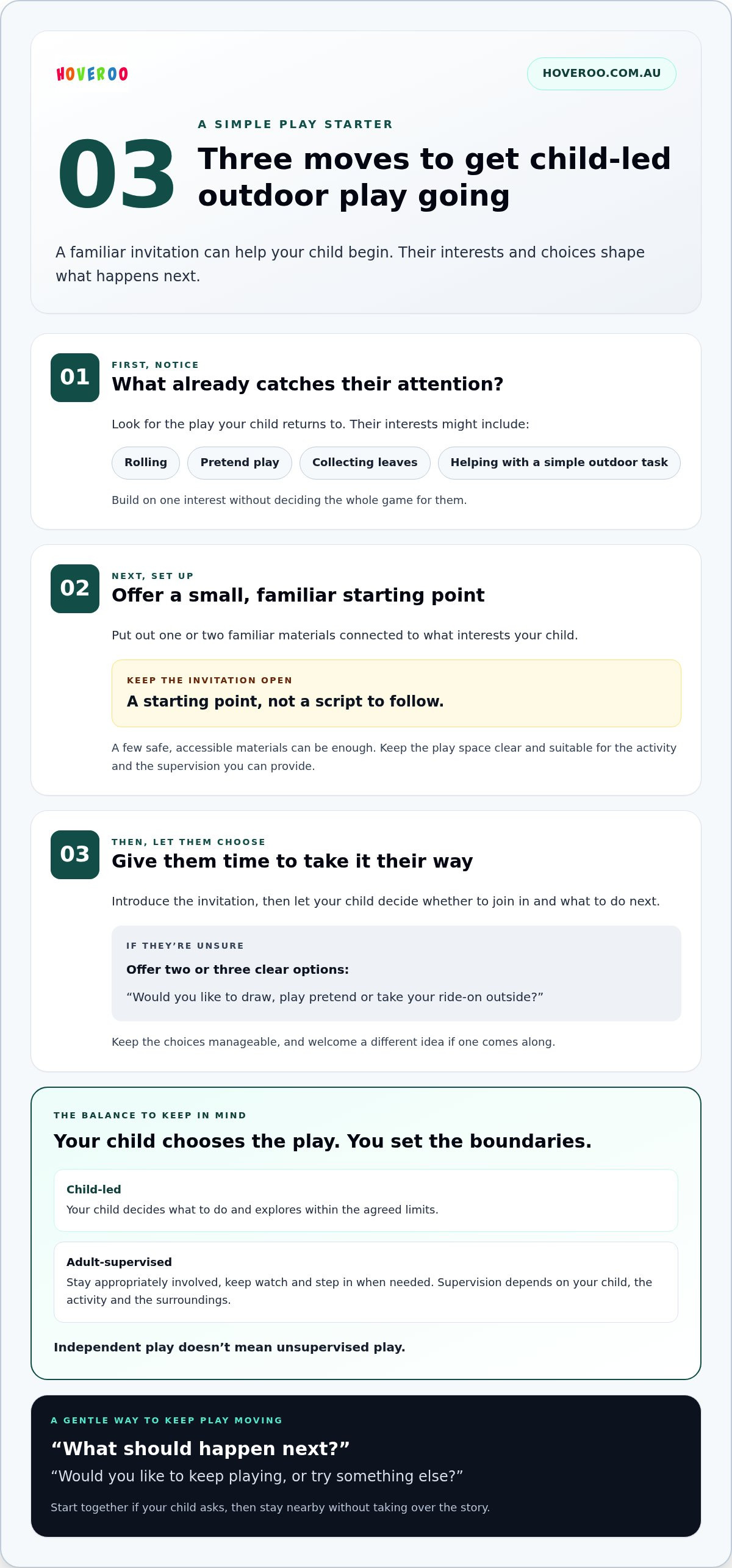
Try this quick sequence:
- Notice: Pay attention to the play your child returns to, such as rolling, pretending, collecting leaves or helping with a simple outdoor task.
- Set up: Put out one or two familiar materials that connect with that interest.
- Let them choose: Introduce the invitation, then give your child time to decide whether to join in and what to do next.
A simple play invitation gives your child a starting point, not a script to follow. That distinction helps you make play easier to begin without planning every moment for them.
Start with what already catches your child’s attention
Watch for clues in your child’s everyday play. Do they like to scoot, carry objects, pretend to run a shop or help water plants? Build on one of those interests without deciding the whole game. For example, leave a few safe containers near a garden area and let your child choose whether to sort, pour or invent a pretend activity.
If an open-ended invitation leaves them unsure, offer two or three clear options: “Would you like to draw, play pretend or take your ride-on outside?” Keep the choices manageable, and welcome a different idea if one comes along. The aim is to make the first move feel easy, not to steer them towards a particular activity.
Set up a play space that invites a first move
Make suitable materials easy to see and reach, as long as your child can access them safely. A tub of chalk, a ball or a few pretend-play items may be enough. Start with a small selection. Too many things can make it harder to settle on an idea, while familiar materials can help your child get started without waiting for you to organise a whole activity.
Choose a clear area that suits the play and your home setup. Leave room for the activity, keep materials together and make sure the space works with the supervision you can provide. For active play, consider the surface and nearby obstacles before setting equipment out. A backyard ride-on can be one option to explore. This guide to outdoor backyard adventure toys offers an equipment example to consider alongside your space and child’s interests.
Keep the setup flexible. If your child ignores the invitation, leave it available or try something different another time. If they take it up, resist adding instructions straight away. A few accessible materials, a clear starting point and room to choose can help independent outdoor play toys for kids fit into everyday outdoor time. You can also browse children’s ride-on options as you think about what suits your family’s play space.
Which independent outdoor play toys fit different interests?
The best fit isn’t necessarily the biggest toy or the fullest play area. Start with what your child likes doing, then consider the space available and whether they’re ready to use that type of toy with suitable adult supervision. A toy can suggest an activity, but your child decides whether to try it, change the rules or move on.
Use this comparison to connect play interests with broad toy types. The parent question can help you think about fit before choosing equipment.
| Play interest | Broad toy type | Question for the parent |
|---|---|---|
| Moving around a defined area | Wheeled toys and ride-ons | Is there a suitable space for this activity and a supervision plan that fits my child? |
| Making up stories | Pretend-play props and simple role-play toys | What might my child enjoy imagining with these? |
| Touching, sorting or creating | Age-appropriate sensory materials and creative supplies | Can my child use these materials safely in this outdoor setting? |
| Joining in with everyday outdoor tasks | Child-sized tools or simple gardening materials | Which task can my child explore with me nearby? |
Movement-led play: wheeled toys and ride-ons
If your child is drawn to rolling, steering or travelling around a set area, wheeled toys may suit that interest. Hoveroo’s range includes hoverboards, go-karts and the Voltrix TerrainMaster 24V 4x4 Ride On. These are examples of ride-on formats, not promises of independent play. Consider your child’s readiness, the intended play area and the supervision you can provide. For another movement-led option, this kids’ electric dirt bike guide gives an example to consider alongside your child’s interests.
Imaginative and hands-on play outdoors
Not every child wants to ride. Some prefer pretend play, exploring textures or helping with a simple outdoor task. The Zippy Electric Wiggle Car and Hoveroo 5 in 1 Rocking Horse are options in Hoveroo’s range, while familiar materials such as chalk or leaves can inspire play too. Check that a toy’s intended use suits the setting; a play idea that works indoors may not suit every outdoor surface.
Keep your child’s preferences at the centre. If they return to imaginative stories, movement may not be their first choice, and that’s fine. If they love to scoot or steer, a ride-on could be worth considering alongside simpler play options. You don’t need a toy for every interest. A small number of suitable choices can be easier to manage and still leave room for your child to invent their own game.
How to build a safe routine for independent outdoor play
A familiar routine helps you and your child know what to expect, while leaving the play itself open to their ideas. Keep the steps simple: agree on boundaries, begin the activity together, then allow a child-led stretch while supervising at a level that suits the situation.
Independent play still needs age-appropriate supervision, guided by your child, the activity and the play setting. Use that as your starting point, rather than stepping away before your child is ready.
- Agree on boundaries: Make clear where play can happen and which areas or activities are off-limits.
- Begin together: Get the activity started and make sure your child understands how to ask for help or stop.
- Allow a child-led stretch: Stay appropriately close, then give your child room to continue in their own way.
A parental peace of mind checklist can help you consider a ride-on’s relevant safety features, such as a speed limiter or remote override where specified. Use it as a planning prompt, not as a certification or a substitute for reading the product’s safety information. Consider your child’s readiness and the play environment alongside the equipment.
Agree on boundaries before play begins
Be specific and use words your child can remember. You might set a limit such as staying within a visible section of the yard and keeping clear of a driveway or garden bed. Agree on what they should do if they feel unsure, need help or want to stop. For ride-ons, include a helmet in your safety planning and consider the relevant features, without assuming every model includes the same equipment.
Step back gradually and notice what works
Start close by. Once your child is settled, pause before offering another idea or instruction. A brief check-in can reassure them while letting the play continue on their terms. Keep watching in a way that suits the child, equipment and surroundings, and step in if the situation changes or support is needed.
Use what you notice to shape the next play session. If your child stays engaged within the agreed area and knows how to call you, the routine may be working for that setting. If their confidence changes, they lose interest or the play space becomes less suitable, adjust your distance or return to playing together. Independent outdoor play toys for kids should fit into this safety plan, rather than determine how much supervision is needed.
Explore Hoveroo ride-on options as you consider your child’s interests, the play area and the routine you can confidently supervise.
How Hoveroo ride-ons can fit into child-led outdoor play
A ride-on can give a movement-loving child another way to explore, but it won’t decide how play unfolds. Your child’s interest, readiness and play space matter just as much as the toy. Think of Hoveroo’s ride-on range as options to consider, then match the choice to a supervision plan that works for your family.
Match the play format to your child’s interests
Notice what your child is drawn to. Do they like balancing, steering or travelling around a defined area? Hoveroo’s range includes the Hoveroo Hoverboard and Off-Road Hoverboard. For a go-kart format, there’s the Hoveroo SpeedDrift 24V Go Kart; the Voltrix TerrainMaster 24V 4x4 Ride On is another option. These are different formats to consider, not a promise that a particular model will suit every child or create independent play.
Before choosing, picture where the ride-on would be used. Consider the available space, the surface, nearby obstacles and the supervision you can provide. Then think about your child’s interest and readiness for that activity. A child who enjoys steering may be drawn to a different format from one who prefers quieter or imaginative play. The right fit starts with your child and the setting, not simply with the most exciting-looking option.
Keep safety information part of the decision
Read the product information for the specific model you’re considering, including its intended use, age guidance and maximum rider weight. Hoveroo highlights UL 2272 certification for hoverboards. The certification applies to specific models, so look for it in the relevant model’s information rather than assuming it covers every hoverboard. For any ride-on, consider the safety details that apply to the product and your child’s planned play area.
Features such as parental remote override or overload protection matter where they’re specified for the particular product. If either is listed, understand what it does and how it fits your supervision plan. A helmet may also be part of your safety planning for ride-on play. Make sure your child knows where they can ride, how to get your attention and when to stop. These practical checks help you weigh safety alongside excitement.
Hoveroo is an Australian online retailer serving families across Australia, and its site refers to 50,000+ happy families. That community context can offer reassurance as you explore the range, while your decision should still centre on the individual product details and your child’s needs. Independent outdoor play toys for kids are invitations to play, not replacements for adult judgement or supervision.
Once you’ve thought through your child’s interests, the available play area and the safety information, you can browse Explore Hoveroo’s outdoor ride-on range at your own pace.
Make room for your child’s next outdoor idea
Your next step doesn’t need to be a big plan. Give your child a chance to show you what catches their interest, then use that as a clue for the next play session. Their favourite way to move, imagine or explore can change, so keep your approach flexible and let the fun take its own shape.
When choosing independent outdoor play toys for kids, focus on what fits your family rather than filling every corner with equipment. Choose something that suits your child and play space, and keep their age, readiness and your supervision plan in mind. A simple start can leave plenty of room for new ideas!
If a ride-on feels like a good match for your child’s interests, explore the options and consider which could suit your outdoor setup. Explore Hoveroo’s outdoor ride-on range, then let your child bring their own ideas to play. Here’s to more fresh-air fun, little discoveries and moments where your child gets to lead!
Frequently Asked Questions
Is independent play the same as leaving a child alone?
No. Independent play describes who leads the activity, not whether an adult is absent. Your child can make the play choices while you remain responsible for supervision suited to their age, confidence and surroundings. For example, you might stay within sight as they play in a defined part of the yard. If the activity or environment changes, adjust how close you are and step in whenever support is needed.
How long should children play independently outdoors?
There’s no set duration that suits every child or outdoor activity. Consider your child’s comfort, attention and need for support rather than aiming for a particular time. A brief stretch of child-led play can be a useful start, with you nearby and ready to respond. If your child becomes tired, unsettled or asks for company, reconnect and try again another day. Let the routine grow at a pace that feels right.
Can children have independent outdoor play without toys?
Yes. Children can find ideas in the outdoor space itself, such as watching clouds, listening for birds or making up a story about what they notice. You can also invite them to choose a simple job, like deciding which pot to water, with suitable tools and your oversight. Check the area for anything unsuitable before play begins, and keep the activity appropriate to your child’s age and understanding.
What if my child keeps asking me to join their outdoor play?
Join in for a little while, then look for a natural moment to let your child take over. You might help set up a pretend café, then let them decide what happens next while you stay close. If they ask you to return, respond warmly rather than treating it as a setback. Some children want more shared play before they feel comfortable continuing on their own, and their needs can vary from day to day.
How can I encourage a child who prefers screens to play outside?
Try making the transition predictable and appealing instead of presenting outdoor play as a punishment for screen time. You could suggest taking a favourite story or character theme outside, then offer a choice of a few simple activities connected to it. Keep the first invitation manageable and join in if that helps your child get started. Notice which ideas hold their interest, then use those clues for another outdoor session.
Can siblings of different ages play outdoors independently together?
They can share outdoor play, but your supervision plan should account for each child separately. Choose an activity with room for different abilities, such as making up a shared story with age-suitable roles, and set boundaries both children can understand. Don’t rely on an older sibling to supervise a younger one. Stay responsible for watching the play, and adapt the setup if one child needs closer support or the activity becomes unsuitable.
Do independent outdoor play toys need to be electric?
No. Independent outdoor play can involve non-electric toys, everyday materials or no toys at all. A ball, chalk or pretend-play props may suit a child who likes simple games, while an electric ride-on may appeal to one who enjoys movement. Choose based on your child’s interests, the play area and your supervision plan. Independent outdoor play toys for kids are possibilities, not requirements for child-led fun.