
Kids Electric Car Battery Maintenance: The 2026 Aussie Parent’s Guide
Ever wondered why some ride-ons last for years while others barely make it past the first summer holidays? It's a total buzzkill. Your little legend is ready for a backyard adventure in their Thunderbolt Dirt Bike, but the motor won't even tick over. We get it. You've spent your hard-earned A$ on the ultimate gift, only to face the dreaded "battery flat" light way too soon. It's frustrating to deal with confusing charging rules and the constant worry about overcharging while you sleep.
The good news is that mastering kids electric car battery maintenance doesn't require a degree in electrical engineering. You can actually double the lifespan of your ride-on with a few simple, expert tweaks tailored for our unique Aussie climate. Whether you're battling the scorching summer heat or storing the Voltrix TerrainMaster away during a wet winter, we've got the secrets to keep those wheels spinning.
In this 2026 guide, we'll show you how to charge like a pro, store your gear safely, and avoid the cost of premature replacements. Get ready to unlock more playtime and total peace of mind every time you plug in. Let's keep the adventure moving!
Key Takeaways
- Nail the critical initial "prime" charge to set your ride-on up for years of high-speed backyard fun.
- Master kids electric car battery maintenance to double your playtime and avoid the cost of premature replacements.
- Protect your gear from the harsh Aussie sun and learn the "wintering" process for long periods of storage.
- Save your A$ by learning how to spot simple terminal issues before assuming the battery is dead.
- Optimise your terrain choices to reduce the load on your motor and keep your 24V system running at peak power.
Understanding Your Kids Battery Powered Ride On: 6V, 12V, and 24V Explained
Think of the battery as the beating heart of your kid's ride. It is the raw pulse that drives every backyard adventure. In 2026, these machines are more than just toys. They are high performance mini EVs. Proper kids electric car battery maintenance starts with knowing exactly what is under the hood. The right battery ensures your little one has the torque to tackle the driveway and the speed to feel the wind in their hair. Without a healthy battery, even the coolest looking car is just a plastic shell taking up space in the garage.
Matching the battery to the vehicle type is vital for performance. You wouldn't put a lawnmower engine in a race car, right? It is the same here. A Zippy Electric Wiggle Car is designed for smooth, gentle glides on flat ground. It uses a smaller system that prioritises safety for toddlers. Contrast that with the Thunderbolt Electric Dirt Bike. That beast needs serious grunt to fly across the dirt. Understanding these levels helps you manage expectations and keep the fun levels high.
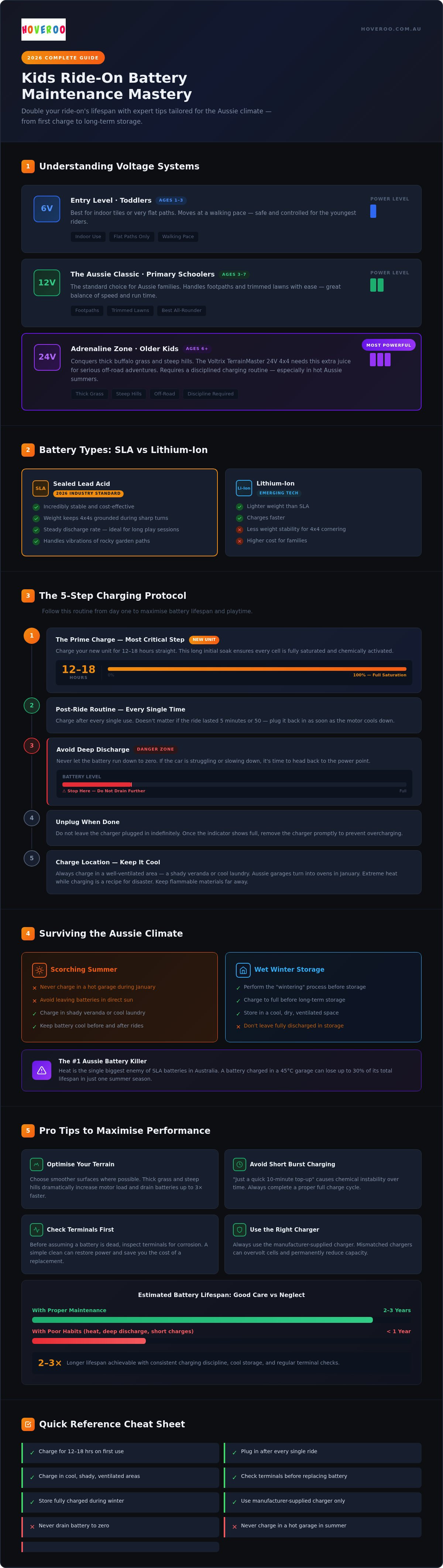
- 6V Systems: Ideal for the youngest riders. These are best for indoor tiles or very flat paths. They move at a walking pace, keeping things safe and controlled.
- 12V Systems: The classic Aussie standard. These handle the footpath and trimmed lawns with ease. They offer a great balance of speed and run time for primary schoolers.
- 24V Systems: This is where the real adrenaline lives. Machines like the Voltrix TerrainMaster 24V 4x4 need this extra juice to conquer thick grass and steep hills.
The Difference Between Lead-Acid and Lithium-Ion
Most ride ons in 2026 still rely on Sealed Lead Acid (SLA) batteries. They are incredibly stable and cost effective for families. While Lithium Ion is lighter and charges faster, SLA batteries provide the necessary weight to keep a 4x4 grounded during sharp turns. They offer a steady discharge rate that is perfect for long, predictable play sessions. Sealed Lead Acid batteries are the industry standard for safety and stability in 2026. They are tough enough to handle the vibrations of a rocky garden path without failing.
Why Voltage Matters for Aussie Backyards
Voltage is all about the "fun factor" and raw capability. A 24V system isn't just about a higher top speed; it is about the power to weight ratio. Australian backyards often feature thick buffalo grass or slight inclines that can bog down a 12V motor. High voltage systems like those in the Voltrix TerrainMaster push through these obstacles without stalling. More power means more heat, though. Our scorching summers mean these high performance batteries require a disciplined charging routine. If you want that "just out of the box" power every single time, you must keep the battery cool and topped up correctly.
Mastering the Charge: The Golden Rules for Battery Longevity
You've just unboxed a brand new Thunderbolt Electric Dirt Bike. The kids are jumping for joy and you're ready to see them fly across the lawn. Stop right there! Before that first ripper session, you must perform a "prime" charge. This isn't just a suggestion; it's the most important moment in your battery's life. Priming chemically activates the cells and sets the baseline for future capacity. Skipping this or rushing into a ride with a half-full battery can permanently stunt the performance of your machine. Proper kids electric car battery maintenance begins before the motor even turns over.
Avoid the temptation of "just a quick ten-minute top-up" to keep the fun going. These short, irregular bursts can lead to chemical instability over time. While modern batteries are designed to be resilient, they still thrive on a consistent rhythm. Always charge in a well-ventilated area like a shady veranda or a cool laundry. Aussie garages can turn into ovens during January, and charging a battery in extreme heat is a recipe for disaster. Keep it cool, keep it safe, and keep those flammable materials far away from your charging station.
The 5-Step Charging Protocol for New Parents
- Step 1: The First Charge. Plug your new unit in for 12 to 18 hours straight. This long, initial soak ensures every cell is fully saturated and ready for action.
- Step 2: Post-Ride Routine. Charge the battery after every single use. It doesn't matter if the ride lasted five minutes or fifty; plug it back in as soon as the motor cools down.
- Step 3: Avoiding the "Deep Discharge." Never let the battery run down to zero. If you notice the car struggling or slowing down, it's time to head back to the power point.
- Step 4: Unplugging. Once the battery is full, pull the plug. Leaving a charger connected for weeks on end can degrade the internal components and shorten the battery's lifespan.
- Step 5: The Cooling Period. Wait about 30 minutes after a ride before plugging the charger in. This allows the internal chemistry to stabilise after the heat of a high-speed adventure.
Signs You Are Overcharging (and How to Stop It)
Keep a close eye on your gear during the charging process. If the battery feels excessively hot to the touch or you detect a strange "rotten egg" smell, disconnect it immediately. That scent is sulphuric acid reacting to internal heat, and it's a major red flag. Modern smart chargers help, but they aren't foolproof. Always use the Hoveroo-supplied cable to ensure the voltage and amperage are a perfect match for your specific model. Overcharging is the #1 cause of battery swelling in Australian homes. If you're looking for a ride that's built to last through every backyard mission, explore our range of high-performance 24V ride ons today.
Storing Your Ride-On in the Australian Climate
The Aussie sun is legendary for a reason, but it's also the primary enemy of your battery. Extreme heat doesn't just make the backyard uncomfortable; it actually cooks the internal chemistry of your ride-on. High temperatures accelerate the chemical breakdown inside the cells, leading to a permanent loss of capacity. If you leave your Thunderbolt or Voltrix TerrainMaster baking in a tin shed during a 40-degree January afternoon, you're effectively shortening its life by months. Effective kids electric car battery maintenance means thinking ahead and finding a spot that stays cool when the mercury rises.
Storing your ride-on directly on a bare concrete garage floor is another rookie mistake. In many parts of Australia, humidity can rise through the slab, creating a damp microclimate that invites terminal corrosion. This moisture, combined with the natural temperature swings of the floor, can cause the battery to discharge faster than it would on a wooden pallet or a shelf. Always aim to keep the vehicle off the ground if you're planning a long break from the action. Disconnecting the battery leads is the final step for total security. Even when the car is "off," small components like dashboard lights or remote-control receivers can create a parasitic drain that slowly kills the charge.
Beating the Heat: Summer Maintenance Tips
Never plug your charger in immediately after a heavy session in the blazing sun. The battery is already hot from discharging, and adding charging heat on top can lead to swelling. Let the machine rest in a shaded, well-ventilated area for at least 30 to 60 minutes. Your goal is the "Goldilocks" zone: a storage spot that isn't a freezer but doesn't feel like an oven. If you live near the coast, salt air is a silent killer for battery terminals. A tiny dab of petroleum jelly on the metal connectors can provide a protective barrier against the salty breeze, keeping your connections crisp and conductive.
Long-Term Storage: The 30-Day Rule
If the kids aren't riding for a month or more, you need a "wintering" plan. Batteries are like muscles; they atrophy if they aren't used. Follow the 30-day rule: even if the N7 Pro Drift Car hasn't moved an inch, give it a full top-up charge every three to four weeks. This prevents the voltage from dropping into the "danger zone" where the battery might never recover. Before you head off on your own holiday, follow this quick prep list:
- Give the battery a final 12-hour charge.
- Locate the red terminal lead and pull it off the battery post.
- Tuck the cable away so it cannot accidentally touch the terminal.
- Cover the vehicle with a breathable sheet to keep dust out of the charging port.
By taking these small steps, you ensure that when the holidays are over, your gear is ready to rip the moment the kids hit the "start" button. Consistent kids electric car battery maintenance is the secret to avoiding that "flat battery" disappointment on the first sunny day of spring.
Troubleshooting Common Battery Issues: Is It Dead or Just Tired?
Nothing kills the vibe faster than a Voltrix TerrainMaster that won't budge. But before you assume the worst, let's look at the basics of kids electric car battery maintenance. Often, the issue isn't a dead battery; it's a simple connection problem or a tired charger. Have you noticed a white, crusty powder on the metal bits? That's terminal corrosion. It blocks the flow of power, leaving your little rider stranded. The classic Aussie fix is a mix of bicarbonate soda and warm water. Scrub it on with an old toothbrush, wipe it dry, and you're back in business! It is a quick, five-minute job that can save you a lot of stress.
The "Short Run-Time" mystery is another common headache. If the car dies after only five minutes, you're likely dealing with a "surface charge." The battery looks full on the charger, but it lacks the depth to sustain a real ride. This usually happens when the battery has been left flat for too long, causing the internal plates to harden. Grab a multimeter from the shed. It is a two-minute job for any DIY parent. A healthy 12V battery should read between 12.6V and 13.0V when fully charged. If yours is sitting below 10.5V after a night on the plug, the cells are likely cooked and ready for retirement.
Visual Inspection: What to Look For
Rough off-road sessions in the TerrainMaster can shake things loose. Pop the seat and check for any wires that have jiggled free from their clips. If the battery looks like it is "swollen" or bulging at the sides, stop using it immediately. That is a sign of internal damage from extreme Aussie heat or overcharging. It is the point of no return for that unit. Also, give the charging ports a quick wipe with a dry, clean cloth. Dust and grit from the backyard can prevent the charger from making a solid connection, leading to a half-baked charge.
The Fuse Factor: The A$2 Fix
Check the thermal fuse before you go buying a whole new power system. It is usually a small black or clear box tucked near the battery terminals. If the kids have been pushing the car too hard up a steep hill or through thick buffalo grass, the fuse might "pop" to protect the motor. It is a brilliant safety feature, not a product failure! Replacing it costs about A$2 at a local hardware store and takes seconds. If you've tried the fuse and the bicarb scrub but still have no luck, it is time to contact the experts for advice. Our team can help you figure out if you need a fresh power source or just a new charger to get the adventure back on track. Ready to upgrade your gear for the next big mission? Browse our high-performance replacement parts to keep those wheels spinning.
Maximising Performance: Pro Tips for Every Hoveroo Adventure
Want to squeeze every last drop of adrenaline out of your Hoveroo gear? It is not just about what happens at the power point. High-performance kids electric car battery maintenance involves looking at the whole rig from the tyres up. If your machine is fighting against stiff axles or soft tyres, the motor has to work twice as hard. That extra grunt comes directly from your battery's reserves, cutting your ripper backyard session short. By keeping the mechanical side of things slick, you ensure every amp of power goes toward speed and fun rather than overcoming friction.
Weight management is another big factor for Aussie parents to watch. We know it is tempting to let "just one more mate" hop on the back of the Voltrix TerrainMaster for a ride around the yard. But exceeding the rated weight limit puts massive strain on the electrical system. This causes the battery to heat up and discharge much faster than intended. Stick to the limits to keep the "heart" of your machine beating strong for years. If you're ready to level up your knowledge on keeping your fleet in top shape, check out our Ultimate Guide to Kids Electric Vehicles for more expert care tips.
Reducing Friction to Save Power
Friction is the silent enemy of battery life. Check your wheel alignment regularly to make sure the car isn't "scrubbing" against the ground as it moves. For models with pneumatic tyres, keeping the pressure at the recommended level is vital; soft tyres create a huge amount of drag. A single drop of multi-purpose oil on the axles and moving joints can actually add up to 10 minutes of extra playtime to your session! It is a tiny task that pays off in big smiles. Keep the chassis clean of mud and debris after an off-road mission to prevent gunk from slowing down the wheels.
Choosing the Right Terrain for the Right Toy
Where your kids ride matters just as much as how they ride. The Thunderbolt Electric Dirt Bike is a total beast on packed dirt, but trying to power through soft sand or long, thick buffalo grass will drain the juice in record time. Teach your little legends to manage their "boost" or high-speed settings. Using the lower speed mode for cruising and saving the high-speed bursts for the flat straights is a great way to conserve energy. For those with larger properties or rugged Aussie yards, our 24V systems offer the necessary torque to handle tougher terrain without crying for the charger every few minutes. Smart terrain management is the final piece of the kids electric car battery maintenance puzzle!
Fuel the Fun for Years to Come
Mastering kids electric car battery maintenance is your ultimate ticket to years of stress-free backyard fun. You now have the expert secrets to double your battery's life and keep those wheels spinning at full speed. Remember to nail that initial prime charge and always store your gear away from the scorching Aussie sun. A simple bicarb scrub or a drop of oil can save you from costly replacements and keep the excitement alive.
Ready to upgrade your fleet? Hoveroo is Australia's leading specialist in kids electric mobility. We build our gear specifically for the rugged Aussie backyard. Our 2026 range features advanced safety and battery tech designed to handle our unique conditions with ease. Don't let a flat battery stall the discovery! Keep the adventure going with Hoveroo’s high-performance ride-ons! Your next great outdoor memory is just one charge away. Get out there and rip it!
Common Questions About Your Kid's Ride-On Battery
How long does a kids electric car battery typically last before needing replacement?
A kids electric car battery typically lasts between one and three years depending on how well you stick to your kids electric car battery maintenance routine. Batteries are consumable items that naturally degrade over time. If you follow the priming and storage rules we discussed, you'll likely hit that three-year mark. However, neglecting them during the off-season can see them fail in just six months. Consistent charging is the key to longevity!
Can I overcharge my kids ride-on car battery if I leave it overnight?
Yes, you can definitely overcharge a battery by leaving it plugged in for days on end. Most standard chargers don't have an automatic cut-off feature. Leaving it overnight is usually fine, but forgetting it for a week can lead to cooking the internal cells. This causes the battery to swell and lose its ability to hold a charge. Always set a timer on your phone to remind you to unplug!
Why does my kids electric car lose power so quickly on grass?
Your ride-on loses power on grass because of the massive increase in rolling resistance. Thick Aussie buffalo grass acts like a brake, forcing the motor to pull significantly more current from the battery. This high discharge rate drains the juice much faster than riding on a flat concrete driveway. If your backyard is mostly lawn, a 24V system like the Voltrix TerrainMaster is a much better choice for maintaining speed.
How often should I charge the battery if the car isn’t being used?
You should give the battery a full top-up charge every three to four weeks if the car is sitting idle. Even when not in use, lead-acid batteries naturally self-discharge over time. If the voltage drops too low, the battery might enter a deep discharge state from which it can't recover. A quick monthly charge ensures the chemistry stays active and ready for the next spontaneous backyard adventure!
Is it safe to leave the battery in the car during a hot Australian summer?
It is definitely not safe to leave the battery in a car that is baking in the direct sun or a tin shed. High temperatures are the number one killer of battery life in Australia. If the car must stay outside, try to remove the battery and keep it in a cool, dry laundry or pantry. Keeping the temperature stable prevents the internal plates from warping and ensures a reliable start every time.
What should I do if the battery terminals look white and crusty?
If you spot white, crusty buildup, you need to clean it immediately to restore a solid electrical connection. This corrosion acts as an insulator, stopping the power from reaching the motor. While we mentioned the bicarb fix earlier, you can prevent this by applying a tiny smear of petroleum jelly to the clean terminals. This blocks moisture and salt air from reacting with the metal, keeping your kids electric car battery maintenance simple and effective.
Can I upgrade a 12V ride-on car to a 24V battery for more speed?
No, you shouldn't just swap a 12V battery for a 24V one without upgrading the rest of the car. The higher voltage will almost certainly fry the 12V motor, the speed controller, and the wiring harness. It is a major fire risk! If you want more speed and power for rugged terrain, it is much safer and more cost-effective to buy a dedicated 24V machine like the Thunderbolt Electric Dirt Bike.
How do I know if the charger is broken or the battery is dead?
You can identify a faulty charger by checking the indicator lights or using a multimeter to test the output. If the charger light stays green even when the battery is flat, the charger might be the culprit. Conversely, if your multimeter shows the charger is pushing out the correct voltage but the battery won't hold it, the battery has likely reached the end of its life. Testing both components saves you from buying parts you don't need!