
Toys That Promote Gross Motor Skills: Active Play Ideas for Kids
What if the best way to get your child moving isn’t one perfect toy, but a mix of playful ways to run, balance, steer and climb? The right toys that promote gross motor skills invite big, whole-body movements while keeping play fun and suited to your child.
It helps to look beyond a toy’s label. Gross motor skills are the everyday movements children use to jump, kick, pedal, balance and move around. With room to try, wobble and practise, children can build confidence at their own pace.
In this guide, you’ll find active ideas for different ages, interests and play spaces, from ball games and simple obstacle courses to ride-ons such as wiggle cars. Each invites a different kind of movement, so you can mix powered rides with running, climbing and other self-propelled play.
You’ll also find practical ways to make play comfortable and safer, including choosing a clear space, supervising wheeled activities and using a helmet where appropriate. Let’s find a play mix your family will be excited to try!
Key Takeaways
- Match play ideas to the movement your child wants to practise, from climbing and balancing to throwing, pushing or riding.
- Compare toys that promote gross motor skills by considering your child’s participation, the space you have and the supervision each activity needs.
- Before play, prepare a clear area, set simple boundaries and follow the toy’s instructions and age guidance.
- For ride-ons, check the maximum rider weight and choose an option that suits your child and play space.
- See how the Hoveroo 5 in 1 Rocking Horse and Zippy Electric Wiggle Car can add different kinds of movement to a broader mix of active play.
What are gross motor skills, and how does active play help?
Gross motor skills use large muscles for whole-body movement. They’re at work when your child walks across the yard, jumps over a line, climbs playground steps or throws a ball. Play gives children room to try these movements in different ways and at their own pace. For a broader overview, see What are gross motor skills?
Toys that promote gross motor skills can invite children to move, balance and practise steering or throwing as part of an enjoyable game. A toy doesn’t guarantee a particular developmental outcome, and it doesn’t need to. The aim is active, age-appropriate play that feels fun for your child, whether that means a lively outdoor game or careful steps around a simple obstacle.
Which everyday movements count as gross motor skills?
Think about the different actions children use during play. One activity can bring several movement patterns together:
- Travelling: walking, running, jumping or stepping over a suitable obstacle.
- Balance: standing on one foot, walking along a clear path or adjusting posture while moving.
- Coordination: throwing and catching a ball, kicking towards a target or steering around open space.
- Strength-related movement: climbing, pushing a toy or pulling it along.
For example, a child steering around open space may move forward, change direction and adjust their balance in one activity. Notice what your child chooses to repeat. That can help you find play ideas they’re keen to try again.
Why does active play matter for children?
Active play makes movement part of a game, rather than a task to get right. Your child can explore what feels comfortable, pause when they need to and have another go when they’re ready. A ball can become a throwing game; a clear outdoor area can become a route to walk, run or steer around.
Play with siblings or friends can also bring conversation, turn-taking and shared laughter into the mix. Some children enjoy joining in straight away; others prefer to watch before taking a turn. Both approaches can be part of relaxed play.
Children develop at different paces, so there’s no need to compare their movements with someone else’s. Choose activities that suit your child today, keep the focus on enjoyment and let their interests guide what comes next!
Gross motor toys by movement: from balancing to riding
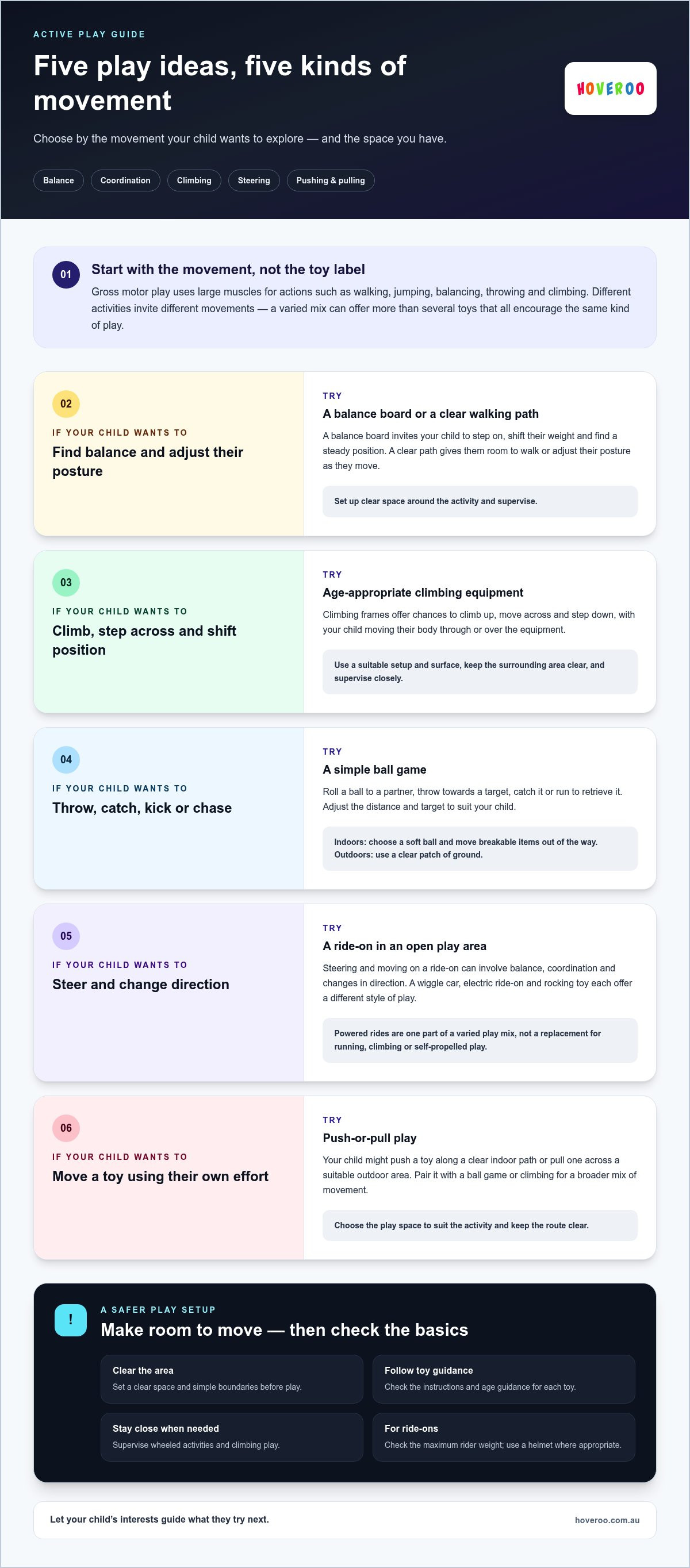
Choose play by the movements your child can explore, not just by toy type. Some activities invite careful steps and balance; others bring in throwing, climbing, pushing or steering. Mix options indoors or outside, depending on your space, your child’s interests and the supervision needed.
Which toys encourage balance, climbing and coordination?
Balance boards invite children to step on, shift their weight and find a steady position. Climbing frames and other age-appropriate equipment offer chances to climb up, move across and step down. Set them up on a suitable surface with clear space around them, and stay close to supervise.
Balls bring a different kind of action. Children can roll one to a partner, throw it towards a target, catch it or run to retrieve it. For indoor play, choose a soft ball and move breakable items out of the way. Outdoors, a clear patch of ground gives children more room to chase and throw. Adjust the distance and target to suit your child, and keep the setup simple.
Can ride-on toys be part of gross motor play?
Yes. Steering and moving on a ride-on can involve balance, coordination and changes in direction. Powered rides offer a different experience from activities where children run, climb or propel themselves, so they work best as one part of a varied play mix, not a replacement for it.
The options aren’t interchangeable. A wiggle car invites a different style of play from an electric ride-on; a rocking toy keeps movement in one spot, while a ride-on moves through a play area. For example, the Hoveroo 5 in 1 Rocking Horse and Zippy Electric Wiggle Car offer distinct ways to play. Follow each toy’s instructions and age guidance, and supervise children as they play.
Push-or-pull toys add another choice. A child might push a toy along a clear indoor path or pull one across a suitable outdoor area, practising movement through play. You can pair these activities with ball games or climbing, making room for both child-powered movement and ride-on play.
For ideas on choosing a ride-on for outdoor adventures, read this guide to off-road ride-on cars. Explore children’s ride-on toys as one possible part of your family’s broader mix of active play.
How to compare gross motor toys for your child and play space
The best fit depends on what your child enjoys, how they take part and where they’ll play. Use this comparison to weigh up the movement each activity invites, the space it needs and how closely you’ll need to supervise. No one type suits every family, and a varied mix can be more useful than several toys that all invite the same kind of play.
| Play type | Movement invited | Child’s participation | Space and supervision |
|---|---|---|---|
| Climbing | Climbing up, stepping across and shifting position | Moves their body through or over the equipment | Needs a suitable setup and clear space; supervise closely during use |
| Ball play | Rolling, throwing, catching, kicking and moving towards a target | Propels the ball and follows its path | Can suit a clear indoor area with a soft ball or an open outdoor space; keep play clear of obstacles |
| Self-propelled toys | Pushing, pulling or moving along through the child’s own effort | Provides the movement themselves | Choose a clear route and stay nearby, especially if other people share the play area |
| Powered ride-ons | Steering and moving through the play area | Guides the ride-on rather than powering every movement themselves | Needs room to move, a suitable surface and active adult supervision |
Which movement and play setting should you consider?
Start with the space you have. A ball game or simple pushing activity may fit a clear indoor area, while climbing or riding may call for a suitable outdoor spot. Think about the surface, nearby obstacles and room to turn. Self-propelled play asks your child to create the movement; powered riding offers a different experience, so it can sit alongside, rather than replace, running, climbing and child-powered activities.
Your child’s interests count, too. If they love chasing a ball, make room for that. If steering or pushing sparks their curiosity, build from there. Enjoyment can make it easier to return to an activity, without needing a large collection of toys that promote gross motor skills.
How do you choose an age-appropriate activity?
Check the specific product’s age guidance and, for a ride-on, its maximum rider weight. Consider whether your child seems comfortable with the activity, can follow simple instructions and needs you close by. Match your supervision to the play and the setting. For more age-focused context, read the guide to safer ride-ons for two-year-olds.
Pick an activity your child is keen to try, prepare the space and see how it feels in practice. A small, thoughtful mix can bring plenty of movement to play. Explore children’s ride-on toys as one option among many.
How to make gross motor play enjoyable and safer
A little preparation helps play feel relaxed and ready for action. Choose an activity that suits your child, set up the space, explain a few simple boundaries, then stay close and supervise. Keep the focus on having a go, not getting every movement right. That makes it easier for your child to explore at a comfortable pace.
What should you check before active play starts?
- Choose the activity: Think about your child’s comfort and experience, and select play that suits them.
- Prepare the space: Clear away obstacles and choose a surface suited to the activity and product. Leave room to move and turn.
- Check the equipment: Look for visible damage and follow the maker’s setup, use and care instructions.
- Set boundaries: Explain where play can happen and what to avoid in simple, child-friendly language.
- Stay nearby: Supervise in a way that suits your child, the activity and the play space.
Before using a ride-on, read its instructions and age guidance, and check its maximum rider weight. These details vary by product, so use the information for the specific model rather than making assumptions.
What belongs on a ride-on parental peace of mind checklist?
A parental peace of mind checklist can help you prepare without turning play into a lecture. Check the product’s safety information, including any certification that applies to that specific model. Don’t assume a certification applies to every ride-on or hoverboard.
Next, make sure your child wears a properly fitted helmet and any protective equipment suited to the product and activity. Choose a clear area, supervise closely and explain simple boundaries before the ride begins. Make sure your child understands how to follow your instructions and when to stop. If they seem unsure, pause and revisit the setup together.
Keep checks calm and routine. A quick look at the play area, product and protective gear can help you feel ready while your child focuses on the fun. For related riding ideas, see this kids’ electric dirt bike guide.
Ready to explore ride-on play as one part of a varied activity mix? Explore Hoveroo ride-on options.
Where Hoveroo ride-ons fit in a varied gross motor play mix
Ride-ons can add another way for your child to move, explore and enjoy outdoor play. They’re one option among many, not a replacement for running, climbing, ball games or activities where children move themselves. A varied play mix lets your child try different kinds of movement and choose what feels fun.
Which Hoveroo play options can families explore?
The Hoveroo 5 in 1 Rocking Horse and Zippy Electric Wiggle Car offer distinct play experiences. One is a rocking toy; the other is a wheeled ride-on. Hoverboards, go-karts and ride-on vehicles are other categories in the Hoveroo range, each offering a different way to play. No toy develops a skill by itself, but a child may explore movement as they play with a suitable option.
Choose based on the experience your child enjoys and the space you have. Australian outdoor conditions and surfaces vary, so follow the specific product’s instructions for suitable places and conditions of use, along with its age guidance and maximum rider weight. Follow the maker’s care instructions to help look after the toy.
How can you keep active play varied?
Mix ride-on time with child-led movement. Your family might alternate between riding, walking around the yard, running after a ball and making up a simple movement game. These activities invite different kinds of participation, from steering to moving under your own power. Toys that promote gross motor skills can be part of the mix, but you don’t need a toy for every activity.
Follow your child’s interests, keep play enjoyable and choose activities that suit their age and comfort. Some days they may want to ride; on others, a ball game or a lively run around may be the favourite. Let their enthusiasm guide the next move!
Ready to explore a ride-on as one part of your family’s active play mix? Browse Hoveroo’s range, and read the safety information for the specific product you choose.
Make active play part of your family’s routine
Gross motor play can be as simple as walking, climbing, chasing a ball or steering a ride-on. The best toys that promote gross motor skills invite movement your child enjoys, suit your available space and leave room for different kinds of play. A ride-on can add variety, but it doesn’t replace running, climbing or moving under your own power.
Choose activities your child is keen to try, keep them age-appropriate and follow the product’s instructions and safety guidance. For hoverboards, check model-specific information, including whether UL 2272 certification applies to that model. Hoveroo supports Australian families, with more than 50,000 happy families in its community.
Ready to find a ride-on that could fit your family’s active play mix? Explore Hoveroo ride-on toys for active play!
Keep it fun, follow your child’s curiosity and enjoy every new reason to get moving together!
Frequently Asked Questions
What are gross motor skills in children?
Gross motor skills are movements that use large muscles for whole-body actions. Walking, running, jumping, balancing, climbing, pushing and throwing are everyday examples. Children may use several movements together during one game, such as stepping over an obstacle while keeping their balance. These skills emerge at different paces, so follow your child’s interests and offer enjoyable chances to move without comparing them with others.
Which toys help develop gross motor skills?
Climbing equipment, balance boards, balls, push-or-pull toys and ride-ons can all invite different types of movement. A ball can prompt rolling, throwing or chasing; climbing equipment invites children to move up and across. Toys that promote gross motor skills don’t guarantee a particular outcome. Choose options that suit your child, the available play space and the movement they enjoy, then follow the product’s age guidance and instructions.
Can ride-on toys promote gross motor skills?
Ride-on toys can invite children to move, steer and adjust their balance as they play. The experience varies by toy: a child-powered wiggle car involves a different kind of participation from an electric ride-on. Treat rides as one part of active play, alongside running, climbing, ball games and other self-propelled movement. Check the specific product’s age guidance, maximum rider weight and instructions before use.
Are gross motor toys suitable for toddlers?
Some movement toys may suit toddlers, but suitability depends on the child and the specific product. Read the age guidance and instructions, and consider whether your toddler is comfortable with the activity and can follow simple directions. For ride-ons, check the maximum rider weight too. Stay close and supervise, especially as your child gets used to a new toy or play space. Keep the activity relaxed and enjoyable.
How can I encourage gross motor play at home?
Make a clear space and suggest a simple activity your child can enjoy, such as rolling a soft ball, walking around cushions or pushing a toy along an open path. Outdoors, you could try a ball game or a supervised ride-on activity. Follow your child’s lead, keep boundaries clear and switch activities if interest fades. You don’t need a large toy collection; everyday movement and child-led play count too.
Do electric ride-on toys count as active play?
Yes, electric ride-ons can be part of active play because children steer and move through a play area. They involve a different level of physical participation from running, climbing or propelling a toy themselves, so they’re best included in a varied mix. Pair ride-on time with child-powered games, such as walking to collect a ball or running around a clear outdoor space. Supervise and follow the product instructions.
What safety checks should I make before a child uses a ride-on toy?
Before a ride, read the instructions and age guidance, check the maximum rider weight, and look over the toy and play area. Choose a clear surface suited to the product, fit your child’s helmet properly, and use protective equipment appropriate to the activity. Explain where they can ride and when to stop, then supervise closely. Check safety information for the specific model, including any certification that applies to it.