
5 in 1 rocking horse for baby development: choosing the right fit
A first ride-on doesn’t have to travel far to feel like a big adventure! Most rocking horses are suitable from 12 months, and a 5 in 1 rocking horse for baby development can offer a gentle way to practise balance, coordination and movement through play. Your child’s ability to sit securely and enjoy the motion matters as much as their age.
It makes sense to weigh up more than the fun factor: you want a design that suits your child and your space, with safety in mind. This guide explains what to look for in size and design, how rocking play compares with other ride-on toys, and what customer experiences can reveal. You’ll have a clearer picture of when a rocking horse may fit your child’s stage, and which features help make play feel comfortable and manageable.
Key Takeaways
- Look for signs your child can sit securely and is comfortable with gentle movement when deciding whether a rocking horse suits them.
- Use the toy’s measurements and weight limit to judge how it will fit your child and your play space.
- Customer feedback can reveal practical details, including how a toy behaves when used in different modes.
- Compare the kind of movement each ride-on encourages to find a play style that best suits your child’s interests.
Balance, coordination and motor skills
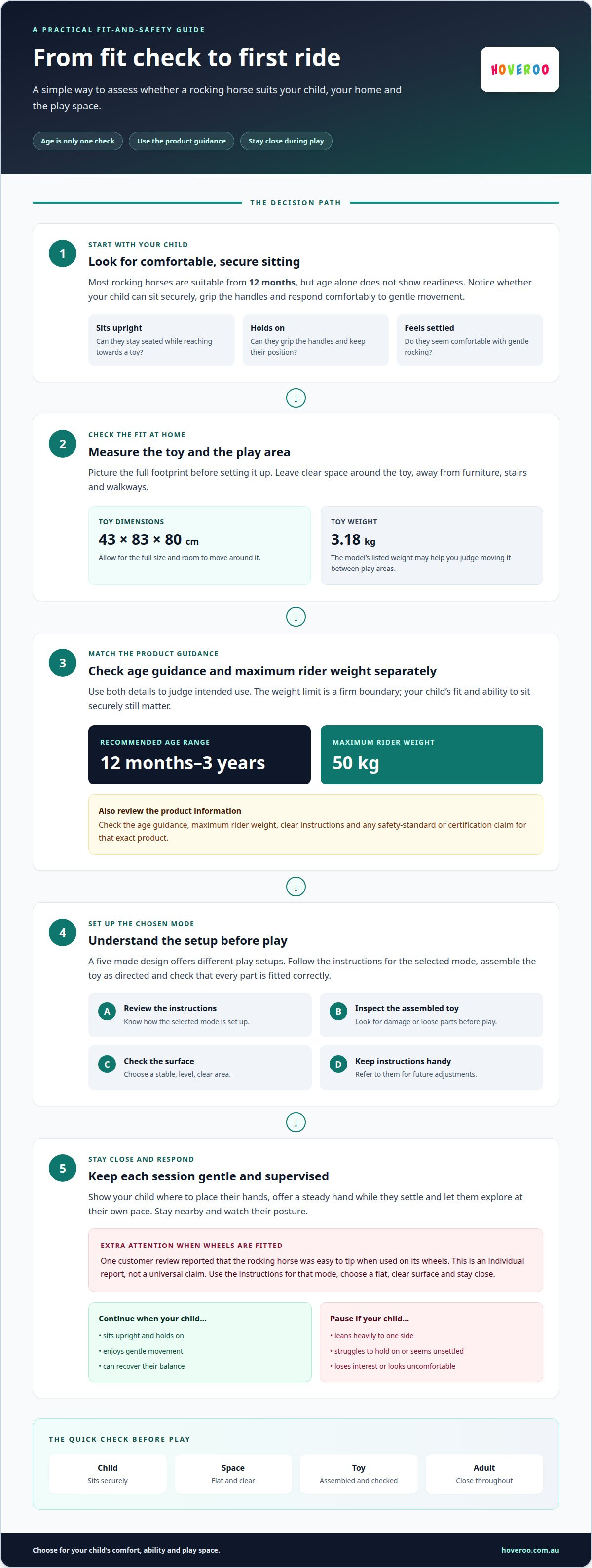
Most rocking horses are suitable for children from 12 months, but age alone doesn’t show readiness. Notice how your child sits, reaches and responds to gentle movement. For example, can they stay seated while reaching towards a toy, then return to an upright position? These everyday movements give you useful clues about whether rocking play matches their current abilities.
Rocking creates a simple movement pattern: your child shifts their weight, steadies their body and holds on as the horse moves. That gives them a chance to practise balance and coordination through play. Their hands grip the handles, their legs help them stay positioned, and their body adjusts with each forward-and-back motion. The 5 in 1 rocking horse for baby development may offer varied ways to play, but it doesn’t guarantee a particular developmental result.
Introduce the toy calmly. Sit your child on the horse, show them where to place their hands, then let them explore the movement at their own pace. Stay close and watch their posture. If they lean heavily to one side, struggle to hold on or seem unsettled by the rocking, pause and try again another time. A familiar toy or your hand nearby can help them feel more at ease.
Keep the play simple and responsive:
- Offer a steady hand while your child settles into the seat.
- Invite them to rock gently, rather than pushing them quickly.
- Notice whether they can grip, sit upright and recover their balance.
- Stop the activity when they lose interest or look uncomfortable.
These observations help you match the activity to your child, not just their age. A child who enjoys gentle movement may find rocking inviting; one who prefers standing or walking may engage more with another play style. Keep an adult nearby during riding, and make each session a chance to notice what your child can do comfortably today.
Choosing a suitable size and design
For Australian parents, key safety checks include the toy’s age guidance, maximum rider weight, clear instructions and any safety-standard or certification claim for that exact product. Check that the assembled toy sits securely on the intended surface and has no visible damage or loose parts before play.
Use the listed measurements to picture the toy in your home. This rocking horse measures 43 × 83 × 80 centimetres, so allow room for its full footprint and for movement around it. Measure the play area before setting it up. A clear space away from furniture, stairs and walkways makes it easier to supervise and reduces interruptions during play.
The model weighs 3.18 kilograms, which may make it easier for an adult to move between play areas. Its maximum rider weight is 50 kilograms, while its recommended age range is 12 months to 3 years. Treat both details as separate checks: age guidance helps you judge intended use, and the weight limit sets a firm boundary. A child’s fit and ability to sit securely still matter.
Consider the design as well as the dimensions. A five-mode toy offers different play setups, so think about whether changing modes suits your household and whether each configuration has clear instructions. Assemble the toy as directed and check that every part is fitted correctly before your child rides. Keep the instructions handy for future adjustments.
- Measure the space: allow for the 43 × 83 centimetre floor footprint.
- Compare limits: match the child’s age and weight to the product guidance.
- Review the design: understand how each mode is set up before use.
- Inspect before play: check the assembled toy and surrounding area.
These checks help you choose a design that fits your child and your home. In a compact play space, the toy’s footprint may matter most. For a growing toddler, focus on the age guidance and maximum rider weight. Choose for the child who will use it now, rather than choosing based on the number of modes alone.
Customer experiences with the rocking horse
One customer review reported that the rocking horse was easy to tip when used on its wheels. This highlights why each mode needs its own setup and supervision. A wheeled configuration moves differently from a stationary rocking base, so use the toy on a flat, clear surface and stay close while your child plays.
How should you supervise a baby? Stay within arm’s reach, place the toy on a stable surface and watch your child throughout play. Follow the instructions for the selected mode, and stop if the toy shifts or your child becomes unsettled.
A child may fall if they lean too far, lose their grip or use a wheeled mode on an uneven surface. The toy may also be unsuitable if your child can’t sit securely or is outside its intended age or weight guidance. Keep rocking play on level ground, away from steps, furniture edges and busy walkways.
Customer feedback is most useful when you distinguish an individual experience from a universal claim. One report of tipping on wheels doesn’t show that every rocking horse will behave the same way. It does raise a practical question: how does the toy move in each mode, and does your play area suit that movement?
Before each session, use a quick routine:
- Set the toy up according to its instructions for the chosen mode.
- Check the floor for slopes, obstacles or objects that could catch a wheel.
- Help your child sit in the intended position and hold the handles.
- Stay close, especially when wheels are fitted or the mode changes.
- Pause play if the toy rocks unexpectedly or begins to tip.
Turn a customer’s specific warning into a practical safety check. A review can flag what to watch for, while observing your child at home shows how they interact with the toy. Stay close, use the intended configuration and include the play area in your safety routine.
Rocking horses compared with other ride-on toys
A rocking horse keeps play in one spot, while wheeled ride-ons move across the floor or outdoors. That difference shapes the movement your child practises. Rocking involves shifting weight in a steady back-and-forth rhythm; a wiggle car asks a child to steer and propel it. Neither style is automatically better. Choose the movement that suits your child’s interests and current abilities.
Compare how each toy moves. A traditional rocker moves as your child rocks, making it suited to pretend journeys without travelling far. A push-along ride-on introduces forward movement and steering, while a powered ride-on adds controls that need adult oversight. On a balance bike, a child walks or glides with their feet. The label “ride-on” alone doesn’t tell you how a toy feels to use.
For younger children, a stationary rocking setup may be easier to supervise in a familiar play area. A wheeled toy needs clear space to move, while a powered model has different operating considerations. Match the toy to the setting: a lounge-room rocker differs from an outdoor ride-on used on open ground. Follow the instructions and stay nearby during play, whatever the style.
A five-mode design offers more than one way to use the same toy, but the number of modes doesn’t determine whether it’s a good fit. Consider how each configuration moves, where it can be used and whether your child can manage it comfortably. Prioritise the play experience over the feature count.
- Choose rocking for contained, back-and-forth play.
- Choose wheels when steering and travelling are the main appeal.
- Choose powered movement only when adult supervision suits the controls.
- Compare modes by setup, movement and play space, not quantity alone.
The key takeaway is to choose based on movement and setting, not the broad ride-on category. A rocking horse suits a child drawn to gentle, stationary motion; a wheeled or powered toy supports different play goals. Choose one your child can use comfortably, with space for safe, supervised play.
Hoveroo: Hoveroo 5 in 1 Rocking Horse
Hoveroo 5 in 1 Rocking Horse gives your child a choice of play modes in one ride-on toy. Hoveroo recommends the rocking horse for children aged 12 months to 3 years. Changing between modes takes under 10 seconds, and assembly takes under 5 minutes without tools.
Use the age guidance alongside your child’s ability to sit securely and the toy’s instructions. The product comes with a 1-year Australian warranty. These practical details can help you decide whether its design suits your family’s play space and routine.
If you’d like to discuss the Hoveroo 5 in 1 Rocking Horse, contact Hoveroo.
Make your child’s next play choice with confidence
The best next step is to match the toy to the way your child enjoys moving today. If gentle, contained rocking appeals, consider whether a 5 in 1 rocking horse for baby development fits your family’s play space and routine. Keep your child’s comfort and supervised use at the centre of that decision.
As your child’s interests change, their preferred way to play may change too. Hoveroo also offers the Hoveroo Hoverboard, Off-Road Hoverboard and Thunderbolt Electric Dirt Bike for families exploring a different style of movement when their child is ready.
Want help deciding whether the rocking horse suits your child’s play needs? Contact Hoveroo for rocking horse advice. Choose a play experience that feels right for your child, then enjoy watching their next little adventure begin!
Frequently Asked Questions
How old should a child be for a rocking horse?
Many rocking horses are suitable from 12 months, but follow the age guidance for the specific model. For a first introduction, choose a calm moment and let your child explore the stationary toy before rocking begins. Stay close and keep the play area clear. A child’s comfort with the movement can help you decide whether to continue or try again another day.
What is a 5-in-1 rocking horse and what modes does it offer?
A 5-in-1 rocking horse is designed to convert between five modes, giving one toy different play configurations. The Hoveroo model can be changed between modes in under 10 seconds. Use the product’s instructions to understand the setup for each configuration and make sure the toy is assembled correctly before play. The practical difference is flexibility, rather than needing five separate toys.
What developmental skills can a 5-in-1 rocking horse support in babies and toddlers?
Rocking play gives babies and toddlers an opportunity to practise balance, coordination and body control. Holding the handles and responding to gentle rocking, for example, involves adjusting posture and grip. Pretend play can also encourage imagination and interaction with a parent. These are opportunities to practise, not guaranteed developmental outcomes. Keep play suited to your child’s comfort and abilities.
What age and weight limits apply to 5-in-1 rocking horses sold in Australia?
Limits vary by model, so use its stated age recommendation and maximum rider weight together. The Hoveroo 5 in 1 Rocking Horse is listed for ages 1 to 5, with a maximum rider weight of 50 kilograms. Those limits don’t replace supervision or correct setup. Stop play if your child can’t use the toy comfortably or it isn’t stable in the selected mode.
How does a 5-in-1 rocking horse compare with a standard rocker or ride-on toy?
A standard rocker offers one main rocking setup, while a 5-in-1 design converts between different configurations. A wheeled or electric ride-on is built for travelling, so it calls for a different play space and supervision. For electric ride-ons, children should wear a helmet and protective gear, with a responsible adult supervising. Use products in line with applicable national, state, territory and local laws.