
Compare electric 4x4 options for kids by safety and features
The biggest, fastest-looking 4x4 isn’t automatically the right pick. An electric ride-on can be a fun way for your child to explore outdoors, but the right choice depends on more than its rugged styling. The best electric 4x4 for adventurous kids is one that suits your child’s abilities, your available space and the kind of play you have in mind. A good match makes the first ride feel more manageable for everyone.
It’s natural to want the excitement of independent play and the reassurance of knowing what to look for. Product descriptions can make models seem similar, yet their layouts, controls and intended use can differ. Take a moment to think about how your child likes to play, where they’ll ride and how much hands-on support they need. Those priorities can help you focus on useful differences instead of choosing by appearance alone.
This guide compares electric ride-on cars, utes, buggies and quads, and explains how battery setup, motor configuration, remote controls, age guidance and rider weight limits affect your decision. You’ll also learn what to consider about riding surfaces and battery care. Use these points to shortlist a ride-on that suits your family and makes room for fun, confidence and supervised adventures.
Key Takeaways
- Match the ride-on to your child’s abilities, and use its age guidance and maximum rider weight as key selection points.
- Compare cars, utes, buggies and quads by where your child will ride, including the surface and available space.
- Look beyond battery voltage: consider the motor setup and how they suit the intended riding conditions.
- Assess safety features such as a parent remote, speed controls and battery protection before choosing a model.
- Plan for supervised rides and a helmet, then use the article’s checklist to compare options with confidence.
1. Are electric ride on cars safe for children?
An electric ride-on can support supervised outdoor play when its features suit your child and riding area. Start with the maker’s age guidance and maximum rider weight, then check the controls, tyres, battery protection and surface suitability. A 4x4 badge alone doesn’t establish how a vehicle handles grass, gravel or slopes.
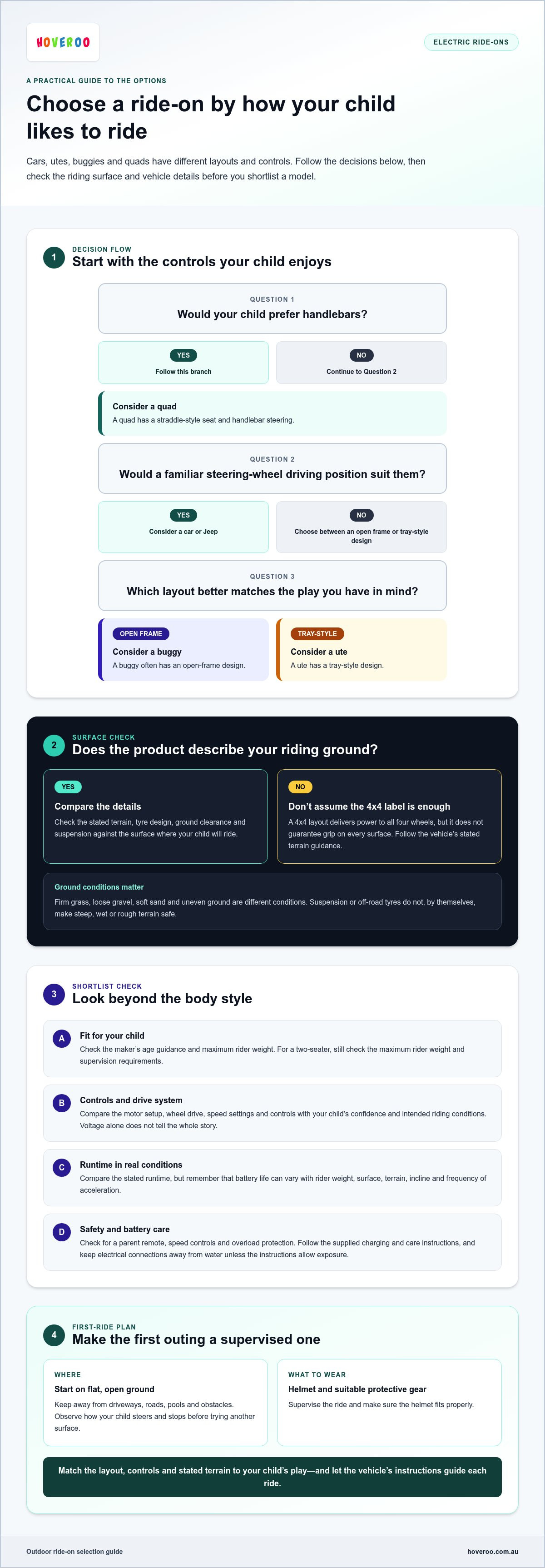
For off-road riding, match the terrain to the vehicle’s stated capabilities. Firm grass is different from loose gravel, soft sand or uneven ground. Start on a flat, open area, away from driveways, roads, pools and obstacles. Observe how your child steers and stops before moving to another surface. Supervise the ride and use a properly fitting helmet and suitable protective gear.
Four-wheel drive may help deliver power to more than one wheel, but it doesn’t guarantee grip on every surface. Tyre design, ground clearance, motor setup, rider weight and surface conditions all affect how a ride-on moves. Check the product description for its intended terrain. If it describes pavement or firm ground, treat that as the riding boundary rather than assuming the 4x4 label means bush-track capability.
Suspension can help a vehicle handle bumps, while off-road tyres may suit more varied ground than smooth, hard tyres. Neither feature makes steep, wet or rough terrain safe by itself. Check the tyre type and suspension details, then compare them with the ground where your child will ride. A flat backyard lawn, for example, calls for different capabilities from a rutted gravel area.
Battery protection matters on every ride. Overload protection helps prevent the battery from being drawn beyond its safe current limit. Check the specifications for this feature and follow the supplied charging and care instructions. Keep the battery and electrical connections away from water unless the product instructions explicitly allow exposure. Stop using the vehicle if you notice damage, unusual heat or a change in its operation.
Battery life can vary with the surface, rider load, terrain and frequency of acceleration. Grass or uneven ground may demand more from the battery than smooth, level ground. Plan rides around the conditions, and don’t treat a quoted runtime as a promise for every outing.
The Rigo off-road Jeep ride-on is one model to assess using the same practical checks, not a safety rating. Compare its stated terrain, tyre and suspension details, battery protection, rider limit and age guidance. Apply those checks to other off-road vehicles, too. A two-seater layout doesn’t remove the need to check maximum rider weight and supervision requirements.
2. Electric 4WD ride-on cars, utes, buggies and quads
Electric 4WD ride-ons come in several shapes, from SUV-style cars and Jeeps to utes, buggies and quad bikes. Choose the body style around your child’s play, available space and riding surface. A car or Jeep gives a familiar seated driving position, while a ute has a tray-style design. A buggy often has an open frame, and a quad uses a straddle-style seat and handlebar steering. Those differences affect how your child gets on, holds the controls and turns.
Which kids’ electric 4x4s have the best battery life, speed and off-road ability? Compare each model’s stated runtime, maximum speed and terrain guidance, then prioritise what matters most for your child’s rides. Battery life and speed can change with rider weight, ground conditions, incline and acceleration, so consider the conditions behind any listed figures.
When comparing ride-ons for Australian backyards, start with the ground. A vehicle suited to firm lawn may not suit loose gravel or sand. Check the product description for its intended surface, tyre design, clearance and suspension. An SUV or truck shape may look ready for adventure, but styling alone doesn’t establish off-road capability. A licensed design describes the vehicle’s appearance, not its power or terrain suitability.
In kids’ ride-on cars, 4WD means power is delivered to all four wheels. That layout may help the vehicle move across suitable surfaces, but it doesn’t guarantee traction everywhere. Read the model’s drive-system description alongside its motor and battery details. For example, compare a four-wheel-drive buggy with a two-wheel-drive car on the same surface and with the same rider load, rather than judging by body style alone.
Electric car power and performance are related, but voltage alone doesn’t tell the whole story. Motor setup, wheel drive, battery capacity, rider load and terrain all influence acceleration and handling. A larger-looking truck may weigh more than a compact Jeep, affecting the power needed to move it. Compare speed settings and controls with your child’s confidence, then plan early rides on level, open ground.
To compare Australian models, focus on the features that shape your child’s ride: seating, controls, drive system, intended surface and listed runtime. The right fit depends on where the vehicle will be used and how your child likes to play. These details give you a more practical comparison than choosing between SUVs, trucks, Jeeps and buggies by appearance alone.
Before choosing, list the features that matter most to your family. A child who prefers a familiar steering wheel, for example, may suit a car or Jeep, while one who enjoys handlebars may feel more comfortable on a quad. Consider storage space, turning room and your home’s riding surface, too. Compare suitable models against these everyday needs, and keep the vehicle’s instructions handy for its first outing.
3. Battery voltage and motor configurations
Check the voltage, battery capacity, motor setup, charging instructions and terrain guidance before choosing a kids’ electric 4x4. For maintenance, use the supplied charger, follow the maker’s charging directions and inspect the battery area and connections for visible damage before rides.
Ride-on electric cars typically use rechargeable batteries ranging from 6 to 24 volts. Voltage describes the battery’s electrical output, but it doesn’t tell you the full story about runtime or suitability. Battery capacity, motor demand, rider weight, speed and terrain all affect how long an electric ride lasts. A higher voltage may support a different drive setup, but it doesn’t automatically mean longer battery life.
For example, larger 24V 4WD ride-on toys may handle short, firm grass better than smaller 12V models. That comparison is specific to the stated terrain, not every lawn, slope or off-road surface. Check the model’s drive system and intended use alongside voltage. Two motors can distribute drive across wheels, while motor configuration and vehicle weight influence how much effort the battery supplies.
Charging time varies by battery and model. Many 12V ride-on toys need around 8 to 10 hours for a full charge, while some 24V ride-on toys may need around 12 to 14 hours. Use those figures as planning guidance, then follow the instructions supplied with your vehicle. Avoid guessing from another toy’s charging time. A replacement battery should match the original model’s required voltage, capacity, battery type and connections. Use the manufacturer’s replacement guidance rather than choosing by appearance.
Good battery care starts with the manual. Use the supplied charger, connect it as directed and charge the battery under the recommended conditions. Keep connectors clean and dry, and inspect cables for wear before charging. Overload protection helps prevent the battery from being drawn beyond its safe current limit, but it doesn’t replace correct charging and care.
Runtime depends on how the vehicle is used. Soft grass, uneven terrain, repeated acceleration and a heavier rider can draw more power than steady driving on flat ground. Plan outings with these conditions in mind rather than treating stated runtime as exact for every ride. Brand styling, such as a Mercedes- or Toyota-inspired body, doesn’t indicate battery performance. Compare the battery and motors, not just the shell.
For Australian family use, match the battery setup to your child’s usual riding surface and charging routine. A model used on firm backyard grass has different demands from one driven over varied terrain. Check the age and rider-weight guidance too, since load affects battery demand. Keep the charger and instructions together, and follow the model-specific steps each time.
For short, firm grass, larger 24V 4WD models may be better suited than smaller 12V models. Battery life and speed also depend on capacity, motor demand, rider weight and terrain, so voltage alone cannot identify the best all-round choice for the best electric 4x4 for adventurous kids.
4. Do 4WD ride-on toys come with parental remote control?
Some 4WD ride-on toys include a parent remote, but it isn’t a standard feature across every model. A parent remote is a handheld controller used by an adult to control the ride-on toy remotely. With parental remote override, an adult can intervene while a child is learning to steer or stop. Compare the controls described for each vehicle, rather than assuming every 4x4 has them.
Check what the remote actually controls. One model may let an adult guide movement, while another may offer different functions. Read the operating instructions before the first ride, identify each button and test the remote while the vehicle is stationary. Then practise in a flat, open area, with your child seated and an adult close by. This lets you learn how the remote responds before adding obstacles or uneven ground.
A remote is a backup, not a substitute for supervision. Keep your child in sight, stay close enough to step in and choose an open area away from driveways, roads, pools and other hazards. A remote’s range and response depend on its design and operating conditions. Don’t assume it will work through every barrier or across a large outdoor area. Follow the model’s instructions and stop the ride if you can’t maintain control.
For beach trips, keep the ride-on route away from the shoreline. Sand, salt and water can affect electrical parts, so don’t take the vehicle onto wet sand unless its instructions specifically allow that use. Depending on the model’s terrain guidance, a dry, firm area may be more suitable. After a beach visit, follow the care instructions before charging or storing the vehicle. A children’s ride-on is not transport for remote touring or a full-size off-road vehicle.
Use a short safety routine before each backyard session:
- Confirm the remote and vehicle are switched on as instructed.
- Check that steering, accelerator and stopping controls respond correctly.
- Set the ride in a clear area, then practise remote intervention at low speed.
- Keep the child supervised and wear a properly fitting helmet.
A dual-speed system can help adults match available speed settings to a beginner’s confidence. Pair it with a parental remote override where offered, and explain the controls before your child starts moving. Practise turning and stopping on level ground before using the ride-on in a larger space. Remote control, speed settings and supervision work together; none replaces the others.
Choose a model based on its actual features and your family’s usual riding space. A compact backyard calls for different planning from a wide, clear private area. Check the remote instructions, speed controls, maximum rider weight and suitable terrain together. This practical match helps you make the most of outdoor play while keeping adult supervision in place.
5. Age ranges and weight limits
Start with the age range and maximum rider weight listed for each ride-on car. These limits vary between models, even when two vehicles look similar. Age guidance helps you judge whether the controls and seat suit your child; the weight limit shows the maximum load the vehicle is designed to carry. Both matter, so don’t choose by age alone.
Before deciding, compare your child’s age with the model’s guidance, then check their weight against its maximum rider weight. Make sure they can sit comfortably, reach the steering wheel and use the controls without stretching. A child who can’t reach the pedals or hold the steering wheel securely may find driving difficult, even if their age fits the listing.
Seat space matters, too. Your child should be able to sit back and keep their feet in the intended position. For a two-seater, check the vehicle’s maximum rider weight and how that limit applies when both seats are occupied. Don’t assume a second seat means the vehicle can carry twice the weight. Follow the model’s instructions.
Rider weight can affect how a ride-on moves. A heavier load may place more demand on the battery and motors, especially on grass or uneven ground. Suspension and tyres also influence how the vehicle responds to bumps. Compare the stated weight limit with your child’s current weight rather than choosing a model they may grow into. An oversized vehicle can also make steering and control harder for a younger rider.
Next, match the controls to your child’s confidence. A beginner may benefit from clear, simple controls and adult supervision during practice. Check whether the model has a parent remote or speed settings, then read how those features work. Let your child practise starting, steering and stopping in an open, level area before riding elsewhere. A familiar routine helps you judge whether the vehicle feels manageable.
Body styling isn’t a guide to fit or capability. A truck-shaped ride-on, an SUV body or engine-inspired details still need to suit your child’s age and weight. Compare the seat, controls, maximum rider weight and intended riding surface for each model. Choose based on those practical details, not just the look they’ll love.
Before each ride, recheck that your child still fits the seat and can use the controls comfortably. As they grow, revisit the model’s age guidance and weight limit. Keep a helmet ready, supervise every ride and use the vehicle only as its instructions describe. For your next step, compare electric ride-on options against your child’s fit and riding needs.
Hoveroo: Hoveroo Hoverboard
The Hoveroo Hoverboard suits children keen to try a self-balancing ride, while the Voltrix TerrainMaster 24V 4x4 Ride On is the closer fit for families comparing electric 4x4s. Hoveroo also offers the Off-Road Hoverboard and Thunderbolt Electric Dirt Bike, giving you other ride-on styles to consider. Compare each option’s product details with your child’s needs and intended riding area.
For extra reassurance, Hoveroo provides Australian customer support and a 1-year Australian warranty covering manufacturing defects. The business also reports serving more than 50,000 Australian families. Those details can help you weigh up ongoing support alongside the vehicle itself. Choose the ride-on that best fits your child’s interests, then contact Hoveroo or visit Hoveroo online to explore the options.
Make your next ride a confident choice
Turn your shortlist into a simple family plan. Decide where your child will ride, what kind of play they enjoy and how much adult involvement is right for them. Let them share what excites them, while you guide the final choice around fit and safe use. That balance gives young riders room to build confidence and makes outdoor play an adventure to enjoy together.
The best electric 4x4 for adventurous kids isn’t just the one with the boldest look. It’s the model that suits your child and your family’s everyday riding plans. If you’re still weighing up ride-on styles, Hoveroo’s range also includes the Hoveroo Hoverboard, Off-Road Hoverboard and Thunderbolt Electric Dirt Bike. Each offers a different kind of ride, so compare the relevant product details with your child’s needs.
Ready to take the next step? Contact Hoveroo for help choosing, and find a ride-on that brings more fun to your family’s outdoor play. Here’s to happy adventures and confident little drivers!
Frequently Asked Questions
Are electric ride on cars safe for children?
They’re designed for children’s play, but safe use depends on choosing a suitable model and following its instructions. For example, Hoveroo lists UL2272, SAA, CE, ROHS and ISO 8124 among its product safety certifications. Use a helmet and protective pads, supervise your child, and keep rides within the vehicle’s intended use. Products are subject to applicable national, state, territory and local requirements, which consumers are responsible for checking.
What is the age group of kids ride on cars?
Age recommendations depend on the specific ride-on, rather than a single age range for every model. For example, Hoveroo lists the Voltrix™ Outback 24V Terrain Master 4WD for ages 6 to 12. Check the model’s age guidance alongside the child’s weight and ability to manage its controls. A child who meets the age recommendation still needs adult supervision and a riding space suited to their confidence.
Am I able to assemble my children ride on car myself?
Yes, if you can follow the assembly instructions supplied for that model and use the required tools. Lay out the parts first, compare them with the manual and assemble the vehicle on a clear, stable surface. Don’t guess if a step or connection is unclear. Before your child rides, check that the parts are secure and the controls respond as the instructions describe.
Can 4WD ride-on cars drive on grass?
Some 4WD ride-on cars can suit short, firm grass, but the model’s terrain guidance is the key guide. Grass length, softness, moisture and slope can all affect how the vehicle moves. Check the instructions for the intended surface, then begin on a level patch of firm lawn. Stay nearby and observe how the ride-on responds before letting your child continue.
Do 4WD ride-on toys come with parental remote control?
Some models include a remote, but you need to check the specific vehicle’s features. The Voltrix™ Outback 24V Terrain Master 4WD package includes a remote control. Read its instructions so you know how the controller works before a child rides. Practise using it in a clear area, and stay close enough to supervise rather than relying on the remote alone.
How do I look after the battery?
Use the charger supplied for your model and follow its manual for charging and storage. For example, the Voltrix package includes a 24V 14Ah battery and an SAA-certified charger. Keep the charging area dry, inspect cables and connectors for visible damage, and don’t use damaged equipment. The manual’s care steps are the right reference for that battery, rather than advice intended for another ride-on.
What are the best electric 4x4s you can buy right now?
The right choice depends on your child’s age, weight, riding surface and desired controls. One named option is Hoveroo’s Voltrix™ Outback 24V Terrain Master 4WD, which has four independent 350W motors and progressive speed settings of 6, 10 and 15km/h. Compare those details with the model’s age and weight guidance, plus your family’s intended riding area, before deciding.
What are the best electric 4x4 ride-on cars for kids in Australia?
A strong contender for the best electric 4x4 for adventurous kids is a model whose specifications suit your child and riding space. In Australia, the Voltrix™ Outback 24V Terrain Master 4WD is listed for ages 6 to 12, with a maximum rider weight of 75kg. Check local requirements before use, especially for public areas, and choose a suitable private riding space for supervised play.