
Electric Ride-On Cars with Remote Control in Australia
A parent remote lets you guide a child’s ride-on car and take control when needed. That’s the key appeal of an electric ride on car with remote control in Australia: your child gets the fun of steering, while you can step in to help.
Outdoor play can help kids build confidence and enjoy some independence. A parent remote adds support during early rides, making it easier to help your child get comfortable behind the wheel.
Here, you’ll learn what the remote can do, why it may suit your family and what to consider when choosing a ride-on. We’ll also explain how to compare prices and sale prices across the Australian market, so you can focus on the features that matter for your child and your space.
Key Takeaways
- Match the ride-on’s battery setup and design to your child’s experience and the places they’ll ride.
- Look for a parent remote that lets you take control when your child needs a hand.
- Compare ride-on styles, from cars and utes to SUVs and buggies, by how your family plans to use them.
- Use a parental peace of mind checklist to consider safety features, rider limits and protective gear.
- Explore Hoveroo’s ride-on options to find a style that fits your child’s next outdoor adventure.
Why buy a remote control ride-on car?
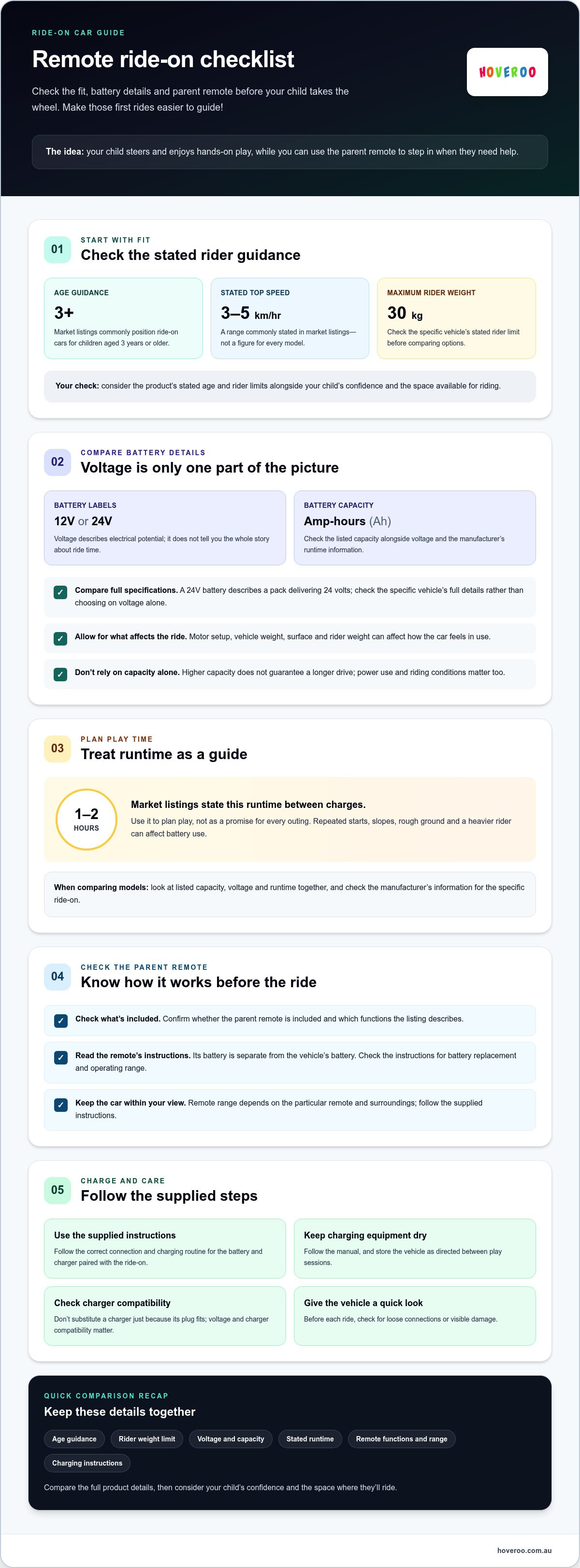
A parent remote can help you guide your child through their first turns, stops and starts. The child still gets hands-on play, while you can take over when they need help. Market listings commonly position ride-on cars for children aged 3 years or older, with stated top speeds of 3-5 km/hr and maximum rider weights of 30 kg. These details help you assess suitability alongside your child’s confidence and the space available for riding.
Battery voltage is another practical comparison. A 12V or 24V label tells you the battery’s voltage, not the whole story about how long a ride lasts. A 24V battery describes a pack delivering 24 volts, but check the specific vehicle’s full specifications before comparing models. Motor setup, vehicle weight, surface and rider weight also affect how the car feels in use. Choose based on the product’s stated age and rider limits, not voltage alone.
Battery capacity is usually measured in amp-hours (Ah), while voltage describes electrical potential. Check both figures alongside the manufacturer’s runtime information. Higher capacity alone does not guarantee a longer drive, as power use and riding conditions also matter. Compare the listed capacity, voltage and runtime for each model.
Market listings state 1-2 hours of runtime between charges for ride-on cars. Treat that as a guide for planning play, not a promise for every outing. Repeated starts, slopes, rough ground and a heavier rider can affect battery use. The parent remote has its own battery, separate from the vehicle’s battery. Its operating range depends on the particular remote and surroundings, so follow the supplied instructions and keep the car within your view.
Charging time depends on the battery and charger paired with the ride-on. Use the supplied charging instructions for the correct connection and charging routine. To care for the battery, follow the manual, keep charging equipment dry, and store the vehicle as directed between play sessions. Don’t substitute a charger just because its plug fits; voltage and charger compatibility matter. A quick check before each ride can also spot loose connections or visible damage.
- Compare 12V and 24V models using their full specifications, not voltage alone.
- Check capacity, stated runtime, age guidance and rider weight together.
- Read the parent remote’s instructions for battery replacement and operating range.
- Follow the supplied charging steps to support reliable use over time.
Colour and styling can make a ride-on feel special, but consider them after fit, battery details and remote operation. That way, your child gets an exciting ride that also suits your play space and routine.
Product prices and sale prices
Ride-on listings may show a standard price, a sale price or both. Compare the advertised price with the vehicle type, included features and details relevant to your child.
Listed ride-on car prices
Use the listed price as a starting point for comparing similar ride-ons. Check whether the product is a car, quad bike, digger or another style, then compare its stated features and intended use. A ride-on designed for indoor play may differ from a larger outdoor vehicle. Compare like with like before judging value.
Example product prices
Use examples to understand how listings present products, not as a direct ranking. A four-wheel electric ATV, a Jeep-inspired ride-on and a smaller ride-on car are different product types. Their descriptions may include details such as top speed or remote control. Compare the stated specifications and included items, rather than assuming two electric vehicles offer the same experience because both are ride-ons.
Sale prices
A sale label highlights a reduced advertised price, but it doesn’t explain the full value on its own. Compare the sale listing with its stated original price, then read the product description for the same vehicle and included features. Look for clear sale terms and check that you’re comparing the same model, not a different style or package. That keeps the comparison useful and fair.
For a remote-controlled car, check whether the parent remote is included and which functions the listing describes. Compare the vehicle’s size, rider guidance and safety features too. A lower price may reflect a different package, particularly if accessories or the remote differ. Note these details before comparing options.
Consider where the ride-on will be used. A compact car may suit a smooth, flat area, while a digger-style toy may appeal to a child who enjoys construction play. The body shape, tyres, battery details and stated riding conditions help explain differences between listings. Choose a vehicle that suits your space and your child’s interests, not just the sale label.
Try this quick comparison:
- Record the vehicle type and the exact model name shown.
- Compare the listed and sale prices for that same model.
- Check the remote, included accessories and stated safety features.
- Read the product details for rider guidance and intended use.
Keep the listing details together, especially when comparing a standard car with an ATV or licensed-style vehicle. A clear, like-for-like comparison makes it easier to judge the offer and choose a ride-on that suits your child’s next outdoor adventure.
Need Help Choosing the Perfect Ride-On Car?
Start with the vehicle shape and play space, then compare the controls and product guidance. Cars, utes, SUVs and buggies each offer a different kind of ride.
Ride-on vehicle types
A car has a familiar shape for children who enjoy pretend driving. A ute or SUV may appeal to kids who like a bigger vehicle look, while a buggy suggests open-air adventures. Work-style toys such as a digger bring construction play into the ride. Compare body style, seating and intended play area before choosing.
Consider how your child will use the vehicle. A single-seater suits solo pretend play, while a multi-seat design can make shared rides part of the fun. Measure your available play space and consider where you’ll store the toy between outings. These practical details can help narrow your shortlist.
Electric models and voltage
Electric ride-on cars and buggies vary in design, battery setup and controls. A 12V label identifies the battery voltage, but it doesn’t explain every aspect of the ride. Compare the complete product description, including rider guidance, remote-control details and the intended surface. That gives you a more useful picture than choosing by voltage alone.
For a 12V model, read the manufacturer’s instructions and match the stated limits to your child. Check that the parent remote is included if remote operation is a priority. Then think about where the vehicle will run, such as a smooth, level play area, and whether its shape suits your child’s interests.
Australian use and safety considerations
What Australian safety standards apply to children’s electric ride-on cars? Requirements depend on the product and its classification. Review its Australian compliance information and safety instructions, including age guidance, rider limits, warnings and charging directions, before your child rides.
Can children’s ride-on cars be used on Australian roads or footpaths? Treat these toys as equipment for supervised play, not road vehicles. Don’t use one on a public road or footpath unless local rules and the product instructions permit it.
Choose a contained play area away from traffic, driveways and obstacles. Stay close enough to supervise, especially while your child is learning the controls. A parent remote can help you guide a ride, but it does not replace supervision or the product’s safety instructions.
Use this quick selection check before deciding:
- Match the car, ute, SUV, buggy or work-style toy to your child’s play interests.
- Compare the seating, product guidance and available play space.
- Read the Australian compliance information and the remote-control instructions.
- Choose a supervised play area that suits the vehicle’s stated use.
What can the parent remote do?
A parent remote lets an adult guide a ride-on while a child learns. Functions vary by model, so read the instructions before the first drive. When choosing an electric ride on car with remote control in Australia, compare the listed functions with your needs instead of assuming every controller works the same way.
A remote can help you guide a child through a turn or stop the vehicle when needed. Read the manual and practise using the buttons while the ride-on is stationary. Keep the vehicle and child in view during play. Choose a clear space for early practice so you can focus on how the controls respond.
Before ordering online, read the product page closely. Confirm the vehicle type, whether a remote is included and the rider guidance. Toyota-inspired styling describes a look, not necessarily licensed branding. Check the exact model details and package contents to compare what each ride-on offers.
Safety details matter alongside remote operation. Hoveroo’s published safety information names UL 2272 certification among its credentials. Read the specific product’s safety information to understand which certifications apply to it, and follow its instructions during use. A certification is one part of your decision, alongside rider guidance, protective gear and active adult supervision.
Hoveroo also cites more than 50,000 Australian families among its customers. That community proof point can offer context as you explore, while your choice should still rest on the product details that suit your child. Check the controls, play setting and the support information provided for the model you’re considering.
Set a simple routine before each ride. Explain where the vehicle can go, how your child can signal for help and when you’ll step in. Practise stopping together in the chosen play area so your child understands how adult guidance fits into the fun.
Keep the remote within reach and use it when guidance is needed. As your child grows more comfortable, let them steer independently while you supervise. The right balance depends on their confidence, the vehicle’s instructions and the play space. If you’re unsure how a control works, reread the manual.
- Read the model’s remote instructions before the first ride.
- Practise its controls with the vehicle stationary.
- Keep the child and vehicle in view during supervised play.
- Review product-specific safety information alongside remote functions.
Parent-controlled remote operation
A parent remote lets an adult take control while a child practises driving. One market example is a 24V 800W Licensed Mercedes-AMG G63 4WD kids ride-on car with a parent remote control. The key point is the adult’s ability to guide the vehicle, not the licensed styling. For an electric ride-on car with remote control in Australia, focus on how remote operation fits your child’s first rides.
Read the instructions for the specific vehicle and controller before setting off. They explain how to connect and operate the remote. Practise while the car is stationary, and learn how to take over and stop. Don’t assume one controller works like another. Knowing the controls helps you respond calmly if your child needs guidance.
Choose a clear, level space for early practice. Let your child try steering while you stay close with the remote ready. If they approach an obstacle or need help turning, take control as the instructions describe. Keep the child and car in view throughout the ride. Remote operation supports supervision; it doesn’t replace your attention or a suitable play area.
Agree on a simple routine before play begins. Explain where the car can go and how your child can let you know they need help. Practise starting, stopping and handing control between child and adult. This clarifies your role while leaving room for your child to enjoy steering. Keep instructions simple and repeat the routine on later rides.
Check the remote’s stated functions against your needs. Some models allow an adult to take over control, while controller layouts and instructions differ. Read how the remote works, what the product says about its use and any relevant rider guidance. Keep the controller accessible, and avoid relying on a feature you haven’t tested or understood.
As your child becomes more comfortable, let them steer while you continue to supervise. Step in when they need help, then return control when they’re ready. The balance depends on your child’s confidence, the vehicle instructions and the play space. A remote is most useful when you understand how it works and stay close enough to guide the ride.
- Read the vehicle and remote instructions before use.
- Practise taking control while the car is stationary.
- Choose a clear play area and stay within view.
- Keep the remote accessible during supervised rides.
Hoveroo: Hoveroo Hoverboard
Hoveroo Hoverboard is a different way for your child to enjoy active play. If you’re choosing specifically between electric ride-on cars with remote control, consider the Voltrix TerrainMaster 24V 4x4 Ride On as the closer fit. Its 4x4 ride-on format suits families looking for a vehicle-style outdoor toy.
For a different kind of outdoor play, explore the Off-Road Hoverboard or Thunderbolt Electric Dirt Bike. Choose according to your child’s interests and the type of ride you have in mind. Compare each product’s instructions and rider guidance, especially if a parent remote is essential for your family.
Explore Hoveroo’s ride-on and rideable options to find the right starting point for your child’s next adventure. Visit hoveroo.com.au or contact Hoveroo to continue exploring.
Make your child’s next ride their own
Choosing an electric ride-on car with remote control in Australia involves more than picking a fun design. Think about the play your child enjoys, from pretend driving to outdoor exploring or learning to steer with you nearby. This helps you decide what matters most in your family’s next ride-on.
Before choosing, consider where your child will ride and how you’ll supervise. Knowing your play space and your child’s interests can make it easier to narrow the options. Then explore the products and their details at your own pace.
Ready to take the next step? Contact Hoveroo for help choosing an option for your child. Here’s to exciting outdoor play and new little adventures!
Frequently Asked Questions
Can the child still drive manually?
Yes. If the model has child-operated steering and pedals, your child can drive while you leave the remote unused. The adult controller provides another way to guide the vehicle, but may not be the only way to operate it. For example, let your child practise steering in a wide, clear area while you supervise. Check the instructions to understand how the child and remote controls work together.
Do I need to pair the remote before using it?
It depends on the ride-on model. Check the manual for setup instructions, including whether the remote needs pairing and how to tell when it’s ready. If pairing is required, complete the steps before your child gets in. Test the controls while the vehicle is stationary, and keep the manual nearby in case setup needs repeating after battery changes or storage.
What electric ride-on cars with parental remote control are available in Australia?
Australian listings include remote-controlled cars and larger ride-on styles such as 4x4s and ATVs. Features vary, so compare the product description for the remote’s stated functions and whether it comes with the vehicle. Hoveroo’s range includes the Voltrix TerrainMaster 24V 4x4 Ride On. Read that model’s product details to see how it fits your child’s interests and play space.
How much do remote-control kids' ride-on cars cost in Australia?
The price depends on the vehicle and what the listing includes, such as the remote, seating and accessories. Compare the exact model and package contents rather than judging by a sale label alone. Check the displayed price and sale terms, then compare equivalent features across options. This helps you assess value without confusing different vehicle types or packages.
What age, weight and height limits apply to popular ride-on cars?
Limits vary by model. Market listings commonly give ride-on cars age guidance of 3 years or older and a maximum rider weight of 30 kg. Height guidance depends on the vehicle’s dimensions and seating. Compare your child’s size with the product’s stated limits and cabin measurements, and allow enough room for comfortable seating and operating the controls.
Are ride-on cars with remote control suitable for toddlers, and what supervision is needed?
Many ride-on car listings give an age recommendation of 3 years or older, so check the exact model before choosing one for a toddler. Stay beside your child during play, use a contained area away from vehicles and obstacles, and keep the remote accessible. A helmet and other protective gear can add protection; follow the product’s safety instructions every time.
What warranty, delivery and returns policies do Australian sellers offer?
Policies differ between products. Before ordering, read the warranty terms, including which faults are covered and how to make a claim. Review delivery estimates, tracking arrangements and the process for reporting a parcel problem. For returns, check eligibility, required item condition and how to submit a request. Keep your order confirmation and the relevant policy details.
Which Australian retailers sell electric ride-on cars with remote control?
Hoveroo is mentioned as offering ride-on options.