
Kids battery powered jeeps for outdoor play in Australia
A kids’ battery-powered jeep in Australia can be a fun fit for outdoor play when it suits your child and the surfaces they’ll ride on. Toy Jeeps are generally described as suitable for ages 3 to 8, depending on the model. The motor and battery matter too: they shape how the ride feels and how you plan playtime.
Kids battery powered jeep Australia searches often come from parents looking for a fun ride-on that feels manageable for the family. The right choice depends on the child’s age and size, where they’ll ride, and which controls and safety features the vehicle has. This guide explains what to check, from parental remote control to setup and battery care, so you can compare options with confidence.
Key Takeaways
- Choose a ride-on with a parent remote if you want to guide early driving practice and step in when needed.
- Match the vehicle’s age guidance, speed settings and maximum rider weight to your child before outdoor play.
- Use a parental peace of mind checklist to compare safety features, including braking, speed control and helmet use.
- Plan the assembly area and first ride on a clear, suitable surface, and follow the product instructions from the start.
- Check the motor and battery details to understand how the ride may feel and how charging fits into your play routine.
Do Jeep ride-on cars come with parental remote control?
A parent remote is a model-dependent feature, so look for it in the specific Jeep ride-on’s product details and instructions. In Australia, replacement batteries and parts are model-specific, while warranty support follows the terms supplied for that vehicle.
A parent remote lets an adult control a ride-on with a handheld controller. Controls vary by model: a remote may steer, change speed or provide another type of control. Don’t assume a vehicle includes one just because it has Jeep styling. The product description should state whether a remote is supplied and explain its functions.
A remote can help during a child’s first drives, especially in a clear outdoor space. Read the instructions and learn how the controls respond before the ride. Keep the controller within reach and stay close enough to supervise. Remote control doesn’t replace active supervision or a suitable riding area.
Jeep-themed ride on cars can resemble SUVs or 4WDs, with features such as a raised body, broad wheels, doors and a front grille. These are styling details, not proof that a toy can handle every outdoor surface. Check the vehicle’s stated use and weight limit. For example, a Kids Electric 12v Ride On Jeep lists a maximum load capacity of 28 kg. That figure applies to that model, not every Jeep ride-on.
Use this quick comparison when choosing a Jeep-style electric vehicle:
- Remote: Confirm whether it’s included and what the adult can control.
- Rider fit: Compare the child’s size with the listed age guidance and maximum load.
- Outdoor use: Match the intended surface to the vehicle’s instructions, rather than its 4WD appearance.
- Setup: Check that the remote and vehicle operate as described before the first ride.
Prioritise safety information over a military-style finish or SUV shape. Read the manufacturer’s warnings and assembly instructions, and look for clear documentation relevant to Australian use. A remote is not proof of certification, and Jeep styling does not show that a ride-on meets a particular standard. A helmet and close adult supervision are practical safeguards for outdoor play.
For replacement parts, identify the exact model before matching a battery or component; voltage and connectors need to suit the vehicle. Keep the warranty documents and follow their stated coverage and claim steps. A carton measurement, such as 1870 × 900 × 580 mm for a Mini Willys Jeep, can also help you plan delivery and storage, but it says nothing about remote compatibility or parts fit.
Age suitability and speed settings
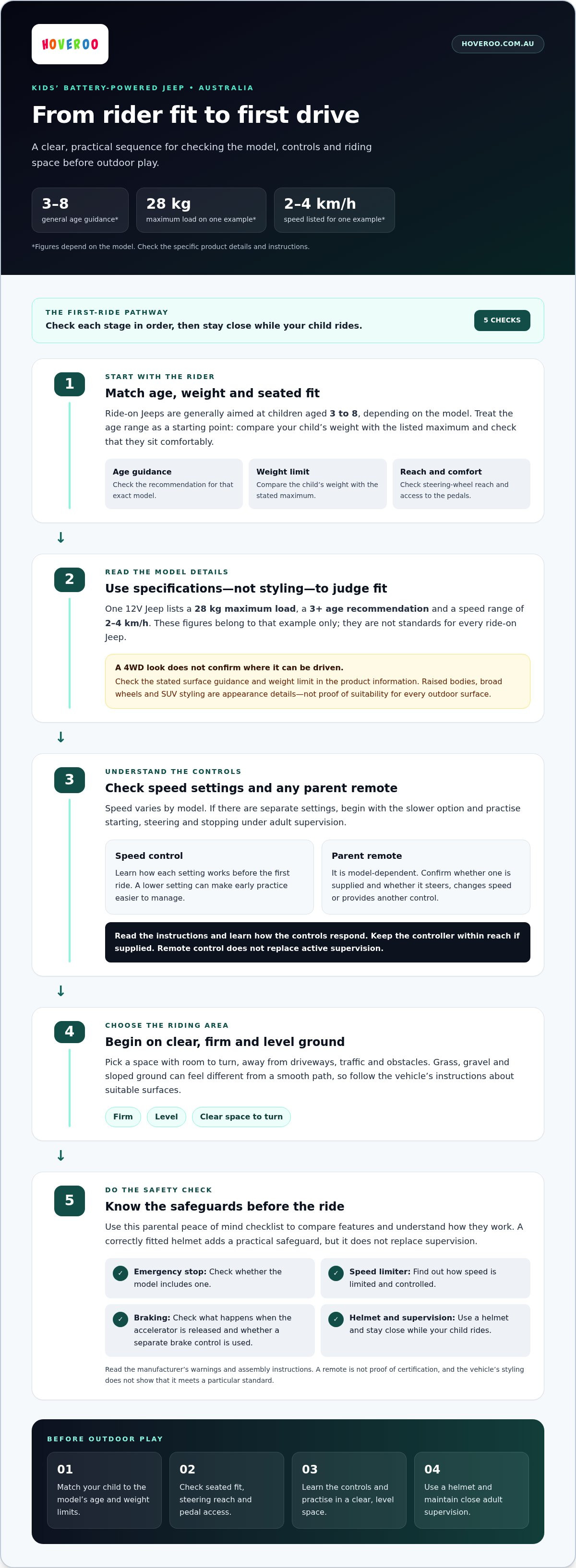
Ride-on Jeeps are generally aimed at children aged 3 to 8, depending on the model. One 12V Jeep lists a 28 kg maximum load and a 3+ age recommendation; height suitability depends on how your child fits the seat and reaches the controls. Choosing kids’ battery-powered jeeps in Australia starts with matching those details to your child.
Age suitability
Use the age range as a starting point, then compare your child’s build with the ride-on’s stated limits. For example, the listed 12V Jeep is recommended for children aged 3 years and above, with a maximum load capacity of 28 kg. Height has no universal limit across Jeep models, so check that your child can sit comfortably, reach the steering wheel and operate the controls.
Check the specific product’s age, weight and fit guidance. Even a child within the suggested age range may find a seat or footwell too large or small. Compare your child’s weight with the maximum rider weight, and consider whether their legs can reach the pedals while seated. These checks help match the vehicle to its rider, not just their age.
Speed settings
Speed varies by model and setting. One Kids Electric 12v Ride On Jeep lists a speed range of 2-4 km/h. Treat that figure as specific to that Jeep, not a standard for all ride-on cars. A lower setting can make initial practice easier to manage, while a higher setting may suit a confident child in an appropriate open area.
Check how the speed control works before the first ride. If the model has separate settings, start with the slower option and practise starting, steering and stopping under adult supervision. A parent remote, if supplied, adds adult control, but the child’s ability and riding space still matter. Jeep styling or custom details don’t indicate the vehicle’s speed.
Surface choice also affects how manageable an outdoor ride feels. Start on a firm, level area with room to turn, away from driveways, traffic and obstacles. Grass, gravel and sloped ground can feel different from a smooth path, so follow the vehicle’s instructions for suitable surfaces. A 4WD look alone doesn’t establish where a ride-on can be driven.
Use this quick check before outdoor play:
- Match the child’s age and weight to the specific model limits.
- Check seated fit, including steering reach and pedal access.
- Learn the speed controls and practise in a clear, level space.
For a battery-powered Jeep for kids in Australia, compare the fit and speed details with your family’s intended riding space. You can also browse these electric ride-on options alongside the specifications that matter for your family.
Safety features
A safer outdoor ride starts with features you can identify and check. Look at the braking, speed control, seat restraint and tyres, then consider whether they suit your child and the riding area. A correctly fitted helmet adds a practical safeguard, but doesn’t replace supervision.
Use a parental peace-of-mind checklist before choosing a vehicle. Check whether the model has an emergency stop, speed limiter or parental remote override. A remote can let an adult control the ride-on, while a limiter can help keep its speed manageable. Read the instructions first so you understand each control before your child starts driving.
Check how the braking works. Find out what happens when your child releases the accelerator and whether there’s a separate brake control. If the product describes auto-lock braking, make sure the instructions explain how it operates. Check that the seat belt or restraint closes properly and stays secure during ordinary movement. It’s useful only when it fits and is fastened as directed.
Assess each accessory for its purpose. A helmet should fit the rider securely; a loose helmet can shift during play. Before each session, check the tyres, steering and bodywork for visible damage. If you notice a loose wheel, exposed wiring or an unresponsive control, stop using the ride-on until it’s safe to operate again.
Read the product label and supplied safety documents rather than relying on Jeep styling or a general claim. Check the manufacturer’s stated age, maximum rider weight, warnings and any named safety certification. UL 2272 is a certification associated with hoverboards; it should not be taken as certification for a Jeep ride-on. Use the documentation for the specific vehicle to understand its safety claims and intended use.
Before each outdoor session, run through these practical checks:
- Riding space: Clear the route of obstacles and keep it away from driveways and traffic.
- Vehicle: Check the seat restraint, wheels, steering and controls.
- Rider: Fit the helmet, fasten the restraint and keep an adult close by.
- Controls: Test the stop function and any remote before the child rides.
Choose a model with clearly explained safety features, not just lights, sounds or Jeep-style details. A Bluetooth speaker or portable tech from electronics retailers such as Voltix adds entertainment, for example, but doesn’t improve braking or adult control. Make safety checks part of the routine, then let your child enjoy the ride in a suitable, supervised space.
Assembly and setup
A Jeep ride-on may arrive in a carton and need adult assembly before its first ride. Set up in a clear work area, keep children away from loose components and follow the instructions supplied with that model. The Jeep shape or military styling doesn’t mean every vehicle uses the same parts or assembly steps.
Plan where you’ll unpack and store the vehicle before delivery. For example, the Mini Willys Jeep carton measures 1870 × 900 × 580 mm. That measurement can help you assess access through a doorway and space to unpack, but the assembled vehicle may need different clearance. Keep the packaging until assembly and checks are complete, so you can refer to component labels if needed.
Follow the manufacturer’s manual rather than a generic online guide. Lay out the supplied pieces and compare them with the parts list. Attach components in the stated order, using only the fittings and tools named in the instructions. If a part doesn’t align or a connector looks damaged, pause instead of forcing it into place. Assembly steps vary by model.
After assembly, inspect the main connections before switching the vehicle on. Check that the wheels and steering components are secure, the seat is fixed and any restraint closes as intended. Connect the battery only as directed. Keep wiring clear of moving parts, and don’t let a child sit in the Jeep during assembly or testing.
Prepare for the first ride in a controlled space. Check that the accelerator, steering, stopping function and parent remote, if supplied, respond as the manual describes. Test them without a child aboard if the instructions allow. Set the Jeep on a firm, level surface and clear the route of obstacles. These checks can reveal setup issues before play begins.
Charging is part of setup. Follow the supplied instructions for the battery and charger, including the charging location and connection steps. Some ride-on Jeep instructions advise charging the battery on arrival, even if the vehicle won’t be used soon. Follow that advice only if it appears in your model’s instructions. Keep the charger and cable away from children while charging.
Use this final setup sequence before handing over the keys:
- Match the carton contents against the manual’s parts list.
- Complete assembly in the stated order, tightening fittings as directed.
- Check wheels, steering, seat, restraint and visible wiring.
- Test the controls and remote according to the instructions.
- Choose a clear, level first-ride area and supervise closely.
Careful setup keeps the focus on the ride, not missing fittings or unclear controls. Keep the manual with the Jeep for charging, storage and maintenance guidance, and repeat the visible checks before each session.
Electric motor and battery
The motor affects how a Jeep ride-on moves, while the battery determines when it needs charging. Compare both details together. A Kids Electric 12v Ride On Jeep, for example, has a 70 W twin motor and runs for 1-2 hours per full charge. Those figures describe that model, not every electric Jeep.
Motor wattage is useful for comparison, but it doesn’t tell the whole story. The vehicle’s weight, rider load and surface also affect how it performs. “Twin motor” describes the number of motors; wattage is their stated power rating. Read the specifications alongside the maximum rider weight and intended surfaces to decide whether the vehicle suits your family’s outdoor play.
Charging time also shapes the routine. Many Jeep ride-on cars need around 7 to 12 hours for a full charge. Product guidance advises against charging a Jeep ride-on for more than 18 hours. Follow the instructions supplied with your model, including any directions about the charger, charging location and battery connection. Don’t substitute a charger simply because its plug appears to fit.
Some product instructions advise charging the battery upon receipt, even if the Jeep won’t be used soon. For a vehicle that’s stored between play sessions, guidance also advises charging its battery at least every 20 days. These are practical care directions from the product information, so use the schedule that applies to your specific Jeep. Keeping the instructions accessible makes it easier to follow the right routine.
Battery charge can affect playtime, so plan outdoor sessions around the stated running time. The example 12V Jeep operates for 1-2 hours per full charge. Actual play can include frequent stops and starts, which may make a session feel different from uninterrupted driving. Avoid promising a fixed duration for every ride-on; compare its stated run time and your child’s planned use instead.
Before the first charge, check the battery label and manual for the correct charging steps. During regular use, watch for damaged cables, loose connections or a battery that doesn’t charge as instructed. Stop using damaged charging equipment, and follow the product’s care guidance. Keep the charger out of children’s reach while connected, and store it as the manual directs.
For a quick comparison, note the motor rating, battery details, stated run time and charging guidance together. That gives you a clearer picture of both the driving experience and the preparation each session needs. Explore electric ride-on options and compare their listed motor and battery information before choosing your next outdoor ride.
Hoveroo: Hoveroo Hoverboard
Hoveroo’s electric ride-on range offers alternatives for families considering outdoor electric play. The Hoveroo Hoverboard is a self-balancing board, not a seated Jeep, so it suits a different style of riding. If your child needs a seat, steering wheel or parent remote, choose a ride-on vehicle with those features.
For a seated outdoor option, the Voltrix TerrainMaster 24V 4x4 Ride On is closer to the Jeep-style experience. Hoveroo also offers the Off-Road Hoverboard and Thunderbolt Electric Dirt Bike. Australian customer support and a 1-year Australian warranty provide added assistance for product questions and manufacturing defects.
Choose the vehicle type that fits your family’s plans, then review its product details and instructions. Explore Hoveroo’s available options online.
Choose the ride that fits your family’s next adventure
When comparing a kids battery powered jeep in Australia, consider where your child will ride and the kind of play they enjoy. A seated vehicle may suit pretend driving and independent outdoor exploration. For a different kind of ride, Hoveroo also offers the Hoveroo Hoverboard, Off-Road Hoverboard and Thunderbolt Electric Dirt Bike.
Make your next step practical: compare the vehicle style with your child’s interests, then review the product details and instructions together. This helps you choose for the kind of play your family wants, rather than relying on looks alone. Keep the conversation upbeat, involve your child in choosing a favourite style and plan for adult supervision from the start.
Ready to explore options for your family? Contact Hoveroo about kids’ jeeps. Here’s to fresh air, happy little drivers and outdoor adventures you’ll love sharing!
Frequently Asked Questions
Are Jeep ride-on toys good for outdoor use?
Yes, a Jeep ride-on can suit outdoor play on surfaces permitted by its instructions. Choose a space with enough room to turn, away from vehicle access and foot traffic. After a session, check the tyres and body for dirt or damage, then store the vehicle as its manual directs. A rugged-looking grille or 4WD styling doesn’t establish that a model is designed for every outdoor surface.
Can I pick up a Jeep ride-on car today?
Hoveroo is an online retailer, not a physical retail showroom, so don’t plan on walk-in collection today. Orders are placed online, with delivery options shown during checkout. If you’re choosing a ride-on as a gift, allow for delivery rather than relying on same-day pickup. Check the model’s carton dimensions too, so you can plan where to receive and store it at home.
Can two children ride together?
Only if the particular ride-on is designed for more than one rider and its stated load limit allows it. Seat count alone doesn’t show how much combined weight the vehicle can carry. For example, a 24V 4WD Willys Jeep is described as a three-seater, but that doesn’t establish the limits of other models. Check the product’s rider capacity and total weight guidance before children share a vehicle.
How Can I Safely Use My Ride-On Car?
Match the model’s instructions to the child, riding area and controls. An adult should supervise, and the child should wear a properly fitted helmet. Keep the route clear, keep the vehicle out of traffic and stop play if a control or wheel appears damaged. Use is subject to national, state, territory and local laws and council by-laws; check the requirements for the intended area. Products are not represented as approved for use in any public area unless expressly stated.
How do I look after the battery?
Use the charger supplied or specified for that ride-on, and follow its manual’s charging and storage instructions. Keep the charging area dry and clear, with the cable out of children’s reach. Check the charger and visible wiring before plugging in; don’t use damaged equipment. If the Jeep will be stored between play sessions, follow the manufacturer’s battery-care schedule rather than leaving charging decisions to guesswork.
What types of battery-powered ride-on jeeps for kids are available in Australia?
Options include Jeep-style vehicles with different battery voltages, body designs and seat layouts. Examples include a 12V military-style Jeep and a 24V 4WD Willys Jeep described as a three-seater. Some models borrow classic Jeep or SUV styling, while others focus on a utility-vehicle look. For a wider look at children's electric ride-on vehicles and their features, online stores like luxuryrideontoysllc.com showcase various styles and designs. Compare the seat arrangement, drive description and rider limits, rather than choosing by appearance alone.
Which Australian retailers sell kids' ride-on battery-powered jeeps?
Hoveroo is an Australian online retailer of children’s electric ride-on vehicles, including the Voltrix TerrainMaster 24V 4x4 Ride On. It isn’t a Jeep-branded car, so compare its vehicle style and details with the Jeep look you have in mind. Review the product information, delivery options and usage guidance online to decide whether a listed ride-on suits your child and outdoor space.
What battery voltage, run time and charging time do kids' ride-on jeeps offer?
Specifications vary by model. One 12V Jeep example lists a 70 W twin motor and 1-2 hours of operation per full charge. Many Jeep ride-on cars need around 7 to 12 hours to charge fully. A 24V label alone doesn’t tell you the run time or charging duration, so compare all three details in the specific model’s instructions before planning play sessions.