
Multi-functional rocking horses for toddlers in Australia
The age guide is the starting point: a multi-functional rocking horse for toddlers in Australia is listed for children aged 12 months to 3+ years. But age isn’t the only fit check. Your child’s size, confidence and comfort matter too.
Choosing a ride-on toy is about more than picking a fun shape. You want play that feels exciting and a design that suits your little one. This guide explains how to assess fit, materials and safety, then compare convertible functions such as rocking, riding and other ways to play.
Ready to compare your options? Learn what to look for in a multi-mode design, how to assess the space it needs and which details can make play comfortable and enjoyable. Let’s find a good fit for your family.
Key Takeaways
- Use the age guidance as a starting point, then consider your toddler’s confidence and ability to sit securely.
- Compare the rocking horse’s dimensions and 50 kg weight capacity with your child’s size and available play space.
- Look for clear material information: the HOVEROO 5 in 1 Rocking Horse uses BPA- and lead-free HDPE.
- Consider whether tool-free conversion between play modes will make it easier to switch up play as your child grows.
How old should a child be for a rocking horse?
The right starting point is the maker’s age guidance, then your child’s size and ability to sit securely. One listed multi-functional rocking horse is intended for children aged 12 months to 3+ years, with a maximum rider weight of 50 kg.
Age suitability as children grow
The 12 months to 3+ years age guide gives you a starting range, not a substitute for observing your child. At the younger end, look for a child who can sit steadily and engage with the rocking motion while an adult stays close. Read the specific model’s age guidance before choosing.
As your toddler grows, their reach, balance and interests can change. Watch how they sit and whether they stay comfortably positioned during gentle rocking. A child who loses interest may enjoy another play mode, if the design offers one. Age alone won’t tell you whether a particular shape or motion suits your child.
Keep the first play session calm and brief. Stay beside your child, show them how the toy moves and let them get familiar with it at their own pace. If they can’t sit comfortably or seem unsettled by the movement, pause and try again when they’re ready. Their response helps you judge fit more clearly than age alone.
Age and weight limits
Check both limits because they answer different questions. The age range indicates the intended stage of use, while the weight capacity sets a maximum rider load. For the listed model, those figures are 12 months to 3+ years and 50 kg. They describe that model, not every multi-functional rocking horse available in Australia.
Before each play session, check that your child is within the stated age guidance and below the maximum weight. A higher weight limit doesn’t override the age range; these figures serve different purposes. If more than one child wants a turn, have them ride individually unless the product instructions specifically allow otherwise.
As your child grows, revisit the limits and check how they fit when seated. Make sure they can sit comfortably and understand how to use the rocking motion. Keep an adult nearby, especially during early play. These practical checks help you match the product’s stated limits to your child’s current stage.
Choosing the right size and design
Fit involves more than age: your child needs a comfortable seat and room to move. Check the product dimensions, weight limit and base design, then compare them with your child and play area.
Start by measuring the space where the horse will be used, including clearance around its rocking path. Move nearby furniture, hard-edged objects and loose rugs before play. A clear, level floor makes it easier to see how the base sits and moves. If you’ll put the toy away after each session, consider whether it’s easy to move and store.
Next, check how your toddler sits. Their hands and feet should reach the intended contact points without awkward leaning or stretching. A seat that’s too large can make it harder to stay centred; a cramped position may restrict comfortable movement. Follow the assembly and use instructions, and don’t add cushions or makeshift supports.
Stability depends on the whole setup, not just one feature. Place the rocking horse on a firm, even surface and check that its base rests as designed. Watch for shifting or wobbling during gentle movement. Stop play if the toy rocks unevenly, a component feels loose or the floor beneath it moves. Adult supervision helps you spot changes quickly.
One listed multi-functional model has a maximum rider weight of 50 kg. Treat that as a limit, not a target, and use the age guidance alongside it. A higher capacity doesn’t tell you whether the seat suits your child’s proportions. Compare the stated measurements with your available space, then review the design’s intended use before choosing.
- Measure the play area and allow room for rocking.
- Check seated fit, base contact and the stated weight limit.
- Follow the assembly instructions and supervise every session.
Use these checks to compare rocking horse designs with your child’s size and play space.
Materials and product safety
Australian recall notices identify affected products through details such as the brand and model. Match those details on the toy and packaging with the notice, then follow the instructions for owners.
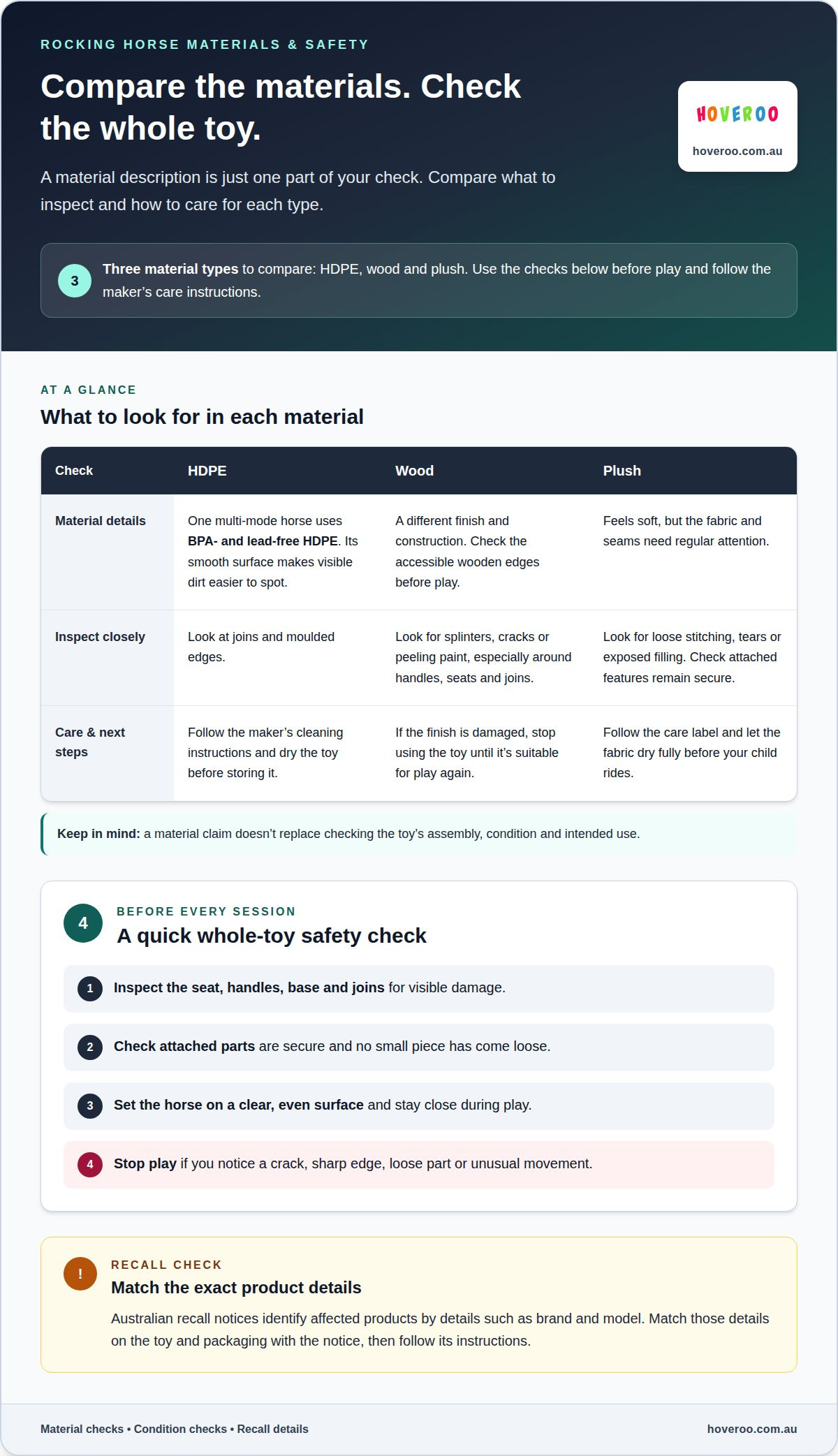
Material affects how you clean and inspect a rocking horse. BPA- and lead-free HDPE is one material option for a multi-mode horse. Its smooth surface makes visible dirt easier to spot, but joins and moulded edges still need close inspection. Follow the maker’s cleaning instructions and dry the toy before storing it.
Wooden rocking horses have a different finish and construction. Check for splinters, cracks or peeling paint, especially around handles, seats and joins. Run your hand over accessible wooden edges before play. If the finish is damaged, stop using the toy until it’s suitable for play again. A quick inspection after moving or storing it can reveal new knocks.
Plush designs feel soft, but their fabric and seams need regular attention. Look for loose stitching, tears or exposed filling. Check that attached features, such as ears or decorative pieces, remain secure. Follow the care label and let the fabric dry fully before your child rides. Damp fabric can hide dirt or damage.
Use this simple safety check before each session:
- Inspect the seat, handles, base and joins for visible damage.
- Check that attached parts remain secure and no small piece has come loose.
- Place the horse on a clear, even surface and stay close during play.
- Stop if you notice a crack, sharp edge, loose part or unusual movement.
Material claims and safety checks are separate considerations. A BPA- and lead-free description doesn’t replace checking the whole toy, its assembly and its condition. Keep the packaging or product details handy so you can match the exact brand and model to recall notices. Regular inspections help you spot wear before the next play session.
Australian recall notices can identify affected rocking horses by brand and model. Match those details and follow the instructions in the notice.
Multi-mode rocking horse and convertible play functions
A multi-mode design can offer different ways to play without needing a separate toy for every activity. Consider what each mode does, how to switch between them and whether each setup suits your child’s age and play space.
Start with the mode list in the product instructions. Terms such as rocker, ride-on or push toy should describe distinct ways to play, not just different positions of the same feature. For each mode, consider what your child does: move the toy themselves, rock in place or rely on an adult to guide it? Clear differences make the options easier to compare.
Next, check how the toy converts. Some multi-mode designs switch between modes without tools, making changes simpler. Read the instructions and follow each step in order. Before your child uses a new setup, make sure the parts are fitted as directed and the toy sits securely on the floor. A toddler shouldn’t change modes alone.
Convertible play is most useful when the modes fit your routine. A rocker, for example, can suit a quiet indoor session, while another configuration may offer a fresh activity in the same room. Consider where you’ll use and store each setup. A mode that takes up too much floor space or needs adult help each time may be used less often.
Use this quick comparison when reviewing a design:
- List each mode and what your child does in it.
- Note the steps needed to convert the toy.
- Check the setup and stability before each change of play.
- Match the modes to your child’s abilities and available space.
More modes don’t automatically mean a better fit. A clear, manageable conversion and distinct play options matter more than a long feature list. Compare the multi-mode rocking horse design against those practical checks before choosing.
Hoveroo: Hoveroo Hoverboard
Hoveroo Hoverboard is a separate ride-on option, not a convertible rocking horse. It may suit families considering a different style of active play as their child grows, but it shouldn’t replace a toddler rocking horse unless the rider meets its product guidance.
Choose based on your child’s current abilities and the toy’s intended use. If your toddler enjoys seated rocking and different play modes, prioritise those features. If you’re considering a hoverboard instead, review its age guidance, safety information and rider limits first. These products suit different play needs, so there’s no need to rush from one to the other.
Explore Hoveroo’s ride-on range to compare options, or visit hoveroo.com.au to learn more.
Choose a play option for your child’s next stage
Your child’s interests will change, so consider the kind of play they enjoy now and what might keep them curious. A multi-functional rocking horse for toddlers in Australia can bring movement and imaginative play together. Think about how it could fit into everyday family play, then decide whether its design suits your child.
For a toddler ready for rocking and convertible play, the Hoveroo 5 in 1 Rocking Horse is the relevant option. Let your child’s changing interests guide future choices, while keeping each new ride-on suited to their stage and intended use. A thoughtful fit can make playtime feel like an invitation to explore at their own pace.
Want to take the next step? Contact Hoveroo about toddler rocking horses and explore a play option that feels right for your family. Here’s to joyful play and fresh adventures together!
Frequently Asked Questions
What features do multi-functional rocking horses for toddlers in Australia offer?
Features vary by model, but convertible designs can offer several ways to play. Check the product description for the named modes and how each configuration works. A five-in-one label signals multiple functions, but the number alone doesn’t explain them. Read the instructions to understand each mode and choose one that suits your toddler’s interests and routine.
Which multi-functional rocking horses are available from Australian retailers?
The Hoveroo 5 in 1 Rocking Horse is one option available from an Australian retailer. Compare each model’s intended age range, maximum rider weight, material and conversion instructions before choosing. Retailer descriptions can use similar terms for different designs, so look for the exact product name and its own details. That makes it easier to distinguish a multi-mode rocker from a traditional rocking horse.
Which rocking horses meet Australian toy safety standards?
Choose a rocking horse with safety and compliance information specific to that product, rather than relying on general claims about the retailer or material. Check the packaging and instructions for the model, age guidance and warnings. A certification stated for an electric ride-on doesn’t automatically apply to a toddler rocker. Match any safety documentation to the exact rocking horse you’re considering.
How do wooden, plastic and plush multi-functional rocking horses compare?
Wood, plastic and plush each have a different feel and care routine. Wooden designs have hard surfaces, so inspect edges and joins for damage. Plastic models are generally easy to wipe, but check moulded edges and connection points. Plush versions have soft fabric that needs seam and surface checks. Whatever the material, follow its care instructions and inspect the toy before play.
Which models convert between rocking, riding and other play modes?
The Hoveroo 5 in 1 Rocking Horse is a named multi-function model. The “5 in 1” description indicates multiple configurations, but it doesn’t identify every mode by itself. Use the model’s product details and instructions to see what each configuration is designed for. This helps you choose based on the play activities your toddler enjoys, rather than assuming every five-function toy offers the same modes.
Where can I buy a multi-functional rocking horse in Australia, and what are shipping costs?
You can buy the Hoveroo 5 in 1 Rocking Horse through Hoveroo’s Australian online store. Delivery information for your order is presented during checkout, so you can review the available shipping details before placing it. For a smooth purchase, have your delivery address ready and read the product information and order details carefully before completing checkout.