
Off-Road Electric Bike for Kids: 2026 Parent’s Guide
What matters more: a bigger motor, or a bike your child can comfortably control? When choosing an Off-road electric bike for children Australia families should look beyond power and consider the rider, riding setting and intended use. An off-road dirt bike isn’t the same as a pedal-assist e-bike for public roads and paths, so understanding the difference is a smart first step.
You want your child to feel excited and capable, while you feel confident about fit, supervision and safety. This guide explains how to compare the details that matter, match a bike to your child’s size and riding experience, and prepare helmets, protective gear and a suitable place to ride. You’ll also find out how Hoveroo’s Thunderbolt Electric Dirt Bike fits into the options for off-road riding on private property.
Ready to make sense of the specifications without getting lost in jargon? Let’s get your family closer to an outdoor ride that feels fun, considered and right for your child!
Key Takeaways
- Use this Off-road electric bike for children Australia guide to compare intended use and published details, not just motor wattage.
- Start with your child’s fit and riding confidence, then consider the terrain and space available for practice.
- Compare bike-style electric bikes, off-road hoverboards and seated ride-ons by how your child sits and controls each type.
- Before the first ride, prepare suitable protective gear, supervise closely and set aside a space for practice.
- Explore the Thunderbolt Electric Dirt Bike as Hoveroo’s bike-style option, and use your family’s needs to guide your decision.
What is a kids' off-road e-bike and who is it for?
A kids’ off-road e-bike is a child-sized, battery-powered bike intended for riding away from ordinary roads, such as on suitable private land. Designs vary. Some have familiar bike-style handlebars and a saddle, while their controls and operation can differ from a conventional pedal bicycle. The label alone doesn’t tell you how a particular model works or where it’s intended to be ridden.
Look past phrases like “electric bike” and “dirt bike”. Read the manufacturer’s intended-use guidance and specifications, then consider whether the design suits your child and the riding space. If you’re comparing an Off-road electric bike for children Australia families might choose, start with the rider and riding setting, not the product label or a single specification.
How does an electric dirt bike differ from other kids’ ride-ons?
A bike-style electric ride-on typically places the child astride a seat, with hands on handlebars and feet positioned as the design requires. Controls vary, so don’t assume every bike starts, steers or stops in the same way. Read the instructions and product details to understand how the specific model operates.
A hoverboard is controlled through the rider’s stance and balance. A seated ride-on supports the child in a seat and has its own control layout. No format is automatically the right fit for every child. If you’re comparing ride-on types, the kids’ electric dirt bike guide offers more context on bike-style riding.
Which children and riding settings might suit this bike style?
Start with your child’s physical fit and confidence. Can they sit comfortably, reach and operate the controls as the manufacturer describes, and follow your instructions? Use the product’s stated age or rider guidance where provided. Age alone can’t tell you whether a bike is manageable for a particular child.
Next, assess the riding space. A clear, suitable practice area and an attentive adult nearby can help your child get used to a new ride-on at a comfortable pace. Consider the surface, available space and obstacles before choosing where to ride. Follow the manufacturer’s intended-use guidance, and don’t assume an off-road label means a bike is suitable for every track, park or public path.
Electric-bike terminology covers different designs and uses. For a broader overview of electric bicycles and their types, see Understanding Electric Bicycles. Use that background alongside the specific product information rather than treating every electric bike as interchangeable.
The right choice brings together rider fit, confidence, design and setting. Take time to understand how the bike works and what it’s intended for. That helps you choose a format that feels exciting for your child and considered for your family!
How to assess fit, terrain and specifications before choosing
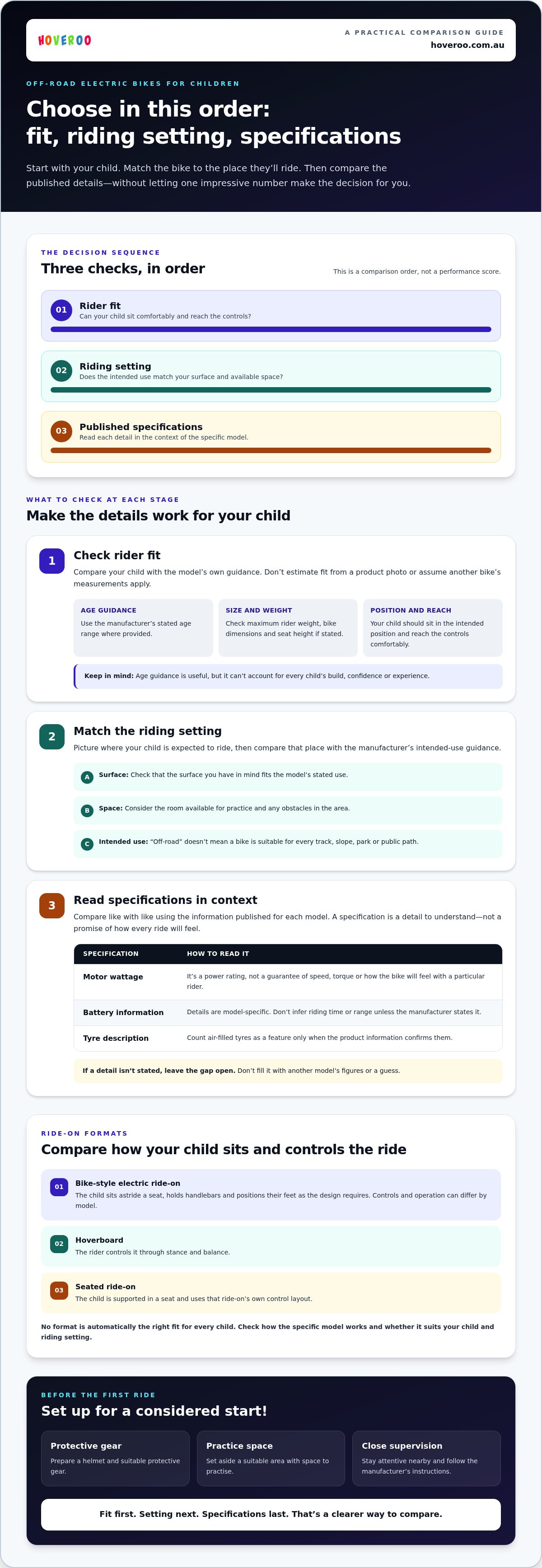
Work through the decision in order: check the rider, picture the riding space, then compare product details. This keeps impressive-sounding numbers in perspective and focuses your search on what matters for your child’s intended use.
- Assess rider fit. Compare your child with the manufacturer’s stated age guidance, maximum rider weight and bike dimensions.
- Define the riding setting. Consider the surface and available space, then check that they match the manufacturer’s stated intended use.
- Compare published specifications. Review details such as motor wattage and battery information without treating them as promises of a particular ride.
Quotable takeaway: The best comparison starts with how the bike fits your child and where it’s meant to be ridden, not with the biggest number on the specification sheet.
What should parents check about rider fit?
Use the model’s own guidance rather than assumptions based on another bike. Check the stated age range, maximum rider weight and dimensions against your child. If seat height or another measurement is provided, compare it with your child’s size. Don’t estimate fit from a product photo alone.
Your child should be able to sit in the intended position and reach the controls comfortably, following the manufacturer’s instructions. Consider whether they can operate the controls without stretching or losing a stable position. An age recommendation is a useful reference, but it can’t account for every child’s build, confidence or experience. Assess each model on its own terms.
Which terrain and product details matter most?
Start with the place you expect your child to ride. “Off-road” can describe different intended settings, so compare the surface you have in mind with the manufacturer’s description and specifications. A product intended for a particular off-road setting shouldn’t be assumed suitable for every rough track, slope or surface.
Read specifications in context. Motor wattage is a power rating, not a guarantee of speed, torque or how a bike will feel with a particular rider. Battery details are also model-specific. Don’t infer riding time or range from a battery label unless the manufacturer states it. Tyre descriptions matter too: count air-filled tires as a feature only when the specific product information confirms them.
If a detail matters to your decision but isn’t stated, don’t fill the gap with another model’s figures or a guess. Compare like with like using each bike’s published information. This is especially useful when building an Off-road electric bike for children Australia shortlist, because product labels can make different designs sound more alike than they are.
Use the same checks when exploring Hoveroo’s children’s electric ride-ons: start with your child, match the intended riding space, then weigh the stated details against your family’s needs.
Is an off-road electric bike safe for children? A parent-first comparison
It’s sensible to consider safety before the first ride. Safety isn’t determined by vehicle style alone. It also depends on whether the child fits the product, understands its controls and rides in a suitable setting with attentive adult supervision and appropriate protective gear. When comparing an Off-road electric bike for children Australia families might consider, weigh these factors together rather than relying on a single feature or label.
Each ride-on format positions the rider differently and uses a different style of control. This comparison can help you think about what your child may find familiar, but it can’t rank one format as safest for every child.
| Ride-on format | Rider position | How control generally works |
|---|---|---|
| Bike-style electric bike | Astride a seat, hands on handlebars | Uses the model’s stated controls; layouts and operation vary. |
| Off-road hoverboard | Standing on the board | Typically responds to the rider’s balance and stance. |
| Seated ride-on | Supported in a seat | Uses the vehicle’s particular control layout. |
Ask which riding position your child can manage comfortably and which controls they can follow calmly. Then assess the specific product, not just its category.
What belongs on a parental peace of mind checklist?
Before riding, work through a few practical checks. Use this parental peace of mind checklist to prepare, then follow the instructions for the model you have:
- Fit the helmet correctly and use suitable protective gear.
- Choose a clear, controlled practice area suited to the product’s intended use.
- Stay close enough to supervise and give clear instructions.
- Read the product’s rider limits, control guidance and safety information.
- Check that the bike is ready to ride as described in its instructions.
Some ride-ons include features such as a parental remote override, which lets an adult control the vehicle remotely, or overload protection, which limits the battery’s current draw. Treat these as model-specific details and rely on them only when the exact product information confirms them. They don’t replace a suitable practice space or adult supervision.
What should parents know about certifications and riding locations?
A certification relates to a particular standard or scope. It isn’t a blanket promise that a ride-on is safe in every situation or suitable for every child. Check the documentation for the exact model and the certification it names. Don’t assume UL 2272 certification applies to an electric dirt bike just because it’s mentioned for another type of ride-on.
Location matters, too. Check current guidance for your state or territory and any rules set by the land manager before riding. Private riding spaces, public paths and managed recreation areas may have different requirements or restrictions. Match the planned use to the product instructions, then choose a permitted space where you can supervise closely. A thoughtful setup helps your child build confidence while keeping the fun within clear boundaries!
What should you prepare before your child’s first off-road ride?
A little preparation can help your child settle in and make the first outing more manageable. For families choosing an Off-road electric bike for children Australia-wide, keep the plan simple: check the bike and fit, prepare protective gear, choose a suitable practice space, and stay close while your child learns the controls.
Use this pre-ride checklist before each outing:
- Check the fit: Make sure your child can sit in the intended position and reach the controls as the manufacturer describes. Follow the model’s rider guidance and limits.
- Prepare protective gear: Have a correctly fitted helmet and suitable protective gear ready before the bike is switched on.
- Choose the space: Pick a clear area that suits the product’s intended use, with room to practise and no unexpected obstacles in the riding path.
- Plan supervision: Decide which adult will stay nearby, watch the rider and help them follow the instructions.
- Read the manual: Understand the controls, starting steps, charging instructions and care guidance for that exact model.
How can families make the first ride feel manageable?
Begin in a controlled practice area suited to the specific bike, rather than heading straight onto unfamiliar ground. Follow the manufacturer’s starting guidance and stay close enough to supervise. Focus early practice on learning the controls and building confidence, not covering distance or trying to ride quickly. Pause whenever your child needs a breather or another explanation.
Ride-on formats handle differently, so match your preparation to the vehicle. A bike-style model, an off-road hoverboard and a seated ride-on each have a distinct rider position and control style. If you’re weighing up those formats, the off-road versus regular hoverboard guide can help explain how hoverboard designs differ.
How do you prepare for Australian outdoor conditions?
Look closely at the conditions where you plan to ride. Consider the actual surface, nearby obstacles, weather exposure and where the bike will be stored afterwards. Conditions can change between outings, so choose a practice space that suits the day as well as the product’s stated use.
Don’t assume an IP rating means a bike can be used in any weather or exposed to water or dust in any way. Read the product’s own care instructions, including guidance for charging and storage, and follow them for the specific model. If the bike or charging equipment appears damaged, set it aside and follow the manufacturer’s instructions before using it again.
Rules for riding locations and permitted use can vary. Before setting out, check current guidance from your state or territory and any rules set by the land manager for that place. Don’t assume a spot is suitable just because it looks open. Confirm the planned use is allowed, then keep the first session calm, supervised and focused on control.
Ready to compare a bike-style option with your family’s needs in mind? Explore Hoveroo’s children’s electric ride-ons and consider which format and intended use suit your plans.
Explore Hoveroo’s Thunderbolt Electric Dirt Bike for your family
Hoveroo’s Thunderbolt Electric Dirt Bike is its bike-style option for families exploring electric dirt bikes for children. Rather than focusing only on whether it sounds exciting, compare its stated guidance, design and intended riding setting with your child and your plans.
Hoveroo is an Australian business with more than 50,000 families in its customer community and Australian support. This offers local context as you compare product information and decide what suits your family. Keep your decision grounded in the details for this specific bike, rather than assuming features or claims from other ride-ons apply to it.
How does the Thunderbolt fit the decision framework?
The Thunderbolt product information states an age range of 5-12 years, a 350W motor, a top speed of 16 km/h, parent-controlled speed modes starting at 8 km/h, and a 60-minute battery life. These are model-specific published details, not a promise of how the bike will perform for every rider or in every condition.
Its stated intended use is off-road riding on private property. The setting is therefore an essential part of your decision: don’t assume an off-road dirt bike is suitable for public roads, paths or parks. Read the product’s guidance, compare the stated age range with your child’s fit and experience, and consider whether you have a suitable private riding space where an adult can supervise.
Specifications are most useful when they answer a practical family question. The stated age range, for example, can help you decide whether to explore the bike. Your child’s ability to follow instructions and the availability of a supervised practice space also matter. A motor rating describes the motor; it doesn’t determine by itself whether the bike is the right match.
What is the next step for interested parents?
Before deciding, review the Thunderbolt Electric Dirt Bike’s product information and instructions. Consider its stated intended use and specifications alongside your child’s size, confidence and planned riding space. Base your decision on the product’s own information rather than figures for another model.
For broader context on bike-style options and backyard riding, the Australian kids’ electric dirt bike guide can help you think through the format and how it might suit your family. Use it alongside the specific product details, not as a substitute for them.
Choosing an Off-road electric bike for children Australia families can feel good about starts with matching the product to the rider and permitted setting. If the Thunderbolt suits your plans, explore Hoveroo’s electric ride-on range and compare the options for your family!
Make room for the next family adventure
A new ride can spark more time outdoors and give your child a chance to build confidence. Invite them to help plan the first outing, from choosing a simple practice goal to deciding how to celebrate each new skill. Small moments of responsibility can make the experience feel exciting and shared.
As you consider an Off-road electric bike for children Australia-wide, focus on the product details that matter to your family and the kind of riding experience you want to create. There’s no need to rush. Review the options together and picture how a bike-style ride could fit into your outdoor plans.
Hoveroo’s Thunderbolt Electric Dirt Bike is a bike-style option to explore. Explore Hoveroo’s Thunderbolt Electric Dirt Bike and see whether it feels like the right next step for your young rider. Here’s to fresh air, new skills and happy family adventures!
Frequently Asked Questions
Is an off-road electric bike suitable for children?
An off-road electric bike can suit a child when the bike’s published guidance matches their size and ability, and you can provide close supervision in an appropriate riding area. Start by considering whether they can manage the riding position and follow instructions, rather than assuming enthusiasm means readiness. A gradual introduction, with an adult nearby and a clear plan for stopping, helps you see whether they’re comfortable.
What age can a child ride an off-road electric bike?
Age guidance depends on the individual model, so use its stated range rather than applying one general rule to every kids’ dirt bike. Hoveroo’s Thunderbolt Electric Dirt Bike lists an age range of 5-12 years. That product-specific guide doesn’t replace checking your child’s fit and confidence. Public riding rules can differ from private-property use, so check current state or territory guidance before choosing a location.
How do I choose the right electric dirt bike size for my child?
Compare your child’s height and weight with the exact model’s published dimensions and maximum rider weight. If the product gives seat or handlebar measurements, check whether your child can sit in the intended position and reach the controls without stretching. Don’t size up based on expected growth alone: a bike that feels difficult to manage now may affect control. Use the manufacturer’s fit guidance and don’t borrow figures from another model.
Can children ride electric dirt bikes on public roads in Australia?
What protective gear should a child wear on an electric dirt bike?
A child should wear a correctly fitted helmet and suitable protective gear, such as gloves, enclosed footwear and protective pads appropriate to the ride. Check that the gear stays secure when the child takes their riding position and doesn’t interfere with operating the controls. Follow the bike maker’s instructions for required equipment, and replace damaged gear. An adult should supervise throughout, especially while the child learns how the bike responds.
How is an off-road electric bike different from an off-road hoverboard?
An off-road electric bike is ridden astride a seat and steered with handlebars, while an off-road hoverboard is ridden standing, with movement controlled through balance and stance. The skills to practise differ: mounting, steering and using bike controls, versus maintaining balance and shifting weight. Introduce the relevant control style in a supervised, open space and choose the format your child can understand and manage.
What should I check before buying a kids’ off-road electric bike?
Compare the exact model’s age guidance, dimensions, maximum rider weight, control instructions and stated riding setting with your child and available space. Check battery and charging guidance, required protective equipment, and any named safety certification against product-specific information. For an Off-road electric bike for children Australia parents are assessing, don’t infer road approval, water protection or safety features from a category label or another model’s listing.