
SpeedDrift 24V Go Kart Features, Charging and Dimensions
The drift function is all about controlled sideways movement: as the kart turns, its wheels let it slide around the corner instead of following a standard go-kart line. Among the SpeedDrift 24V go kart features, that sliding action is the one that sets the ride apart. Steering and speed shape how the drift feels.
You’re right to look beyond the thrill. Runtime, charging, rider capacity and age suitability all help you decide whether a go-kart fits your child and your play space.
This guide explains how drifting works and what to consider when comparing runtime, charging time, weight capacity, age suitability, dimensions and product weight. These practical details help you assess where the kart will fit and how easy it may be to move or store. Here’s how the fun and family-friendly factors stack up.
Key Takeaways
- Understand how the drift wheels let the kart slide through turns, and why steering and speed affect the ride.
- Plan charging and play sessions with the battery setup and the way runtime can vary with riding conditions in mind.
- Compare your child’s size and experience with the kart’s rider limits and age guidance before choosing.
- Measure your storage space and access points, then consider the kart’s dimensions and weight before bringing it home.
Battery runtime and charging time
A 24V battery supplies the power for the kart’s electric drive. Its battery pack uses two 12V 14Ah batteries connected in series, giving a total capacity of 14Ah. That setup provides the energy for the dual-motor system, which drives the kart and supports its drift function. As the motors draw power during acceleration and turns, the battery’s stored charge gradually falls.
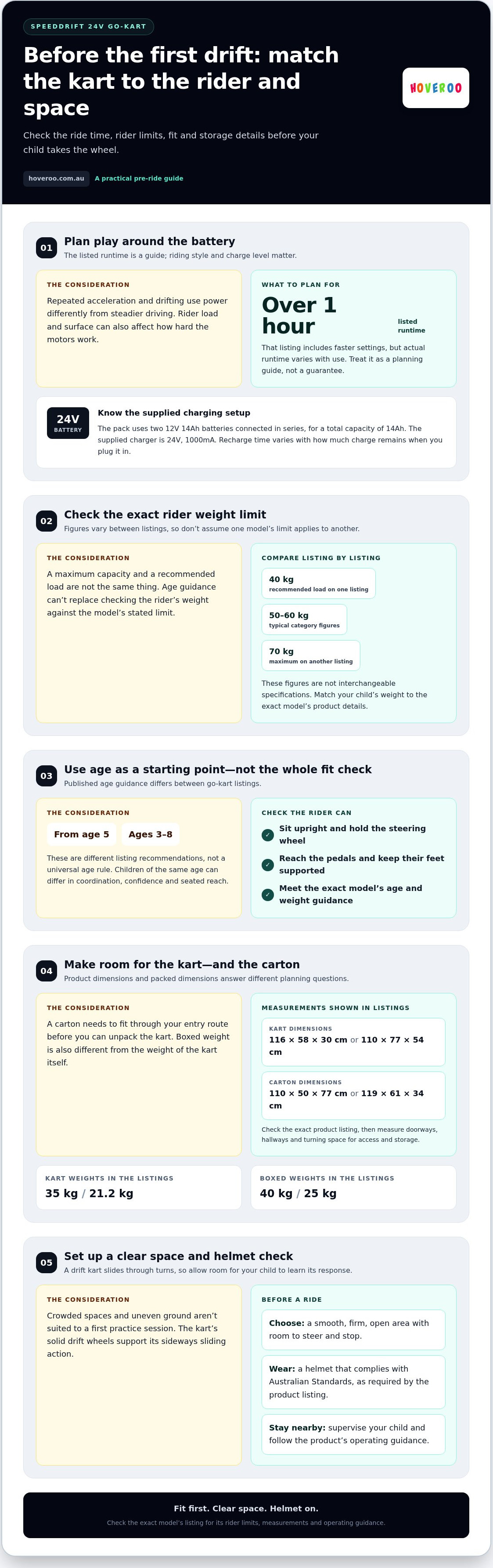
Runtime depends on how the kart is driven. The listed runtime is over an hour, including on faster settings, but repeated acceleration and drifting use power differently from steadier driving. Rider load and surface can also affect how hard the motors work. Treat the runtime as a planning guide, not a guarantee for every ride.
The kart comes with a 24V, 1000mA charger. Its voltage matches the battery system, while its 1000mA output describes the charging current. Charging time depends in part on how much charge remains when you plug in. A partly used battery needs less replenishment than one that has been drained further, so charging sessions can vary.
For practical planning, charge after a session and allow time before the next outing. If your child wants another turn straight away, a depleted battery may interrupt play. The 14Ah capacity and supplied charger tell you what battery and charging setup to expect, while actual recharge time follows the battery’s starting charge and charging conditions.
- Expect over an hour of listed runtime, including on faster settings, with actual use shaped by riding style.
- Use the supplied 24V, 1000mA charger with the 24V battery setup.
- Plan charging around the battery’s remaining charge, since recharge time varies with its starting level.
What Is the Weight Capacity?
Weight capacity is the maximum rider load the go-kart is designed to carry. Published figures for 24V electric drift go-karts vary: one listing gives a maximum of 70 kg, while another recommends a load of up to 40 kg. Typical capacity figures for this category sit between 50 kg and 60 kg. These numbers are not interchangeable specifications for every kart.
The distinction between a maximum and a recommended load matters. A maximum capacity is an upper limit, while a recommended load may set a lower operating threshold. For example, a 70 kg maximum does not mean every 24V drift kart carries that limit. Likewise, a 40 kg recommendation should not be treated as a 70 kg allowance. Match the figure to the exact model’s product details.
For your decision, compare the rider’s weight with the stated capacity for the particular kart. If a child is close to its listed limit, the difference between a 40 kg recommendation and a 70 kg maximum could change whether that model is suitable. Age guidance alone cannot replace this comparison: two children of the same age can have different body weights.
The weight limit helps you assess how long the kart may suit your child as they grow. A child comfortably below the stated limit has more room before reaching it than one already close to the maximum. Consider the limit alongside age guidance, fit and the kart’s dimensions. It is a boundary, not a target to exceed.
- Use 40 kg, 50-60 kg or 70 kg only in the context of the listing that gives that figure.
- Compare your child’s weight with the exact model’s stated maximum or recommended load.
- Don’t treat age suitability as a substitute for checking weight capacity.
Recommended age and child suitability
Published age guidance varies: one go-kart listing says suitable from age 5, while another recommends ages 3-8. A listed 24V kids’ drift kart recommends a maximum load of 40 kg, while another go-kart listing gives a 70 kg maximum. No universal rider-height figure applies across those listings, so judge fit by whether your child can sit comfortably and reach the controls.
Age is a starting point, not the whole decision. A 5-year-old may have different coordination, confidence and seated reach from another child of the same age. Check that your child can sit upright, hold the steering wheel, reach the pedals and keep their feet supported. Those practical checks help you assess control before a ride.
Published dimensions also differ: listed go-kart measurements include 116 × 58 × 30 cm and 110 × 77 × 54 cm. Match measurements to the exact product listing before judging fit or storage. One listed go-kart has solid drift wheels, which support its sideways sliding action.
For a first ride, choose a smooth, firm, open area with room to steer and stop. Avoid crowded spaces and uneven ground while your child learns how the kart responds. Since a drift kart is designed for sliding turns, a clear area makes it easier to practise controlled steering. Stay nearby to supervise and follow the product’s operating guidance.
Helmet use matters, too: the product listing requires a helmet that complies with Australian Standards while operating the kart. Before each session, check your child’s age and weight against the exact model’s limits, then make sure they can reach the controls. If any of these checks don’t fit, that kart isn’t the right match for the rider.
Dimensions and product weight
For planning delivery and storage, the carton can be just as useful as the unpacked kart measurements. One listing gives a box size of 110 × 50 × 77 cm and a boxed weight of 40 kg. Another lists a carton measuring 119 × 61 × 34 cm, weighing 25 kg. These figures show why checking the package details matters before delivery day.
Boxed weight and product weight are different measurements. In the two listings, the karts weigh 35 kg and 21.2 kg respectively, while their packed weights are 40 kg and 25 kg. The difference reflects that the delivered package includes more than the kart itself. Plan for the carton’s full weight when deciding where it can be received and opened.
Use the carton measurements to assess access before delivery. Check doorways, hallways and the space where you plan to unpack it. For example, a package measuring 119 × 61 × 34 cm needs enough clearance to pass through your entry route, including room to manoeuvre at turns. The listed carton dimensions offer a practical starting point for that check.
After unpacking, consider how the product weight affects moving the kart between storage and play areas. A 35 kg kart and a 21.2 kg kart involve different handling demands. Think about where the kart will be stored, how far it needs to travel, and whether the route includes steps or tight turns. Planning this ahead can make regular use easier.
- Use the boxed weight to plan for receiving and unpacking the delivery.
- Compare carton measurements with your access route, not just your storage space.
- Factor in the product’s listed weight when choosing where to keep it.
Compare the available measurements with your storage plans as you view go-kart details.
Hoveroo: Hoveroo Hoverboard
The Hoveroo Hoverboard offers another way to bring outdoor play into your family’s routine if a go-kart isn’t the right fit. It gives you a different ride-on option to consider while weighing up your child’s age, confidence and preferred style of play. For a kart-focused choice, the Hoveroo SpeedDrift 24V Go Kart is the relevant product to explore alongside the details covered above.
Choose based on the riding experience your child wants and the space available for play. Comparing the Hoveroo Hoverboard with the go-kart can help you decide which better suits your family’s plans.
Visit hoveroo.com.au to explore the Hoveroo Hoverboard and other ride-on options.
Choose the ride that fits your child’s next adventure
Use the SpeedDrift 24V go kart features as a guide to the kind of ride your family wants: one built around spirited turns and active outdoor play. Then think about what your child enjoys most. Is it steering through a drift, exploring different terrain, or taking on a dirt-bike-style ride? Matching the experience to their interests can make your next choice feel clearer.
Hoveroo offers the Hoveroo Hoverboard, Off-Road Hoverboard and Thunderbolt Electric Dirt Bike as other ride-on options. Each offers a different way for your child to enjoy independent play, so consider which style best suits your family.
If you’d like help with your go-kart questions or want to explore the options, contact Hoveroo. Here’s to more outdoor fun and new skills gained one ride at a time!
Frequently Asked Questions
How Does the Drift Function Work?
The SpeedDrift 24V go kart features include a drift mode that lets riders make controlled slides through turns. To build confidence, practise on a clear, flat area and use gradual steering inputs rather than sharp corrections. Smooth control helps a child understand how the kart responds during a corner. Keep early practice simple, with plenty of space around the riding area.
How Fast Does It Go?
Listed speeds vary by model: one 24V drift kart lists a low setting of 10 km/h and a high setting of up to 18 km/h. Another listing gives a typical category range of 8-13 km/h. Use the exact kart’s speed settings to guide your choice, and start a learner on the lower setting before progressing.
How Long Does the Battery Last?
Battery duration varies between outings, so use the published runtime as a planning guide, not a guaranteed session length. Decide whether your family will use the kart for one continuous outing or several turns with breaks. Allow time to recharge before the next session and follow the charging guidance supplied with the kart.
Is the Steel Frame Useful for Kids’ Go-Karting?
A steel frame can provide a firm structure, but material alone doesn’t determine whether a kart suits a child. Consider how the seat, steering position and controls fit the rider, along with the stated weight limit. A solid frame doesn’t replace safe riding habits or protective equipment, so assess the whole kart and riding setup together.
What Makes a 24V Go-Kart Different?
The SpeedDrift 24V go kart features include a 24V electrical system, but voltage alone doesn’t determine speed, runtime or rider suitability. Compare the individual kart’s motor arrangement, speed settings and load limit instead. These details explain more about how the ride may suit your child than the voltage label by itself.
What Safety Features Are Included?
Listings describe features such as a lap sash seatbelt and, on one model, a two-speed key speed limiter. Check the exact kart’s details, then use a quick pre-ride routine: secure the belt, clear the riding area and ensure an adult can supervise. The cited product listing requires a helmet complying with Australian Standards during operation.