
What Age Can Kids Ride a Hoverboard? The 2026 Aussie Parent's Guide
What if the most exciting gift you give this year is also the one that builds your child's confidence and coordination like nothing else? You have likely seen them zipping around and wondered, what age can kids ride hoverboard models safely without the constant worry of a scraped knee? It is a question every Aussie parent faces when the "I want one" phase hits full throttle. We know you want the high-spirited thrill of adventure for them, but you also need the absolute security of a board that stays steady under pressure.
We agree that safety is the top priority when it comes to new tech. That is why this 2026 guide is designed to help you discover the ideal age for your child to start rolling. We promise to show you how to keep their first ride stable and heaps of fun while avoiding the common pitfalls of fire risks or confusing regulations. You will get a clear checklist of physical skills, a breakdown of Australian state and territory laws applicable nationwide, and the lowdown on why UL2272 certification is a non-negotiable for your peace of mind. Let's get your little rider ready for a stress-free start.
Key Takeaways
- Most experts suggest starting between 6 and 8 years old, but knowing exactly what age can kids ride hoverboard models depends on their individual coordination and confidence.
- Weight is the real decider; your child needs enough weight to activate the board's pressure sensors for a smooth, shake-free ride.
- Never compromise on safety by choosing only UL2272 certified boards to ensure the battery and charging systems are rock solid for Australian conditions.
- Match the wheel size to the mission, starting with 6.5-inch wheels for smooth paths or upgrading to an Off-Road Hoverboard for bigger adventures.
- Master the "Spotter" method during the first session to give your little legend the steady hand they need to find their balance instantly.
The Golden Question: What is the Best Age for a Hoverboard?
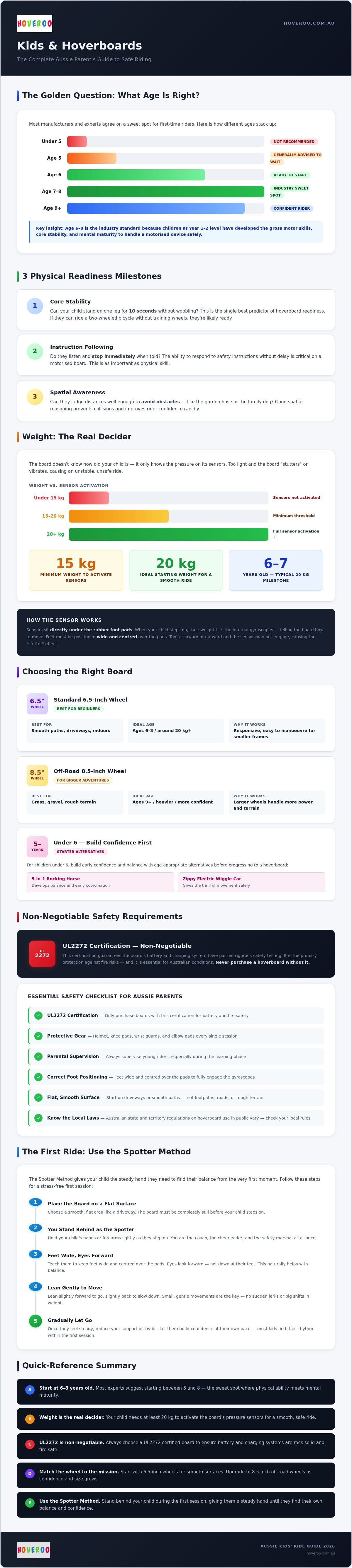
So, you are ready to bring the future home, but you are stuck on the big one: what age can kids ride hoverboard models without it ending in a heap of tears? Most manufacturers set the bar at 6 to 8 years old. This is not just a random number. It is the sweet spot where physical ability meets the mental maturity to handle a motorised device. Choosing the right time starts with asking: what age can kids ride hoverboard gadgets safely in your own backyard? It is about more than just standing still. It is about total control.
Why 6 to 8 is the Industry Standard
By the time your little legend hits Year 1 or Year 2, they have usually mastered the gross motor skills needed for a self-balancing scooter. Think about their core stability. Balance is the big one. If your child can already zip around on a two-wheeled bicycle without training wheels, they likely have the core strength required to master a board in minutes. At this age, they also start to understand speed limits and safety instructions. It is one thing to stand on a board; it is another thing entirely to navigate around the lounge room or driveway with precision. Parental supervision is a must during this phase. You are the coach, the cheerleader, and the safety marshal all in one. Consider these milestones before you buy:
- Core Stability: Can they stand on one leg for 10 seconds?
- Instruction Following: Do they listen when you say "stop" immediately?
- Spatial Awareness: Can they judge distances well enough to avoid the garden hose or the family dog?
Can Younger Kids Ride? The 5-Year-Old Debate
Weight Matters More Than the Number of Candles on the Cake
While birthdates are easy to track on a calendar, the bathroom scale often tells the real story of readiness. When you ask what age can kids ride hoverboard models, the technical answer is usually found in kilograms rather than years. This is because the board does not know how old your child is; it only knows how much pressure is being applied to its sensors. If a rider is too light, the board simply cannot "feel" them, leading to a shaky start for your little legend.
Have you ever seen a hoverboard vibrate or "stutter" like it is nervous? This is the shaking phenomenon. It happens when the pressure pads are not fully depressed. Most high-quality boards require a minimum weight of 15kg to 20kg to activate the internal gyroscopes properly. Without that weight, the motor gets confused. It switches on and off rapidly, creating a bumpy ride that can easily knock a beginner off balance. Ensuring your child meets this weight threshold is the best way to guarantee their first ride is steady and full of smiles.
The Science of the Self-Balancing Sensor
Inside every Hoveroo Hoverboard, clever sensors wait for a specific signal. These sensors sit directly under the rubber foot pads. When your child steps on, their weight tilts the internal gyroscopes. This tells the board exactly how to move. If their feet are positioned too far inward or outward, the sensor might not engage. Correct foot positioning is vital for safety. Teach them to keep their feet wide and centred over the pads. This creates a stable base and keeps the motors running smoothly without any jerky movements.
Finding the 'Goldilocks' Weight Range
Finding that perfect balance is key for a stress-free experience. For younger kids who have just hit that 20kg mark, the standard 6.5-inch wheel models are the ideal entry point. They are responsive and easy to manoeuvre for smaller frames. However, as kids grow or start craving more adventure, their increased weight actually helps them handle more power. Older or heavier kids often find the Off-Road Hoverboard a better fit. Its larger 8.5-inch wheels and beefier motors provide the torque needed to carry more weight over grass or gravel without losing speed.
Do not forget the upper limit either. While these boards are built tough, exceeding the maximum weight limit (usually around 100kg) puts massive strain on the battery and motors. It reduces your top speed and drains the battery much faster. Always check the specific manual for your model to keep the board in peak condition. Matching your child's weight to the right board ensures they get the most "oomph" out of every charge while keeping the hardware healthy for years of outdoor play.
Essential Safety Checklist for Aussie Parents
Safety is the absolute heart of every adventure. Once you have decided what age can kids ride hoverboard models based on their weight and coordination, the focus shifts to the gear. You want them to feel like a superhero, not a crash test dummy! Building a safe environment is the fastest way to turn a nervous beginner into a confident pro. It starts with the right hardware and ends with the right habits. Your child's confidence grows when they know they are protected from the start.
Understanding UL2272 Certification in Australia
Think of UL2272 as the ultimate seal of approval. This certification is the non-negotiable gold standard for electrical and charging safety. It means the battery, the motor, and the charger have all passed brutal tests for fire risks and mechanical failure. Never settle for "grey market" imports from unknown sellers. These boards often bypass Australian safety standards to save a few bucks. For a deep dive into why this matters, check out our guide on UL2272 Certified Hoverboard Australia: The 2026 Parent’s Guide to Safety. Your peace of mind is worth more than a cheap price tag. A certified board is a reliable board.
The Right Gear for the Job
Protective gear is your child's suit of armour. Start with a helmet that meets the Australian Standard (AS/NZS 2063). It needs to fit snugly and sit level on their forehead. Wrist guards are next. They are easily the most underrated piece of safety equipment. When kids lose their balance, they naturally reach out to break their fall. Good guards prevent nasty scrapes and wrist strains. Finally, check their feet. Thongs are for the beach, not the hoverboard! Sturdy sneakers with flat soles provide the best grip and control. Proper footwear ensures they can tilt and turn with total precision. It makes a massive difference in how they feel the board.
Location is everything for that first ride. Avoid steep Aussie hills or cracked, uneven footpaths early on. A flat driveway or a smooth netball court is the perfect training ground. For those who want to practice indoors, you can learn more about DIY Floorboards to find the right surface for a stable start. Look for boards with a built-in "Training Mode" as well. This setting dampens the acceleration and lowers the top speed. It allows your child to get the "feel" of the board without it zooming away. Once they have found their "hover legs," you can dial up the excitement. You will know they are ready when they stop looking at their feet and start looking at the path ahead. When you consider what age can kids ride hoverboard models, remember that the right environment makes any age safer.
Choosing the Right Board for Your Child's Age and Skill
Ready to pick the perfect ride? Not all boards are created equal! Once you know what age can kids ride hoverboard models in your household, it is time to match the wheels to the mission. The right size makes all the difference between a wobbly start and a confident glide. It is about matching their skill level to the board's power. Knowing what age can kids ride hoverboard units safely is only half the battle; the other half is picking the right gear for their specific stage of growth.
The Best Starter Board: 6.5-inch Models
For most kids aged 6 to 10, the 6.5-inch wheel is the gold standard. These boards sit lower to the ground. This creates a lower centre of gravity, making it much easier for beginners to mount and dismount without a fuss. They are perfect for indoor play on floorboards or smooth backyard patios. If you want the full breakdown of the top picks this year, read our Best Kids' Hoverboards: 2026 Aussie Parent's Guide. These models are nimble, light, and incredibly easy to organise in the car for trips to the park. They provide just enough speed to be thrilling without being overwhelming for a first-timer.
- 6.5-inch wheels: Best for smooth surfaces and younger riders.
- 8.5-inch wheels: Built for grass, gravel, and Aussie adventures.
- Hoverkart attachments: Perfect for extra stability and seated fun.
Leveling Up: Off-Road Boards and Hoverkarts
Is your child a bit older or more adventurous? The Off-Road Hoverboard is their best mate. With chunky 8.5-inch wheels, these boards are built to tackle grass, gravel, and the occasional bumpy track. They offer more torque and stability for bigger kids who want to explore beyond the driveway. But what if they aren't quite ready to stand up yet? Enter the Hoveroo Hoverkart. This brilliant attachment turns any stand-up board into a high-speed, sit-down go-kart. It is the ultimate safety hack! Because the rider is sitting down, the risk of a fall is almost zero. It even allows kids as young as 5 or 6 to enjoy the thrill while they build up the courage to stand.
Modern tech makes parental control easier than ever. Many of our models feature app-controlled safety features. You can set the maximum pace from your phone! It gives you total peace of mind while they learn the ropes. You can gradually increase the speed as their confidence grows. It is the perfect way to ensure they stay safe while having heaps of fun. Ready to find their new favourite toy? Shop the full Hoveroo range today and get them rolling!
Ready to Roll? How to Organise the First Ride
The box is open. The helmet is on. The excitement in the air is electric! Now that you have settled the debate on what age can kids ride hoverboard models for your family, it is time for the main event. The first ride is where the magic happens. It is a moment of pure discovery. Your job is to be the steady hand that turns those first few wobbles into a confident glide. Let's make sure that first experience is heaps of fun and totally stress-free.
Before the wheels start spinning, safety starts at the power point. Always charge your board in a clear, open area. Never leave it charging overnight or unattended. It is a simple habit that ensures your tech stays in peak condition. Once the light turns green, you are ready for the "Spotter" method. You are the anchor. Stand directly in front of your child and let them grip your shoulders for support. This physical connection gives them the instant confidence they need to find their balance without the fear of a sudden slip.
The First Five Minutes: A Step-by-Step Guide
Location is everything for a beginner. Start on a flat, non-slip surface like a low-pile rug or a patch of short, dry grass. This provides just enough resistance to keep the board from rolling away too quickly. Follow these steps for a smooth start:
- Mounting: Have them step on with their dominant foot first, keeping it wide and flat.
- Finding the Centre: Encourage them to look at you, not their feet. Looking down shifts their weight forward and causes the board to move before they are ready.
- Small Tilts: Practise tiny movements. Lean a fraction forward to move, then a fraction back to stop.
Mastering the "still point" is the goal of the first session. Once they can stand perfectly still for ten seconds, they have won the battle. For more detailed tips on those first movements, check out our Aussie kids' beginner guide.
Setting Ground Rules for Outdoor Play
Clear boundaries make for better adventures. Set specific "no-go" zones, keeping them well away from roads, steep driveways, or stairs. Our Aussie weather can be unpredictable, so keep an eye on the sky. If an Aussie downpour hits, get the board inside immediately! Water and electronics are a bad mix. After every session, give the board a quick once-over. Wipe down the sensors and check the wheels for any trapped gravel or debris. Keeping the board in top nick ensures it stays responsive and safe for years of play. When you consider what age can kids ride hoverboard units, remember that teaching them to care for their gear is just as important as the ride itself.
Get Your Little Legend Rolling Today
You now have the full roadmap to a successful first ride. While the question of what age can kids ride hoverboard models usually lands between 6 and 8, remember that individual confidence and hitting that 15kg to 20kg weight mark are the true indicators of readiness. By choosing a board with UL2272 Safety Certification and matching the wheel size to your child's skill, you are setting them up for a lifetime of outdoor fun. It is about more than just a toy; it is about building coordination and independence in the fresh Aussie air.
Don't let the excitement fade! Whether you choose a classic 6.5-inch starter or a rugged Off-Road Hoverboard, you are choosing a product specifically Designed for Aussie Kids. We make it easy to get started with Free Shipping Australia Wide and local support whenever you need a hand. Our self-balancing technology ensures that the learning curve is short and the smiles are long.
Shop the Hoveroo range and find the perfect board for your little legend! It is time to step off the sidelines and into the future of play. We can't wait to see your child zip away with total confidence and a massive grin.
Frequently Asked Questions
Is a hoverboard safe for a 7-year-old?
Yes, a hoverboard is generally safe for a 7-year-old as they fall right into the ideal age range of 6 to 8. When asking what age can kids ride hoverboard units, 7 is often the perfect balance of coordination and bravery. Just ensure they wear a helmet and use a board with self-balancing technology to keep their first experience stable, steady, and heaps of fun.
Can a child under 20kg ride a hoverboard?
It is difficult for a child under 20kg to ride a standard board because the internal sensors require a specific amount of pressure to activate. If the rider is too light, the board might stutter or vibrate. This makes it hard to maintain balance. If your child is on the lighter side, consider using a Hoveroo Hoverkart attachment to keep them seated and secure.
What is the weight limit for a Hoveroo hoverboard?
The maximum weight limit for a Hoveroo hoverboard is 100kg. While these boards are built tough, staying within this limit ensures the motors and battery operate at peak efficiency. Exceeding the limit can reduce your speed and put unnecessary strain on the hardware, so always check the manual for your specific model. This helps keep the board in top nick for years of play.
Do kids need a helmet to ride a hoverboard in Australia?
Yes, every child needs a helmet that meets the AS/NZS 2063 standard to ride a hoverboard in Australia. Safety is non-negotiable! Along with a helmet, we always recommend wrist guards and knee pads to protect against scrapes. Proper gear gives your little legend the confidence to push their limits safely while they figure out what age can kids ride hoverboard models.
How long does it take for a kid to learn to ride?
Most kids learn the basics in about 15 to 30 minutes! Thanks to self-balancing technology, the board does a lot of the hard work for them. Once they understand how to tilt their feet to move and stop, they will be zipping around the driveway with total confidence before you've even finished your cuppa. It's much faster than learning to ride a bike!
What happens if a child is too young for a hoverboard?
If a child is too young, they may lack the reaction times and weight needed to control the device, which increases the risk of falls. It is better to start them on a Zippy Electric Wiggle Car or a Hoveroo 5 in 1 Rocking Horse. These toys build coordination at a lower height, preparing them for the day they're ready for a motorised board safely.
Are hoverboards allowed on Australian footpaths?
In states like New South Wales and Victoria, hoverboards are restricted to private property and are illegal on public footpaths or roads. However, regulations in Queensland and the ACT are currently more permissive. Always check your local state laws and council rules before heading out to ensure you're riding in a legal zone. This avoids any unexpected fines while your child explores outdoors.